

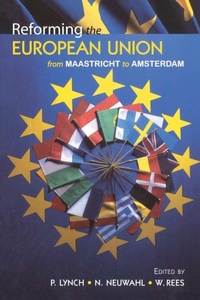
Reforming the European Union
From Maastricht to Amsterdam
1st Edition
Published on 30. March 2000
Book
Paperback/Softback
272 pages
978-0-582-28986-4 (ISBN)
Description
Analyses the likely future of the EU following next year's Intergovernmental Conference (IGC) which is likely to be even more significant for the future of Europe than the Maastricht Treaty. Since Maastricht it has become clear that future developments are less certain with regard to the EU and integration. The IGC will have to try and resolve tensions such as: "widening" Europe to include former communist countries whislt also trying to "deepen" Europe with increased political and economic integration; providing a framework which is acceptable to a core of countries (Benelux, Germany, France) who favour more integration and an early move to monetary union with countries such as the UK, which does not.
More details
Language
English
Place of publication
London
United Kingdom
Publishing group
Taylor & Francis Ltd
Target group
Professional and scholarly
Dimensions
Height: 234 mm
Width: 156 mm
Thickness: 15 mm
Weight
418 gr
ISBN-13
978-0-582-28986-4 (9780582289864)
Copyright in bibliographic data and cover images is held by Nielsen Book Services Limited or by the publishers or by their respective licensors: all rights reserved.
Schweitzer Classification
Other editions
Additional editions

Philip Lynch | Nanette Neuwahl | G. Wyn Rees
Reforming the European Union
From Maastricht to Amsterdam
Book
08/2017
1st Edition
Routledge
€279.20
Shipment within 10-20 days
Philip Lynch | Nanette Neuwahl | G. Wyn Rees
Reforming the European Union
From Maastricht to Amsterdam
E-Book
05/2014
1st Edition
Routledge
€77.99
Available for download
Philip Lynch | Nanette Neuwahl | G. Wyn Rees
Reforming the European Union
From Maastricht to Amsterdam
E-Book
05/2014
1st Edition
Routledge
€77.99
Available for download
Persons
Philip Lynch, Nanette Neuwahl, G. Wyn Rees
Content
Introduction
PART ONE: INSTITUTIONAL REFORM 1. The Council 2. The European Commission 3. The European Parliament 4. The European Court of Justice
PART TWO: POLICY DEVELOPMENTS 5. European Monetary Union: One Money, One Europe? 6. The Paradox of Social Dimension 7. The Regions and Amsterdam: Whatever Happended to the Third Level? 8. An 'Area of Freedom, Justice and Security': Progress and Deficits in Justice and Home Affairs 9. Common Foreign and Security Policy and Defence: A Lost Opportunity?
PART THREE: THE UNION AND ITS CITIZENS 10. The Place of the Citizen in the European Constitution. 11. Flexibility and Closer Cooperation: Evolution or Entrophy 12. Defining a Constitution for the European Union
CONCLUSIONS
PART ONE: INSTITUTIONAL REFORM 1. The Council 2. The European Commission 3. The European Parliament 4. The European Court of Justice
PART TWO: POLICY DEVELOPMENTS 5. European Monetary Union: One Money, One Europe? 6. The Paradox of Social Dimension 7. The Regions and Amsterdam: Whatever Happended to the Third Level? 8. An 'Area of Freedom, Justice and Security': Progress and Deficits in Justice and Home Affairs 9. Common Foreign and Security Policy and Defence: A Lost Opportunity?
PART THREE: THE UNION AND ITS CITIZENS 10. The Place of the Citizen in the European Constitution. 11. Flexibility and Closer Cooperation: Evolution or Entrophy 12. Defining a Constitution for the European Union
CONCLUSIONS