

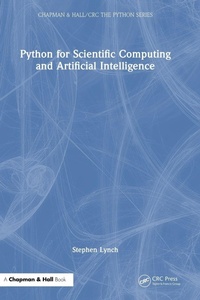
Python for Scientific Computing and Artificial Intelligence
1st Edition
Published on 15. June 2023
Book
Hardback
314 pages
978-1-032-25873-7 (ISBN)
Description
Python for Scientific Computing and Artificial Intelligence is split into 3 parts: in Section 1, the reader is introduced to the Python programming language and shown how Python can aid in the understanding of advanced High School Mathematics. In Section 2, the reader is shown how Python can be used to solve real-world problems from a broad range of scientific disciplines. Finally, in Section 3, the reader is introduced to neural networks and shown how TensorFlow (written in Python) can be used to solve a large array of problems in Artificial Intelligence (AI).
This book was developed from a series of national and international workshops that the author has been delivering for over twenty years. The book is beginner friendly and has a strong practical emphasis on programming and computational modelling.
Features:
No prior experience of programming is required
Online GitHub repository available with codes for readers to practice
Covers applications and examples from biology, chemistry, computer science, data science, electrical and mechanical engineering, economics, mathematics, physics, statistics and binary oscillator computing
Full solutions to exercises are available as Jupyter notebooks on the Web
Support Material
GitHub Repository of Python Files and Notebooks: https://github.com/proflynch/CRC-Press/
Solutions to All Exercises:
Section 1: An Introduction to Python: https://drstephenlynch.github.io/webpages/Solutions_Section_1.html
Section 2: Python for Scientific Computing: https://drstephenlynch.github.io/webpages/Solutions_Section_2.html
Section 3: Artificial Intelligence: https://drstephenlynch.github.io/webpages/Solutions_Section_3.html
This book was developed from a series of national and international workshops that the author has been delivering for over twenty years. The book is beginner friendly and has a strong practical emphasis on programming and computational modelling.
Features:
No prior experience of programming is required
Online GitHub repository available with codes for readers to practice
Covers applications and examples from biology, chemistry, computer science, data science, electrical and mechanical engineering, economics, mathematics, physics, statistics and binary oscillator computing
Full solutions to exercises are available as Jupyter notebooks on the Web
Support Material
GitHub Repository of Python Files and Notebooks: https://github.com/proflynch/CRC-Press/
Solutions to All Exercises:
Section 1: An Introduction to Python: https://drstephenlynch.github.io/webpages/Solutions_Section_1.html
Section 2: Python for Scientific Computing: https://drstephenlynch.github.io/webpages/Solutions_Section_2.html
Section 3: Artificial Intelligence: https://drstephenlynch.github.io/webpages/Solutions_Section_3.html
Reviews / Votes
"For students, the book is crammed absolutely full of real-world examples to help learn Python quickly and efficiently from scratch. The content spans so many topics across so many subject areas that surely all interests are accommodated somewhere within. For instructors, it provides a gold mine of ideas for preparing our own courses and is likely one for the reading list."-Dr Jame Christian, Mathematics Today
More details
Series
Language
English
Place of publication
United Kingdom
Publishing group
Taylor & Francis Ltd
Target group
Professional and scholarly
General
Illustrations
155 farbige Zeichnungen, 9 s/w Tabellen, 155 farbige Abbildungen
9 Tables, black and white; 155 Line drawings, color; 155 Illustrations, color
Dimensions
Height: 260 mm
Width: 183 mm
Thickness: 23 mm
Weight
825 gr
ISBN-13
978-1-032-25873-7 (9781032258737)
Copyright in bibliographic data and cover images is held by Nielsen Book Services Limited or by the publishers or by their respective licensors: all rights reserved.
Schweitzer Classification
Other editions
Additional editions
Book
06/2023
1st Edition
Chapman & Hall/CRC
€107.50
Shipment within 10-20 days
E-Book
04/2023
1st Edition
Chapman & Hall/CRC
€80.49
Available for download
E-Book
04/2023
1st Edition
Chapman & Hall/CRC
€80.49
Available for download
Person
In 2022, Stephen Lynch was named a National Teaching Fellow, which celebrates and recognises individuals who have made an outstanding impact on student outcomes and teaching in higher education. He won the award for his work in programming in the STEM subjects, research feeding into teaching, and widening participation (using experiential and object-based learning). Although educated as a pure mathematician, Stephen's many interests now include applied mathematics, cell biology, electrical engineering, computing, neural networks, nonlinear optics and binary oscillator computing, which he co-invented with a colleague. He has authored 2 international patents for inventions, 8 books, 4 book chapters, over 40 journal articles, and a few conference proceedings. Stephen is a Fellow of the Institute of Mathematics and Its Applications (FIMA) and a Senior Fellow of the Higher Education Academy (SFHEA). He is currently a Reader with MMU and was an Associate Lecturer with the Open University from 2008-2012. In 2010, Stephen volunteered as a STEM Ambassador, in 2012, he was awarded MMU Public Engagement Champion status, and in 2014 he became a Speaker for Schools. He runs national workshops on "Python for A-Level Mathematics and Beyond," and international workshops on "Python for Scientific Computing and TensorFlow for Artificial Intelligence." He has run workshops in China, Malaysia, Singapore, and the USA.
Content
Section I. An Introduction to Python. 1. The IDLE Integrated Development Learning Environment. 2. Anaconda, Spyder and the Libraries NumPy, Matplotlib and SymPy. 3. Jupyter Notebooks and Google Colab. 4. Python for AS-Level (High School) Mathematics. 5. Python for A-Level (High School) Mathematics. Section II. Python for Scientific Computing. 6. Biology. 7. Chemistry. 8. Data Science. 9. Economics. 10. Engineering. 11. Fractals and Multifractals. 12. Image Processing. 13. Numerical Methods for Ordinary and Partial Differential Equations. 14. Physics. 15. Statistics. Section III. Artificial Intelligence. 16. Brain Inspired Computing. 17. Neural Networks and Neurodynamics. 18. TensorFlow and Keras. 19. Recurrent Neural Networks. 20. Convolutional Neural Networks, TensorBoard, and Further Reading. 21. Answers and Hints to Exercises.