

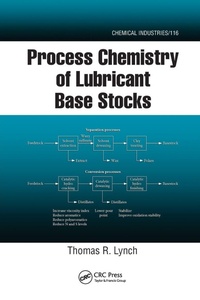
Process Chemistry of Lubricant Base Stocks
1st Edition
Published on 30. June 2020
Book
Paperback/Softback
388 pages
978-0-367-57767-4 (ISBN)
Description
Advances in processing methods are not only improving the quality and yield of lubricant base stocks, they are also reducing the dependence on more expensive crude oil starting materials. Process Chemistry of Lubricant Base Stocks provides a comprehensive understanding of the chemistry behind the processes involved in petroleum base stock production from crude oil fractions.
This book examines hydroprocessing technologies that, driven by the demand for higher performance in finished lubricants, have transformed processing treatments throughout the industry. The author relates the properties of base stocks to their chemical composition and describes the process steps used in their manufacture. The book highlights catalytic processes, including hydrocracking, hydrofinishing, and catalytic dewaxing. It also covers traditional solvent-based separation methods used to remove impurities, enhance performance, and improve oxidation resistance. The final chapters discuss the production of Food Grade white oils and paraffins and the gas-to-liquids processes used to produce highly paraffinic base stocks via Fischer-Tropsch chemistry.
Process Chemistry of Lubricant Base Stocks provides historical and conceptual background to the technologies used to make base stocks, thorough references, and a unique emphasis on chemical, not just engineering, aspects of lubricant processing-making this book an ideal and practical reference for scientists across a wide range of disciplines.
This book examines hydroprocessing technologies that, driven by the demand for higher performance in finished lubricants, have transformed processing treatments throughout the industry. The author relates the properties of base stocks to their chemical composition and describes the process steps used in their manufacture. The book highlights catalytic processes, including hydrocracking, hydrofinishing, and catalytic dewaxing. It also covers traditional solvent-based separation methods used to remove impurities, enhance performance, and improve oxidation resistance. The final chapters discuss the production of Food Grade white oils and paraffins and the gas-to-liquids processes used to produce highly paraffinic base stocks via Fischer-Tropsch chemistry.
Process Chemistry of Lubricant Base Stocks provides historical and conceptual background to the technologies used to make base stocks, thorough references, and a unique emphasis on chemical, not just engineering, aspects of lubricant processing-making this book an ideal and practical reference for scientists across a wide range of disciplines.
More details
Series
Language
English
Place of publication
London
United Kingdom
Publishing group
Taylor & Francis Ltd
Target group
Professional and scholarly
Professional
Dimensions
Height: 229 mm
Width: 152 mm
Thickness: 21 mm
Weight
561 gr
ISBN-13
978-0-367-57767-4 (9780367577674)
Copyright in bibliographic data and cover images is held by Nielsen Book Services Limited or by the publishers or by their respective licensors: all rights reserved.
Schweitzer Classification
Other editions
Additional editions
Thomas R. Lynch
Process Chemistry of Lubricant Base Stocks
Book
09/2007
1st Edition
CRC Press
€298.60
Shipment within 15-20 days
Thomas R. Lynch
Process Chemistry of Lubricant Base Stocks
E-Book
09/2007
CRC Press
€67.49
Available for download
Thomas R. Lynch
Process Chemistry of Lubricant Base Stocks
E-Book
09/2007
CRC Press
€67.49
Available for download
Person
Thomas R. Lynch
Content
Introduction. Viscosity, Pour Points, Boiling Points, and Chemical Structure. Development of the Viscosity Index Concept and Relationship to Hydrocarbon Composition. Compositional Methods. Oxidation Resistance of Base Stocks. Conventional Base Stock Production: Solvent Refining, Solvent Dewaxing and Finishing. Lubes Hydrocracking. Chemistry of Hydroprocessing. Urea Dewaxing and the BP Catalytic Process. Dewaxing by Hydrocracking and Hydroisomerization. Technical and Food Grade White Oils and Highly Refined Paraffins. Basestocks from Fischer-Tropsch Wax and the Gas-to-Liquids (GTL) Process.