

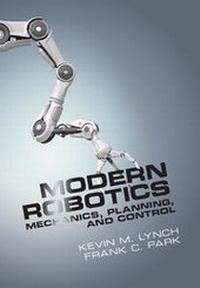
Modern Robotics
Mechanics, Planning, and Control
Published on 31. May 2017
Book
Paperback/Softback
547 pages
978-1-316-60984-2 (ISBN)
Unfortunately, price unknown
The article will not be published
Description
This introduction to robotics offers a distinct and unified perspective of the mechanics, planning and control of robots. Ideal for self-learning, or for courses, as it assumes only freshman-level physics, ordinary differential equations, linear algebra and a little bit of computing background. Modern Robotics presents the state-of-the-art, screw-theoretic techniques capturing the most salient physical features of a robot in an intuitive geometrical way. With numerous exercises at the end of each chapter, accompanying software written to reinforce the concepts in the book and video lectures aimed at changing the classroom experience, this is the go-to textbook for learning about this fascinating subject.
More details
Language
English
Place of publication
Cambridge
United Kingdom
Target group
College/higher education
Professional and scholarly
Product notice
Paperback (trade)
Dimensions
Height: 253 mm
Width: 177 mm
ISBN-13
978-1-316-60984-2 (9781316609842)
Copyright in bibliographic data and cover images is held by Nielsen Book Services Limited or by the publishers or by their respective licensors: all rights reserved.
Schweitzer Classification
Other editions
Additional editions
Book
05/2017
Cambridge University Press
€80.80
Shipment within 15-20 days
Persons
Kevin M. Lynch received his B.S.E. in Electrical Engineering from Princeton, New Jersey in 1989, and Ph.D. in Robotics from Carnegie Mellon University, Pennsylvania in 1996. He has been a faculty member at Northwestern University, Illinois since 1997 and has held visiting positions at California Institute of Technology, Carnegie Mellon University, Tsukuba University, Japan and Northeastern University in Shenyang, China. His research focuses on dynamics, motion planning and control for robot manipulation and locomotion; self-organizing multi-agent systems; and physically interacting human-robot systems. A Fellow of the Institute of Electrical and Electronics Engineers (IEEE), he also was the recipient of the IEEE Early Career Award in Robotics and Automation, Northwestern's Professorship of Teaching Excellence, and the Northwestern Teacher of the Year award in engineering. Currently he is Senior Editor of the IEEE Robotics and Automation Letters, and the incoming Editor-in-Chief of the IEEE International Conference on Robotics and Automation. This is his third book. Frank C. Park received his B.S. in Electrical Engineering from Massachusetts Institute of Technology in 1985, and his Ph.D. in Applied Mathematics from Harvard University, Massachusetts in 1991. He has been on the faculty at University of California, Irvine and since 1995 he has been Professor of Mechanical and Aerospace Engineering at Seoul National University. His research interests are in robot mechanics, planning and control, vision and image processing, and related areas of applied mathematics. He has been an Institute of Electrical and Electronics Engineers (IEEE) Robotics and Automation Society Distinguished Lecturer and has held adjunct faculty positions at the Courant Institute of Mathematical Sciences, New York, the Interactive Computing Department at Georgia Institute of Technology and the Hong Kong University of Science and Technology Robotics Institute. He is a Fellow of the IEEE, Editor-in-Chief of the IEEE Transactions on Robotics, and developer of the EDX course Robot Mechanics and Control I, II.
Content
Foreword Roger Brockett; Foreword Matthew Mason; Preface; 1. Preview; 2. Configuration space; 3. Rigid-body motions; 4. Forward kinematics; 5. Velocity kinematics and statics; 6. Inverse kinematics; 7. Kinematics of closed chains; 8. Dynamics of open chains; 9. Trajectory generation; 10. Motion planning; 11. Robot control; 12. Grasping and manipulation; 13. Wheeled mobile robots; Appendix A. Summary of useful formulas; Appendix B. Other representations of rotations; Appendix C. Denavit-Hartenberg parameters; Appendix D. Optimization and Lagrange multipliers; Bibliography; Index.