

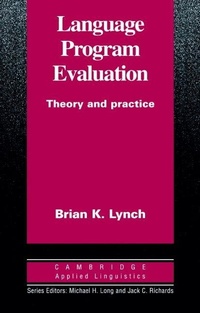
Language Program Evaluation
Theory and Practice
Published on 24. November 1995
Book
Paperback/Softback
212 pages
978-0-521-48438-1 (ISBN)
Description
Although much has been written about the testing and evaluation of language students, few books have dealt with the much broader issue of measuring the success of language programs. Filling a critical gap in the literature of applied linguistics, Language Program Evaluation provides teachers, researchers, and administrators with a complete introduction to both qualitative and quantitative approaches to evaluating the effectiveness of their programs. Through a careful blend of theory, research, and practice, the author presents a testing model that is specifically tailored to the concerns of language education programs and which can be adapted to different contexts and updated as teaching and learning situations evolve. He proposes a shift from purely quantitative studies which consider only end-of-program achievement gains to ones that include an investigation of program process using qualitative, naturalistic methods.
More details
Series
Language
English
Place of publication
Cambridge
United Kingdom
Target group
ELT/ESL
Product notice
Paperback (trade)
Illustrations
35 Tables, unspecified; 7 Line drawings, unspecified
Dimensions
Height: 229 mm
Width: 152 mm
Thickness: 13 mm
Weight
352 gr
ISBN-13
978-0-521-48438-1 (9780521484381)
Copyright in bibliographic data and cover images is held by Nielsen Book Services Limited or by the publishers or by their respective licensors: all rights reserved.
Schweitzer Classification
Other editions
Additional editions
E-Book
08/2012
1st Edition
Cambridge University Press
€28.99
Available for download

Book
11/1995
Cambridge University Press
€45.93
Article exhausted; check for reprint
Previous edition
Book
11/1995
Cambridge University Press
€45.93
Article exhausted; check for reprint
Person
Content
1. Introduction; 2. Historical background; 3. Validity; 4. Positivistic designs; 5. Naturalistic designs; 6. Quantitative data gathering and analysis; 7. Qualitative data gathering; 8. Combining positivistic and naturalistic program evaluation; 9. Conclusions