

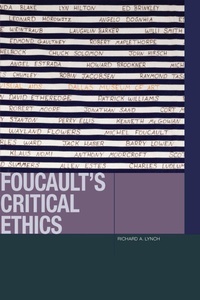
Foucault's Critical Ethics
Published on 5. September 2016
Book
Hardback
248 pages
978-0-8232-7125-2 (ISBN)
Description
The central thesis of Foucault's Critical Ethics is that Foucault's account of power does not foreclose the possibility of ethics; on the contrary, it provides a framework within which ethics becomes possible. Tracing the evolution of Foucault's analysis of power from his early articulations of disciplinary power to his theorizations of biopower and governmentality, Richard A. Lynch shows how Foucault's ethical project emerged through two interwoven trajectories: analysis of classical practices of the care of the self, and engaged practice in and reflection upon the limits of sexuality and the development of friendship in gay communities. These strands of experience and inquiry allowed Foucault to develop contrasting yet interwoven aspects of his ethics; they also underscored how ethical practice emerges within and from contexts of power relations. The gay community's response to AIDS and its parallels with the feminist ethics of care serve to illustrate the resources of a Foucauldian ethic-a fundamentally critical attitude, with substantive (but revisable) values and norms grounded in a practice of freedom.
More details
Series
Language
English
Place of publication
New York
United States
Target group
Professional and scholarly
Product notice
Cloth over boards
Dimensions
Height: 229 mm
Width: 152 mm
Thickness: 25 mm
Weight
499 gr
ISBN-13
978-0-8232-7125-2 (9780823271252)
Copyright in bibliographic data and cover images is held by Nielsen Book Services Limited or by the publishers or by their respective licensors: all rights reserved.
Schweitzer Classification
Other editions
Additional editions
Richard A. Lynch
Foucault's Critical Ethics
E-Book
09/2016
1st Edition
Fordham University Press
€60.49
Available for download
E-Book
09/2016
1st Edition
Fordham University Press
€54.49
Available for download
Person
Richard A. Lynch teaches philosophy at St. Ambrose University and is founder of The Foucault Circle.
Content
Introduction: Michel Foucault as critical theorist 1. Approaching power from a new theoretical basis 2. Disciplinary power: testing the Hobbesian hypothesis 3. Reframing the theory: biopower and governmentality 4. Freedom's critique: the trajectories of a Foucauldian ethics Conclusion: To struggle with hope Appendix: Michel Foucault's shorter works in English Acknowledgments Notes Bibliography Index