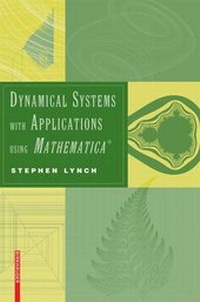
This book provides an introduction to the theory of dynamical systems with the ® aid of the Mathematica computer algebra system. It is written for both senior undergraduates and graduate students. The ?rst part of the book deals with c- tinuous systems using ordinary differential equations (Chapters 1-10), the second part is devoted to the study of discrete dynamical systems (Chapters 11-15), and Chapters 16 and 17 deal with both continuous and discrete systems. It should be pointedoutthatdynamicalsystemstheoryisnotlimitedtothesetopicsbutalso- compassespartialdifferentialequations,integralandintegrodifferentialequations, stochastic systems, and time-delay systems, for instance. References [1]-[4] given at the end of the Preface provide more information for the interested reader. The author has gone for breadth of coverage rather than ?ne detail and theorems with proofs are kept at a minimum. The material is not clouded by functional analytic and group theoretical de?nitions, and so is intelligible to readers with a general mathematical background. Some of the topics covered are scarcely covered el- where. Most of the material in Chapters 9, 10, 14, 16, and 17 is at a postgraduate levelandhasbeenin?uencedbytheauthor'sownresearchinterests. Thereismore theory in these chapters than in the rest of the book since it is not easily accessed anywhere else. It has been found that these chapters are especially useful as ref- ence material for senior undergraduate project work. The theory in other chapters of the book is dealt with more comprehensively in other texts, some of which may be found in the references section of the corresponding chapter.
Reviews / Votes
From the reviews:
"Stephen Lynch's book offers a comprehensive introduction to the theory and application of differential equations and dynamical systems methods. Its focus on applications and avoidance of overly technical arguments makes it a an equally good choice for teaching an undergraduate course in dynamical systems, as self-study for graduate students interested in dynamical systems, or as an introductory text for researchers seeking an overview of some current developments in applied dynamical systems. Most importantly, its content and presentation style convey the excitement that has drawn many students and researchers to dynamical systems in the first place.-Dynamical Systems Magazine
"This accessible university text shows how a wide range of differential equations work and begin to fail to work over a very wide range of solved and unsolvable applications. Mathematica is used throughout, from its tutorial introduction in Chapter 0 to the minimally chaotic neuromodule of the final section. This is the first work I have seen in which genuine self-education by computer is expected of the reader. The one-liner programs come to life when typed in, and the growing programming skill lends itself to inventing [one's] own extensions to the supplied problems.-
Datafile, The Journal of the HPCC
"The book is a good introduction to dynamical systems theory. . This book presents an original, cheap and powerful solution to the problem of analysis of large data sets. . The text is aimed at graduate students and working scientists in various branches of applied mathematics, natural sciences and engineering. . recommend 'Dynamical Systems with Applications using MATHEMATICA®' as a good handbook for a diverse readership, for graduates and professionals in mathematics, physics, science and engineering." (Damian Trif, Studia Universitatis Babes-Bolyai. Mathematica, Vol. LIV (4), December, 2009)
Edition
Language
Place of publication
Target group
Professional and scholarly
Research
Illustrations
7 s/w Tabellen
7 Tables, black and white; XV, 484 p.
Dimensions
Height: 23.5 cm
Width: 15.5 cm
Weight
ISBN-13
978-0-8176-4482-6 (9780817644826)
DOI
10.1007/978-0-8176-4586-1
Schweitzer Classification
Preface
A Tutorial Introduction to Mathematica
Differential Equations
Planar Systems
Interacting Species
Limit Cycles
Hamiltonian Systems, Lyapunov Functions, and Stability
Bifurcation Theory
Three-Dimensional Autonomous Systems and Chaos
Poincaré Maps and Nonautonomous Systems in the Plane
Local and Global Bifurcations
The Second Part of David Hilbert's Sixteenth Problem
Linear Discrete Dynamical Systems
Nonlinear Discrete Dynamical Systems
Complex Iterative Maps
Electromagnetic Waves and Optical Resonators
Fractals and Multifractals
Chaos Control and Synchronization
Neural Networks
Examination-Type Questions
Solutions to Exercises
References
Mathematica Program Index
Index