

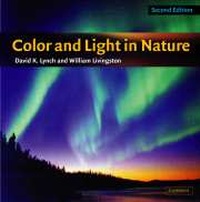
Color and Light in Nature
2nd Edition
Published on 11. June 2001
Book
Paperback/Softback
292 pages
978-0-521-77504-5 (ISBN)
Description
We live in a world of optical marvels - from the commonplace but beautiful rainbow, to the rare and eerie superior mirage. But how many of us really understand how a rainbow is formed, why the setting sun is red and flattened, or even why the sky at night is not absolutely black? This beautiful and informative guide provides clear explanations to all naturally occurring optical phenomena seen with the naked eye, including shadows, halos, water optics, mirages and a host of other spectacles. Separating myth from reality, it outlines the basic principles involved, and supports them with many figures and references. A wealth of rare and spectacular photographs, many in full color, illustrate the phenomena throughout. In this new edition of the highly-acclaimed guide to seeing, photographing and understanding nature's optical delights, the authors have added over 50 new images and provided new material on experiments you can try yourself.
Reviews / Votes
'Most people notice only the occasional rainbow and pretty sunset, yet they could see much more if they only knew what to look for. Color and Light in Nature will facilitate this admirably ... the up-to-date research, new ideas, beautiful pictures, and excellent explanations make Color and Light in Nature the new classic.' Science '... a beautifully illustrated popular account of atmospheric phenomena ... Many teachers as well as a good many naturalists will find the book to be a highly useful and comprehensive treatment of a beautiful subject, one that can be used to enliven dry classroom discussions of optics, light and colour.' Nature 'Lynch and Livingston deserve the thanks of the scientific community for re-opening our eyes to the wonderful world around us.' American Scientist 'A breathtaking list of effects is explained ... along with how they got there. It just made me want to rush out and look at the things.' New Scientist 'If you ever wanted to know why the sky is blue, or what clouds are made of, or how rainbows are formed, then this is the book for you.' Brendan K. Ward, Astronomy & SpaceMore details
Edition
2nd Revised edition
Language
English
Place of publication
Cambridge
United Kingdom
Target group
College/higher education
Edition type
Revised edition
Product notice
Paperback (trade)
Illustrations
19 Tables, unspecified; 119 Plates, color; 84 Halftones, unspecified; 108 Line drawings, unspecified
Dimensions
Height: 251 mm
Width: 250 mm
Thickness: 19 mm
Weight
1118 gr
ISBN-13
978-0-521-77504-5 (9780521775045)
Copyright in bibliographic data and cover images is held by Nielsen Book Services Limited or by the publishers or by their respective licensors: all rights reserved.
Schweitzer Classification
Other editions
Previous edition
David K. Lynch | William Livingston
Color and Light in Nature
Book
06/1995
Cambridge University Press
€25.98
Article exhausted; check for reprint
Persons
David Lynch is an astronomer and atmospheric physicist, specializing in infrared studies of star-formation regions, comets, supernovae and cirrus clouds. After receiving his PhD in astronomy from the University of Texas at Austin, he was a Visiting Associate in Physics at the California Institute of Technology and an Assistant Astronomer at the University of California at Berkeley. He has worked at the Hughes Research Laboratories and the Aerospace Corporation, and operates Thule Scientific, a private research institute. He has organised and chaired many meetings on atmospheric science and been Principal Investigator on a variety of NASA, NOAA, NSF and DoD programs. Bill Livingston has been an astronomer at the Kitt Peak Observatory in southern Arizona for his entire professional life (since Jan 1959). Originally he helped design and build instruments and telescopes. Later he became a solar observer and has spent a great deal of time on Kitt Peak, a fact which accounts for many of the pictures in this book. He participated in many solar eclipse expeditions which took him to Alaska, the South Pacific, Africa, Indonesia, India, and recently Turkey. He has traveled widely in Russia and China, but he hastens to add that his best sightings of atmospheric phenomena were from his backyard in Tucson.
Content
Preface; 1. Shadows; 2. Clear air; 3. Water; 4. Water drops; 5. Ice and halos; 6. Naked eye astronomy; 7. Observing; 8. Exotic clouds; Glossary; Index.