

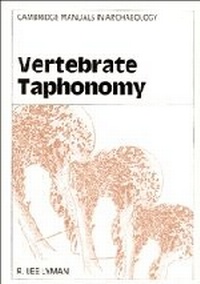
Vertebrate Taphonomy
Published on 7. July 1994
Book
Hardback
550 pages
978-0-521-45215-1 (ISBN)
Description
Taphonomy studies the transition of organic matter from the biosphere into the geological record. It is particularly relevant to zooarchaeologists and paleobiologists, who analyse organic remains in the archaeological record in an attempt to reconstruct hominid subsistence patterns and paleoecological conditions. In this user-friendly, encyclopedic reference volume for students and professionals, R. Lee Lyman, a leading researcher in taphonomy, reviews the wide range of analytical techniques used to solve particular zooarchaeological problems, illustrating these in most cases with appropriate examples. He also covers the history of taphonomic research and its philosophical underpinnings. Logically organised and clearly written, the book is an important update on all previous publications on archaeological faunal remains.
Reviews / Votes
"...a comprehensive, detailed and accurate book that will make taphonomy accessible to specialists and nonspecialists alike. It is essential reading for all vertebrate palaeontologists, archaeologists and palaeoecologists and provides crucial background information for workers in other disciplines who use fossil material, especially molecular biologists attempting to extract DNA from fossil bone." Nature "Vertebrate Taphonomy succeeds through a combination of clear writing, high-quality illustrations, and Lyman's encyclopedic knowledge...A good discussion, extensive up-to-date bibliography, and generally excellent glossary round out this highly recommended volume." E. Delson, Choice "...bold in its wide coverage....Readers will see wisdom in this book, a welcome development in a field where all publications are touted as final authorities....fair and fluid, comprehensive and nonconfrontational....you leave educated and edified." Gary Haynes, Journal of Middle Atlantic Archaeology "Lyman's book is a major scientific contribution and is both an excellent teaching tool for advanced students and a helpful guide to practicing professionals. The author successfully integrates existing knowledge and approaches from a vast array of sources....Moreover, the level of scholarship is excellent....Readers are provided with a comprehensive array of analytical alternatives and equally important, Lyman encourages readers to make their own--albeit better informed--decisions in relation to the problems." American Antiquity "...all scientists who are interested in taphonomy or zooarchaeology can rejoice at the publication of Vertebrate Taphonomy by R. Lee Lyman....an enormous accomplishment for such a broadly based book....essential for anyone interested in taphonomy....This book is a gift to all zooarchaeologists...." Curtis W. Marean, Evolutionary AnthropologyMore details
Series
Language
English
Place of publication
Cambridge
United Kingdom
Target group
Professional and scholarly
Illustrations
26 Halftones, unspecified; 20 Line drawings, unspecified
Dimensions
Height: 255 mm
Width: 178 mm
Thickness: 33 mm
Weight
1358 gr
ISBN-13
978-0-521-45215-1 (9780521452151)
Copyright in bibliographic data and cover images is held by Nielsen Book Services Limited or by the publishers or by their respective licensors: all rights reserved.
Schweitzer Classification
Other editions
New editions
R. Lee Lyman
Vertebrate Taphonomy
Book
07/1994
Cambridge University Press
€105.70
Shipment within 15-20 days
Additional editions
R. Lee Lyman
Vertebrate Taphonomy
Book
07/1994
Cambridge University Press
€105.70
Shipment within 15-20 days
R. Lee Lyman
Vertebrate Taphonomy
E-Book
07/1994
1st Edition
Cambridge University Press
€61.99
Available for download
Person
Content
Preface; 1. What is taphonomy?; 2. The history and structure of taphonomy; 3. Taphonomy in practice and theory; 4. Structure and quantification of vertebrate skeletons; 5. Vertebrate mortality, skeletonization, disarticulation, and scattering; 6. Accumulation and dispersal of vertebrate remains; 7. Frequencies of skeletal parts; 8. Butchering, bone fracturing and bone tools; 9. Other biostratinomic factors; 10. Burial as a taphonomic process; 11. Diagenesis; 12. Taphonomy of fish, birds, reptiles and amphibians; 13. Discussion and conclusions; Glossary.