

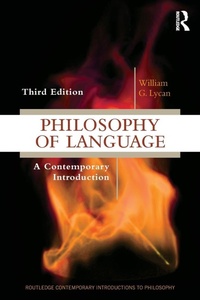
Philosophy of Language
A Contemporary Introduction
3rd Edition
Published on 10. September 2018
Book
Paperback/Softback
238 pages
978-1-138-50458-5 (ISBN)
Description
Now in its third edition, Philosophy of Language: A Contemporary Introduction introduces students to the main issues and theories in twenty-first-century philosophy of language, focusing specifically on linguistic phenomena. Author William G. Lycan structures the book into four general parts. Part I, Reference and Referring, includes topics such as Russell's Theory of Descriptions (and its objections), Donnellan's distinction, problems of anaphora, the Description Theory of proper names, Searle's Cluster Theory, and the Causal-Historical Theory. Part II, Theories of Meaning, surveys the competing theories of linguistic meaning and compares their various advantages and liabilities. Part III, Pragmatics and Speech Acts, introduces the basic concepts of linguistic pragmatics and includes a detailed discussion of the problem of indirect force. Part IV, The Expressive and the Figurative, examines various forms of expressive language and what "metaphorical meaning" is and how most listeners readily grasp it.
Features of Philosophy of Language include:
chapter overviews and summaries;
clear supportive examples;
study questions;
annotated lists of further reading;
a glossary.
Updates to the third edition include:
an entirely new chapter, "Expressive Language" (Chapter 14), covering verbal irony, sarcasm, and pejorative language (particularly slurs);
the addition in several chapters of short sections on pretense theories, addressing (1) puzzles about reference, (2) irony, and (3) metaphor;
a much expanded discussion of Relevance Theory, particularly its notion of ad hoc concept construction or "loosening and tightening," and the application of that to metaphor;
new discussion of Cappelen and Lepore's skepticism about content-dependence;
up-to-date coverage of new literature, further reading lists, and the bibliography, as well as an improved glossary.
Features of Philosophy of Language include:
chapter overviews and summaries;
clear supportive examples;
study questions;
annotated lists of further reading;
a glossary.
Updates to the third edition include:
an entirely new chapter, "Expressive Language" (Chapter 14), covering verbal irony, sarcasm, and pejorative language (particularly slurs);
the addition in several chapters of short sections on pretense theories, addressing (1) puzzles about reference, (2) irony, and (3) metaphor;
a much expanded discussion of Relevance Theory, particularly its notion of ad hoc concept construction or "loosening and tightening," and the application of that to metaphor;
new discussion of Cappelen and Lepore's skepticism about content-dependence;
up-to-date coverage of new literature, further reading lists, and the bibliography, as well as an improved glossary.
Reviews / Votes
"An authoritative, pedagogically sensitive and superbly clear introduction to the central issues of the philosophy of language."Paul Boghossian, New York University, USA "An authoritative, pedagogically sensitive and superbly clear introduction to the central issues of the philosophy of language."
Paul Boghossian, New York University, USA
More details
Series
Edition
3rd edition
Language
English
Place of publication
London
United Kingdom
Publishing group
Taylor & Francis Ltd
Target group
College/higher education
Illustrations
2 s/w Zeichnungen, 1 s/w Tabelle
1 Tables, black and white; 2 Line drawings, black and white
Dimensions
Height: 229 mm
Width: 152 mm
Thickness: 14 mm
Weight
374 gr
ISBN-13
978-1-138-50458-5 (9781138504585)
Copyright in bibliographic data and cover images is held by Nielsen Book Services Limited or by the publishers or by their respective licensors: all rights reserved.
Schweitzer Classification
Other editions
New editions
Book
approx. 07/2026
4th Edition
Routledge
€52.50
Not yet published
Additional editions
E-Book
10/2018
3rd Edition
Routledge
€55.49
Available for download
E-Book
10/2018
3rd Edition
Routledge
€55.49
Available for download
Book
08/2018
3rd Edition
Routledge
€207.70
Shipment within 10-20 days
Previous edition
Book
04/2008
2nd Edition
Routledge
€64.56
Article exhausted; check for reprint
Person
William G. Lycan is William Rand Kenan, Jr. Professor of Philosophy Emeritus at the University of North Carolina, Chapel Hill and currently Distinguished Visiting Professor at the University of Connecticut, Storrs. His eight books include Consciousness and Experience (1996), Real Conditionals (2001), and Philosophy of Language: A Contemporary Introduction (Third Edition, 2018).
Content
1. Introduction: Meaning and Reference Part 1: Reference and Referring 2. Definite Descriptions 3. Proper Names: The Description Theory 4. Proper Names: Direct Reference and the Causal-Historical Theory Part II: Theories of Meaning 5. Traditional Theories of Meaning 6. "Use" Theories 7. Psychological Theories: Grice's Program 8. Verificationism 9. Truth-Condition Theories: Davidson's Program 10. Truth-Condition Theories: Possible Worlds and Intensional Semantics Part III: Pragmatics and Speech Acts 11. Semantic Pragmatics 12. Speech Acts and Illocutionary Force 13. Implicative Relations Part IV: The Expressive and the Figurative 14. Expressive Language 15. Metaphor Glossary Bibliography Index