

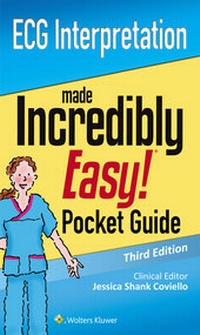
ECG Interpretation: An Incredibly Easy Pocket Guide
3rd Edition
Will be published approx. on 20. December 2016
Book
Paperback/Softback
304 pages
978-1-4963-5216-3 (ISBN)
Description
New at ECG interpretation? No need to go it alone-keep the basic skills and concepts at your fingertips, with ECG Interpretation: An Incredibly Easy! (R) Pocket Guide .
Use this enjoyable reference for at-a-glance reviews of how to use and monitor ECG equipment, obtain and interpret rhythm strips, and accurately spot and treat arrhythmias. Full of helpful charts, illustrations, and easy-to-relate-to definitions, this is the perfect on-the-spot guide for students, new nurses, and all those looking for expert guidance on the job.
Increase on-the-job or classroom confidence with this must-have pocket guide, featuring:
NEW and updated content in quick-read, bulleted format, with easy-to-remember guidance on topics including: o Identifying and interpreting atrial, junctional, ventricular, sinus node, and atrioventricular arrhythmias o ECG effects of electrolyte imbalances o ECG effects of antiarrhythmics o Basic and advanced electrocardiography, including equipment uses and components o Waveform types and components
Dozens of photos, drawings, and diagrams clearly outline key concepts, including:
8-step method of ECG evaluation
Identifying and monitoring disorders, rhythm disturbances, and electrolyte imbalances
Placement of different types of leads
Identifying and solving monitor problems
Interventions - Administering nonpharmacologic and pharmacologic treatments for arrhythmias, including pacemakers, ICDs, and antiarrhythmics
Special features:
Memory jogger - Memory tricks that help you remember key concepts and treatments
Through the ages - Identifies differences in ECG interpretation and pacemaker needs, according to the patient's age
Help desk - Explanations of monitoring equipment components and functions
What causes it - Causes of different disorders, imbalances, and arrhythmias
What to look for - Tips on identifying and interpreting arrhythmia
How it's treated - Steps to take for a variety of treatment
"Nurse Joy" and "Nurse Jake" - Expert insights on ECG methods and problem-solving
End-of-book guides and tests:
The Test Zone - Practice Q&A
Quick guide to arrhythmias
ACLS algorithms: The Pulseless Arrest, Tachycardia, and Bradycardia
Guide to antiarrhythmic drugs
Guide to choosing monitoring leads
About the Clinical Editor
Jessica Shank Coviello, DNP, APM, ANP-BC, is Associate Professor and Director of the Doctor of Nursing Practice Program at Yale Univers
Use this enjoyable reference for at-a-glance reviews of how to use and monitor ECG equipment, obtain and interpret rhythm strips, and accurately spot and treat arrhythmias. Full of helpful charts, illustrations, and easy-to-relate-to definitions, this is the perfect on-the-spot guide for students, new nurses, and all those looking for expert guidance on the job.
Increase on-the-job or classroom confidence with this must-have pocket guide, featuring:
NEW and updated content in quick-read, bulleted format, with easy-to-remember guidance on topics including: o Identifying and interpreting atrial, junctional, ventricular, sinus node, and atrioventricular arrhythmias o ECG effects of electrolyte imbalances o ECG effects of antiarrhythmics o Basic and advanced electrocardiography, including equipment uses and components o Waveform types and components
Dozens of photos, drawings, and diagrams clearly outline key concepts, including:
8-step method of ECG evaluation
Identifying and monitoring disorders, rhythm disturbances, and electrolyte imbalances
Placement of different types of leads
Identifying and solving monitor problems
Interventions - Administering nonpharmacologic and pharmacologic treatments for arrhythmias, including pacemakers, ICDs, and antiarrhythmics
Special features:
Memory jogger - Memory tricks that help you remember key concepts and treatments
Through the ages - Identifies differences in ECG interpretation and pacemaker needs, according to the patient's age
Help desk - Explanations of monitoring equipment components and functions
What causes it - Causes of different disorders, imbalances, and arrhythmias
What to look for - Tips on identifying and interpreting arrhythmia
How it's treated - Steps to take for a variety of treatment
"Nurse Joy" and "Nurse Jake" - Expert insights on ECG methods and problem-solving
End-of-book guides and tests:
The Test Zone - Practice Q&A
Quick guide to arrhythmias
ACLS algorithms: The Pulseless Arrest, Tachycardia, and Bradycardia
Guide to antiarrhythmic drugs
Guide to choosing monitoring leads
About the Clinical Editor
Jessica Shank Coviello, DNP, APM, ANP-BC, is Associate Professor and Director of the Doctor of Nursing Practice Program at Yale Univers
More details
Series
Edition
3rd edition
Language
English
Place of publication
Philadelphia
United States
Target group
Professional and scholarly
Product notice
Paperback (trade)
Illustrations
307
Dimensions
Height: 181 mm
Width: 108 mm
Weight
249 gr
ISBN-13
978-1-4963-5216-3 (9781496352163)
Copyright in bibliographic data and cover images is held by Nielsen Book Services Limited or by the publishers or by their respective licensors: all rights reserved.
Schweitzer Classification
Other editions
Previous edition
Book
07/2009
2nd Edition
Lippincott Williams and Wilkins
€49.71
Article exhausted; check for reprint