

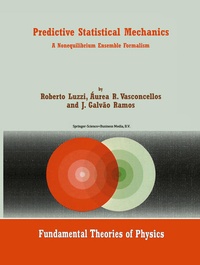
Predictive Statistical Mechanics
A Nonequilibrium Ensemble Formalism
Published on 9. December 2010
Book
Paperback/Softback
XL, 304 pages
978-90-481-5963-5 (ISBN)
Description
Chapters 1 to 5 include a description of the philosophy, foundations, and construction (methodology) of the formalism, including the derivation of a nonequilibrium grand-canonical ensemble for far-from-equilibrium systems as well as the derivation of a quantum nonlinear kinetic theory and a response function theory together with a theory of scattering. In chapter 6 applications of the theory are cataloged, making comparisons with experimental data (a basic step for the validation of any theory). Chapter 7 is devoted to the description of irreversible thermodynamics, providing a far-reaching generalization of Informational-Statistical Thermodynamics. The last chapter gives an overall picture of the formalism, and questions and criticisms related to it are discussed.
More details
Series
Edition
Softcover reprint of hardcover 1st ed. 2002
Language
English
Place of publication
Dordrecht
Netherlands
Target group
Professional and scholarly
Research
Illustrations
XL, 304 p.
Dimensions
Height: 279 mm
Width: 210 mm
Thickness: 19 mm
Weight
849 gr
ISBN-13
978-90-481-5963-5 (9789048159635)
DOI
10.1007/978-94-017-2748-8
Schweitzer Classification
Other editions
Additional editions
Roberto Luzzi | Áurea R. Vasconcellos | J. Galvão Ramos
Predictive Statistical Mechanics
A Nonequilibrium Ensemble Formalism
Book
02/2002
1st Edition
Kluwer Academic Publishers
€106.99
Shipment within 15-20 days
Persons
Prof. Dr. Roberto Luzzi, Universidade Estadual de Campinas, Sao Paulo
Prof. Dr. Aurea R. Vasconcellos, Universidade Estadual de Campinas, Sao Paulo
Prof. Dr. J. Galvao Ramos, Universidade Estadual de Campinas, Sao Paulo
Content
1. Maxent-Nesom in Equilibrium Conditions.- 2. Maxent-Nesom for Dissipative Processes in Open Systems.- 3. Nonequilibrium Generalized Grand-Canonical Ensemble.- 4. Maxent-Nesom-Based Kinetic Theory.- 5. Response Function Theory.- 6. Theory and Experiment.- 7. Informational Statistical Thermodynamics.- 8. Final Remarks.- Appendices.- The variational procedure.- Calculation of Eq. (4.15).- The Partial Collision Operators of Eq. (4.24).- Calculation of Eq. (4.49).- An illustration of the use of Markovian equations.- Calculation of Eq. (4.63).- The Dielectric Function.- Name Index.