

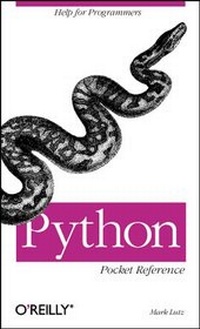
Python Pocket Reference
Published on 8. December 1998
Book
80 pages
978-1-56592-500-7 (ISBN)
Description
Python is a popular object-oriented scripting language that is freely available over the Net. It's portable, powerful, and remarkably easy to use. Python is commonly used for both stand-alone programs and scripting applications, in a wide variety of domains. This book is a companion volume to two O'Reilly Animal Guides, Programming Python and Learning Python. It summarizes Python statements and types, built-in functions, commonly used library modules, and other prominent Python language features. This pocket reference covers the latest Python release and complements Python's online reference material.
More details
Other editions
New editions
Mark Lutz
Python Pocket Reference
Book
12/2001
2nd Edition
O'Reilly
€8.50
Article exhausted; check for reprint
Person
Mark Lutz is a software developer and a Python writer and trainer. He is also the author of the O'Reilly book Programming Python, as well as a Python chapter in a programming languages text. Mark has programmed a variety of Python systems, teaches courses about the language, and has been involved with Python since 1992 (which means he gets to call himself a Python "Old Timer" when he's in a stoic mood). By day, Mark currently works as a software gun-for-hire (described on his resume as a consultant). He earned B.S. and M.S. degrees in computer science from the University of Wisconsin, and has worked on compilers, programming tools, scripting languages, and assorted client/server systems. Most of his recent development experience involves hard-core programming, killer bugs, and arguably insane hours, but he's having too much fun to take up pig farming any time soon.
Content
Conventions. 1. Command-Line Options. 2. Environment Variables. 3. Built-In Types and Operators Operators and Precedence Operations by Category Sequence Operation Notes Specific Built-In Types Type Conversions. 4. Statements and Syntax Syntax Rules Name Rules Specific Statements. 5. Namespace and Scope Rules Unqualified Names: Global Unless Assigned Qualified Names: Object Namespaces. 6. Object-Oriented Programming Classes and Instances Special Overloading Methods Private Attributes. 7. Built-In Functions. 8. Built-In Exceptions Base Classes (Categories) Specific Exceptions. 9. Built-In Attributes. 10. Major Built-In Modules The sys Module The string Module The os Module The posix Module The posixpath Module The math Module The time Module The re Module The regex Module. 11. Other Built-In Modules 12. Persistence: dbm, shelve, pickle Dbm and shelve Interfaces Pickle Interface. 13. Debugger and Profiler The Debugger The Profiler. 14. Python Mode for Emacs Indentation Processing Regions of Code Moving the Point Executing Python Code Variables 15. Python Idioms and Hints