

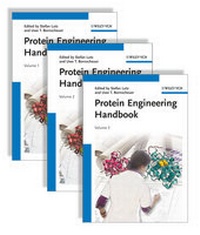
Protein Engineering Handbook
1st Edition
Published on 14. November 2012
Book
Hardback
1500 pages
978-3-527-33144-4 (ISBN)
Description
The first complete reference on this growing field in the biosciences covers the full spectrum of current concepts, methods and application areas in three handy volumes. Highly useful for protein engineers in academia and industry alike.
More details
Edition
1st edition 2013
Language
English
Place of publication
Weinheim
Germany
Target group
College/higher education
Dimensions
Height: 240 mm
Width: 170 mm
ISBN-13
978-3-527-33144-4 (9783527331444)
Copyright in bibliographic data and cover images is held by Nielsen Book Services Limited or by the publishers or by their respective licensors: all rights reserved.
Schweitzer Classification
Persons
Stefan Lutz holds a B. S. degree from the Zurich University of Applied Sciences (Switzerland), and a M.S. degree from the University of Teesside (UK). He then obtained a Ph.D. from the University of Florida and spent three years as a Postdoc with Stephen Benkovic at Pennsylvania State University under a fellowship of the Swiss National Science Foundation. Since 2002 he has been a Chemistry professor at Emory University in Atlanta, Georgia (USA). The research in the Lutz laboratory focuses on the structure-function relationship of proteins through combinatorial protein engineering.
Uwe Bornscheuer studied Chemistry at the University of Hannover (Germany), where he obtained a Ph. D. at the Institute of Technical Chemistry. He then spent a postdoctoral year at the University of Nagoya, Japan, before returning to Germany to join the Institute of Technical Biochemistry at the University of Stuttgart. Since 1999 he has been Professor for Biotechnology and Enzyme Catalysis at the University of Greifswald. His main research interest is the application of engineered enzymes in the synthesis of optically active compounds and in lipid modification.
Uwe Bornscheuer studied Chemistry at the University of Hannover (Germany), where he obtained a Ph. D. at the Institute of Technical Chemistry. He then spent a postdoctoral year at the University of Nagoya, Japan, before returning to Germany to join the Institute of Technical Biochemistry at the University of Stuttgart. Since 1999 he has been Professor for Biotechnology and Enzyme Catalysis at the University of Greifswald. His main research interest is the application of engineered enzymes in the synthesis of optically active compounds and in lipid modification.
Content
VOLUME 1
Guidelines for the Functional Analysis of Engineered and Mutant Enzymes
Engineering Enantioselectivity in Enzyme-Catalyzed Reactions
Mechanism and Catalytic Promiscuity: Emerging Mechanistic Principles for Identification and Manipulation of Catalytically Promiscuous Enzymes
Phi-Value Analysis of Protein Folding Transition States
Protein Folding and Solubility: Pathways and High-Throughput Assays
Protein Dynamics and the Evolution of Novel Protein Function
Gaining Insight into Enzyme Function through Correlation with Protein Motions
Structural Frameworks Suitable for Engineering
Microbes and Enzymes: Recent Trends and New Directions to Expand Protein Space
Inteins in Protein Engineering
From Prospecting to Product - Industrial Metagenomics Is Coming of Age
Computational Protein Design
Assessing and Exploiting the Persistence of Substrate Ambiguity in Modern Protein Catalysts
Designing Programmable Protein Switches
The Cyclization of Peptides and Proteins with Inteins
VOLUME 2
A Method for Rapid Directed Evolution
Evolution of Enantioselective Bacillus subtilis Lipase
Circular Permutation of Proteins
Incorporating Synthetic Oligonucleotides via Gene Reassembly (ISOR): A Versatile Tool for Generating Targeted Libraries
Protein Engineering by Structure-Guided SCHEMA Recombination
Chimeragenesis in Protein Engineering
Protein Generation Using a Reconstituted System
Equipping in vivo Selection Systems with Tunable Stringency
Protein Engineering by Phage Display
Screening Methodologies for Glycosidic Bond Formation
Yeast Surface Display in Protein Engineering and Analysis
In Vitro Compartmentalization (IVC) and Other High-Throughput Screens of Enzyme Libraries
Colorimetric and Fluorescence-Based Screening
Confocal and Conventional Fluorescence-Based High Throughput Screening in Protein Engineering
30 Alteration of Substrate Specificity and Stereoselectivity of Lipases and Esterases
Altering Enzyme Substrate and Cofactor Specificity via Protein Engineering
Protein Engineering of Modular Polyketide Synthases
Cyanophycin Synthetases
Biosynthetic Pathway Engineering Strategies
Natural Polyester-Related Proteins: Structure, Function, Evolution and Engineering
Bioengineering of Sequence-Repetitive Polypeptides: Synthetic Routes to Protein-Based Materials of Novel Structure and Function
Silk Proteins - Biomaterials and Bioengineering
VOLUME 3
Protein Engineering Guided by Natural Diversity
Protein engineering using eukaryotic expression systems
Protein Engineering in Microdroplets
Folding and Dynamics of Engineered Proteins
Engineering Protein Stability
Enzymes from thermophilic organisms
Enzyme engineering by cofactor redesign
Biocatalyst identification by anaerobic high throughput screening of enzyme libraries and anaerobic microorganisms
Organometallic Chemistry in Protein Scaffolds
Engineering Protease Specificity
Polymerase Engineering: From PCR and sequencing to synthetic biology
Engineering Glycosyltransferases
Protein engineering of cytochrome P450 monooxygenases
Progress and Challenges in Computational Protein Design
Simulation of enzymes in organic solvents
Engineering of protein tunnels: Keyhole-lock-key model for catalysis by the enzymes with buried active sites
Guidelines for the Functional Analysis of Engineered and Mutant Enzymes
Engineering Enantioselectivity in Enzyme-Catalyzed Reactions
Mechanism and Catalytic Promiscuity: Emerging Mechanistic Principles for Identification and Manipulation of Catalytically Promiscuous Enzymes
Phi-Value Analysis of Protein Folding Transition States
Protein Folding and Solubility: Pathways and High-Throughput Assays
Protein Dynamics and the Evolution of Novel Protein Function
Gaining Insight into Enzyme Function through Correlation with Protein Motions
Structural Frameworks Suitable for Engineering
Microbes and Enzymes: Recent Trends and New Directions to Expand Protein Space
Inteins in Protein Engineering
From Prospecting to Product - Industrial Metagenomics Is Coming of Age
Computational Protein Design
Assessing and Exploiting the Persistence of Substrate Ambiguity in Modern Protein Catalysts
Designing Programmable Protein Switches
The Cyclization of Peptides and Proteins with Inteins
VOLUME 2
A Method for Rapid Directed Evolution
Evolution of Enantioselective Bacillus subtilis Lipase
Circular Permutation of Proteins
Incorporating Synthetic Oligonucleotides via Gene Reassembly (ISOR): A Versatile Tool for Generating Targeted Libraries
Protein Engineering by Structure-Guided SCHEMA Recombination
Chimeragenesis in Protein Engineering
Protein Generation Using a Reconstituted System
Equipping in vivo Selection Systems with Tunable Stringency
Protein Engineering by Phage Display
Screening Methodologies for Glycosidic Bond Formation
Yeast Surface Display in Protein Engineering and Analysis
In Vitro Compartmentalization (IVC) and Other High-Throughput Screens of Enzyme Libraries
Colorimetric and Fluorescence-Based Screening
Confocal and Conventional Fluorescence-Based High Throughput Screening in Protein Engineering
30 Alteration of Substrate Specificity and Stereoselectivity of Lipases and Esterases
Altering Enzyme Substrate and Cofactor Specificity via Protein Engineering
Protein Engineering of Modular Polyketide Synthases
Cyanophycin Synthetases
Biosynthetic Pathway Engineering Strategies
Natural Polyester-Related Proteins: Structure, Function, Evolution and Engineering
Bioengineering of Sequence-Repetitive Polypeptides: Synthetic Routes to Protein-Based Materials of Novel Structure and Function
Silk Proteins - Biomaterials and Bioengineering
VOLUME 3
Protein Engineering Guided by Natural Diversity
Protein engineering using eukaryotic expression systems
Protein Engineering in Microdroplets
Folding and Dynamics of Engineered Proteins
Engineering Protein Stability
Enzymes from thermophilic organisms
Enzyme engineering by cofactor redesign
Biocatalyst identification by anaerobic high throughput screening of enzyme libraries and anaerobic microorganisms
Organometallic Chemistry in Protein Scaffolds
Engineering Protease Specificity
Polymerase Engineering: From PCR and sequencing to synthetic biology
Engineering Glycosyltransferases
Protein engineering of cytochrome P450 monooxygenases
Progress and Challenges in Computational Protein Design
Simulation of enzymes in organic solvents
Engineering of protein tunnels: Keyhole-lock-key model for catalysis by the enzymes with buried active sites