

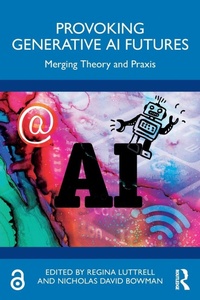
Provoking Generative AI Futures
Merging Theory and Praxis
1st Edition
Published on 27. April 2026
Book
Paperback/Softback
400 pages
978-1-032-78389-5 (ISBN)
Description
An accessible exploration of the myriad applications and challenges of generative AI for media and communication students, scholars, and practitioners alike.
The latest emergence of increasingly low-cost and scalable AI technologies presents a point of both celebration and concern for the contemporary media and information ecosystem. To this end, this edited volume gathers media and communications scholars and practitioners to engage in discussions and exchange ideas about current trends and developments in the field. Questions this volume asks include: What are the essentials of generative AI from a media and communication perspective? How has generative AI influenced research and scholarship? How has generative AI influenced media content and industries? What ethical and legal questions has generative AI introduced or reignited? How are discussions of generative AI influencing perception of the technologies? Who benefits from generative AI, and who might be disenfranchised? As generative AI develops at a rapid pace, this collection provides a calibration point for further discussion and debate around their role in media and communication.
This book will appeal to students seeking to gain greater understanding of generative AI within the media and communication industries, as well as media and communication scholars and practitioners directly engaged in generative AI research, application, and development.
The Open Access version of this book, available at http://www.taylorfrancis.com, has been made available under a Creative Commons [Attribution-Non Commercial-No Derivatives (CC BY-NC-ND)] 4.0 license
The latest emergence of increasingly low-cost and scalable AI technologies presents a point of both celebration and concern for the contemporary media and information ecosystem. To this end, this edited volume gathers media and communications scholars and practitioners to engage in discussions and exchange ideas about current trends and developments in the field. Questions this volume asks include: What are the essentials of generative AI from a media and communication perspective? How has generative AI influenced research and scholarship? How has generative AI influenced media content and industries? What ethical and legal questions has generative AI introduced or reignited? How are discussions of generative AI influencing perception of the technologies? Who benefits from generative AI, and who might be disenfranchised? As generative AI develops at a rapid pace, this collection provides a calibration point for further discussion and debate around their role in media and communication.
This book will appeal to students seeking to gain greater understanding of generative AI within the media and communication industries, as well as media and communication scholars and practitioners directly engaged in generative AI research, application, and development.
The Open Access version of this book, available at http://www.taylorfrancis.com, has been made available under a Creative Commons [Attribution-Non Commercial-No Derivatives (CC BY-NC-ND)] 4.0 license
Reviews / Votes
"A timely and grounded guide to the evolving role of generative AI in communication. This book examines how these technologies are reshaping authorship, creativity, and professional practice, moving beyond novelty to focus on meaningful integration. It will be an essential resource for scholars and practitioners navigating the future of media."- Shengjie Yao, Sam Houston State University, USA
"Provoking Generative AI Futures: Merging Theory and Praxis is a standout text for anyone seeking to increase their understanding of the implications of artificial intelligence for media and communication. Bringing together leading scholars and practitioners, Provoking Generative AI Futures presents a multi-faceted perspective of how people's adoption of AI technologies is changing media industries, organizational communication, and interpersonal relationships. This book stands apart in that it helps the reader to understand both the effects of AI for how people communicate and the theory behind people's motivations, decision-making, and perceptions of AI. Students and scholars alike will benefit from the depth and breadth of its examination of GenAI."
- Andrea L. Guzman, Northern Illinois University, USA
"With generative AI's - in particular large language models - emergence into our everyday lives, it is increasingly important that communication scholars be involved in the ongoing discourse and research regarding generative AI. Luttrell and Bowman's volume represents a critical early step in outlining how the field of communication can contribute to understanding the processes and outputs of LLM interactions with human communication, including sender and receiver variables, interpersonal processes, and effects on mass communication."
- Bree McEwan, University of Toronto, Canada
More details
Language
English
Place of publication
London
United Kingdom
Publishing group
Taylor & Francis Ltd
Target group
College/higher education
Professional and scholarly
Academic, Postgraduate, Professional Reference, and Undergraduate Advanced
Illustrations
13 s/w Photographien bzw. Rasterbilder, 16 s/w Zeichnungen, 17 s/w Tabellen, 29 s/w Abbildungen
17 Tables, black and white; 16 Line drawings, black and white; 13 Halftones, black and white; 29 Illustrations, black and white
Dimensions
Height: 228 mm
Width: 152 mm
Thickness: 24 mm
Weight
602 gr
ISBN-13
978-1-032-78389-5 (9781032783895)
Copyright in bibliographic data and cover images is held by Nielsen Book Services Limited or by the publishers or by their respective licensors: all rights reserved.
Schweitzer Classification
Other editions
Additional editions
E-Book
04/2026
Routledge
€0.00
Available for download
E-Book
04/2026
Routledge
€0.00
Available for download

Book
04/2026
1st Edition
Routledge
€193.50
Shipment within 10-20 days
Persons
Regina Luttrell is Associate Professor of Public Relations and the Senior Associate Dean of the S.I. Newhouse School of Public Communications at Syracuse University, USA. Her research interests focus on public relations, artificial intelligence, data analytics, a multi-generational workforce, and the intersection of social media with society.
Nicholas David Bowman is Professor of Communications in the S.I. Newhouse School of Public Communications, USA. His research considers the cognitive, emotional, physical, and social demands of interactive media technologies-from social media and video games to extended reality and human-machine interactions.
Nicholas David Bowman is Professor of Communications in the S.I. Newhouse School of Public Communications, USA. His research considers the cognitive, emotional, physical, and social demands of interactive media technologies-from social media and video games to extended reality and human-machine interactions.
Content
Editor's Introduction: Generative AI and the Future of Communication Part I: Theoretical Approaches and Emerging Inquiries in AI Communication 1. Predictable Panics, but with Purpose: Understanding our Perceptions of Generative AI 2. Literary Theory for Large Language Models 3. GPT-4-Trinis: Fine-Tuning an LLM on the Grammar of an Underrepresented English Variety 4. Detection Is Not Enough: Toward Explainable Attribution and Characterization of Synthetically-Generated Media 5. Experiencing Generative AI: Technology's Double-Edged Sword 6. AI Sycophancy as Social-Moral Behavior 7. Generative AI and Disinformation: A Systematic Examination of Challenges and Opportunities for Public Communication 8. From Tools to Teammates: Social Norms, Perceived Agency, and Emotional Engagement in Generative AI 9. The Experience and Perception of AI-generated Narratives Part II: AI in Communication Practice 10. Navigating the Artificial Intelligence Revolution: Perspectives from an Emerging Economy 11. Evaluating the Preparedness and Responsiveness of Public Relations Practitioners toward AI Integration in the Digital Communication Landscape 12. Unethical by Design: Tackling Bias in the Development and Deployment of Artificial Intelligence 13. Generative AI Oversight: Who will watch the watchers? 14. Beyond Sentiment: AI and Social Media Measurement 15. The Influence of AI on Media Pitching and Journalist Relations 16. The AI-Augmented Thought Leader: A Mixed-Methods Study of Owned Media in the Generative AI Era 17. Prompting the Frame: Rethinking the Camera and Cinematographic Practice 18. The Determinator: A Suggested Framework for Determining Appropriateness of Generative AI Use Part III: Global Perspectives and Early Observations 19. Generative Artificial Intelligence Ethical and Legal Issues in the Brazilian Media and Information Ecosystem: A Situational Analysis to Think From the Global South 20. A Chronicle Inside Higher Ed: Efficiency and Integrity Framing of Artificial Intelligence in Two Major Higher Education Publications 21. AI Resurrection: Technological, Ethical and Spiritual Discourses Conflicts on Posthumous Communication in China 22. Artificial Intelligence in the Press: A Research Note on Turkish Case 23. Opportunities and Challenges of Using Generative AI in Indian Journalism