

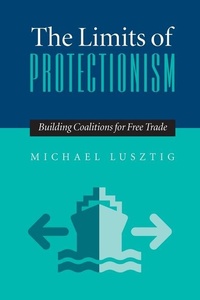
The Limits Of Protectionism
Building Coalitions for Free Trade
Published on 25. July 2004
Book
Paperback/Softback
272 pages
978-0-8229-5843-7 (ISBN)
Description
Conventional wisdom holds that free trade is economically beneficial to nations. But this does not prevent industries and interest groups from lobbying their governments for protection, which creates a fear of electoral backlash among politicians hoping to promote free trade. The Limits of Protectionism demonstrates how governments can attain those economic benefits while avoiding the political costs.
Michael Lusztig\u2019s theoretical model focuses on a process by which protectionists can be pushed to restructure and compete in a global economy. In this process, a small cutback in domestic protection leads to lost market shares at home; producers must then turn to overseas exports, and, as the size of foreign profits grow, former protectionists become active advocates for more and greater free trade opportunities.
In a wide-ranging array of case studies-from nineteenth-century Britain to Depression-era United States to contemporary New Zealand, Australia, Brazil, Canada, Chile, and Mexico-Lusztig reveals that, if skillfully handled, governments can eliminate the obstacles to free trade and enjoy continued economic growth without fear of protectionist groups seeking revenge at the ballot box.
Michael Lusztig\u2019s theoretical model focuses on a process by which protectionists can be pushed to restructure and compete in a global economy. In this process, a small cutback in domestic protection leads to lost market shares at home; producers must then turn to overseas exports, and, as the size of foreign profits grow, former protectionists become active advocates for more and greater free trade opportunities.
In a wide-ranging array of case studies-from nineteenth-century Britain to Depression-era United States to contemporary New Zealand, Australia, Brazil, Canada, Chile, and Mexico-Lusztig reveals that, if skillfully handled, governments can eliminate the obstacles to free trade and enjoy continued economic growth without fear of protectionist groups seeking revenge at the ballot box.
Reviews / Votes
A tour de force for those who want to understand why many countries, if not the entire world, have embraced free trade. . . . Lusztig never loses sight of a most essential ingredient in this profound sea change: the conversion of business from protectionism to free markets. * Guy Poitras, Trinity University * An important contribution to political economy. Its theory, blending rational choice and political culture, is novel and compelling. And the sweep of historical evidence . . . is breathtaking. * Ric Uslaner, University of Maryland * A quick read, is well written and is jargon free. * <i>EH.NET</i> *More details
Language
English
Place of publication
Pittsburgh PA
United States
Target group
Professional and scholarly
College/higher education
Product notice
Paperback (trade)
Illustrations
Illustrations
Dimensions
Height: 228 mm
Width: 152 mm
Thickness: 16 mm
Weight
390 gr
ISBN-13
978-0-8229-5843-7 (9780822958437)
Copyright in bibliographic data and cover images is held by Nielsen Book Services Limited or by the publishers or by their respective licensors: all rights reserved.
Schweitzer Classification
Other editions
Additional editions
E-Book
06/2010
Princeton University Press
€53.99
Available for download
Person
Michael Lusztig, associate professor of political science at Southern Methodist University, is the author of Risking Free Trade.