

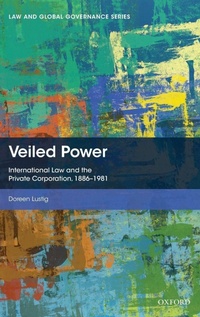
Veiled Power
International Law and the Private Corporation 1886-1981
Published on 16. June 2020
Book
Hardback
250 pages
978-0-19-882209-7 (ISBN)
Description
Veiled Power conducts a thorough historical study of the relationship between international law and business corporations. It chronicles the emergence of the contemporary legal architecture for corporations in international law between 1886 and 1981. Doreen Lustig traces the relationship between two legal 'veils': the sovereign veil of the state and the corporate veil of the company. The interplay between these two veils constitutes the conceptual framework this book offers for the legal analysis of corporations in international law.
By weaving together five in-depth case studies - Firestone in Liberia, the Industrialist Trials at Nuremberg, the Anglo-Iranian Oil Company, Barcelona Traction and the emergence of the international investment law regime - a variety of contexts are covered, including international criminal law, human rights, natural resources, and the multinational corporation as a subject of regulatory concern. Together, these case studies offer a multifaceted account of the history of corporations in international law over time.
The book seeks to demonstrate the facilitative role of international law in shaping and limiting the scope of responsibility of the private business corporation from the late-nineteenth century and throughout the twentieth century. Ultimately, Lustig suggests that, contrary to the prevailing belief that international law failed to adequately regulate private corporations, there is a history of close engagement between the two that allowed corporations to exert influence under a variety of legal regimes while obscuring their agency.
By weaving together five in-depth case studies - Firestone in Liberia, the Industrialist Trials at Nuremberg, the Anglo-Iranian Oil Company, Barcelona Traction and the emergence of the international investment law regime - a variety of contexts are covered, including international criminal law, human rights, natural resources, and the multinational corporation as a subject of regulatory concern. Together, these case studies offer a multifaceted account of the history of corporations in international law over time.
The book seeks to demonstrate the facilitative role of international law in shaping and limiting the scope of responsibility of the private business corporation from the late-nineteenth century and throughout the twentieth century. Ultimately, Lustig suggests that, contrary to the prevailing belief that international law failed to adequately regulate private corporations, there is a history of close engagement between the two that allowed corporations to exert influence under a variety of legal regimes while obscuring their agency.
Reviews / Votes
Lustig's work is a "must read" for anyone interested in this history and in the history of international law more generally. * Peter Muchlinski, SOAS, University of London, Law and History Review * Doreen Lustig offers an original, engaging, and historically grounded insightinto the development of international law's approach to private corporations. * Peter Muchlinski, University of London * Lustig's book is the leading history of the relationship between international law and the modern corporation in the twentieth century. It is a brilliant work of scholarship that has made a silence speak volumes. * Christopher A. Casey, Syracuse University, The Law & Practice of International Courts and Tribunals * ... Lustig has produced a compelling, and well-documented, narrative. Scholars of international law as well as legal historians and legal theorists will find much to their interest in this monograph, which deserves to be read widely. * Filip Batsele, PhD candidate, Institute for Legal History & Rolin-Jaequemyns International Law Institute, Ghent, Leiden Journal of International Law * Lustig's work is an excellent piece of scholarship providing much information regarding the direct paradigms that shape multinational corporations in international law and is a useful reference tool for those who are working on the history of international economic law. * P. Sean Morris, Research Scholar, Faculty of Law, University of Helsinki, The Asian Journal of International Law * Lustig's volume is slim, very slim for a historical study--what an achievement, what a virtue. It is written engagingly, not quite in the conversational style of Clapham, but with utmost clarity and, above all, a story, a real story unfolds from chapter to chapter. It has wonderful momentum. And, importantly, it is not only the historical narrative that is of true interest, but it is abundantly relevant to any contemporary discourse of corporations and international law. * J. H. H. Weiler, New York University School of Law, ICONnect *More details
Series
Language
English
Place of publication
Oxford
United Kingdom
Target group
Professional and scholarly
Dimensions
Height: 240 mm
Width: 161 mm
Thickness: 18 mm
Weight
543 gr
ISBN-13
978-0-19-882209-7 (9780198822097)
Copyright in bibliographic data and cover images is held by Nielsen Book Services Limited or by the publishers or by their respective licensors: all rights reserved.
Schweitzer Classification
Other editions
Additional editions
E-Book
05/2020
1st Edition
OUP eBook
€70.99
Available for download
E-Book
05/2020
1st Edition
OUP eBook
€70.99
Available for download
Person
Doreen Lustig is an Associate Professor at Tel Aviv University Law Faculty.
Content
Introduction
1: Liberia, Firestone, and the End of Slavery as a Political Cause: Between the Weak State and the Unruly Corporation 1926-1934
2: The Nature of the Nazi State and the Responsibility of Corporate Officials at Nuremberg
3: Without the Corporate Entity? Theories of Corporate Authority and their Implications for Business Responsibility at Nuremberg
4: Back to Informal Empire? The Anglo-Iranian Struggle over Oil, 1932-1954
5: From the NIEO to the International Investment Law Regime: The Rise of the Multinational Corporation as a Subject of Regulatory Concern in International Law
Conclusion
1: Liberia, Firestone, and the End of Slavery as a Political Cause: Between the Weak State and the Unruly Corporation 1926-1934
2: The Nature of the Nazi State and the Responsibility of Corporate Officials at Nuremberg
3: Without the Corporate Entity? Theories of Corporate Authority and their Implications for Business Responsibility at Nuremberg
4: Back to Informal Empire? The Anglo-Iranian Struggle over Oil, 1932-1954
5: From the NIEO to the International Investment Law Regime: The Rise of the Multinational Corporation as a Subject of Regulatory Concern in International Law
Conclusion