

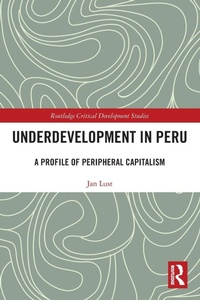
Underdevelopment in Peru
A Profile of Peripheral Capitalism
1st Edition
Published on 18. December 2024
Book
Paperback/Softback
220 pages
978-1-032-26689-3 (ISBN)
Description
At a time when Peru continues to reel from the impact of Covid-19 and the eruption of corruption scandals involving five former presidents, this book analyzes the persistence and the structural underpinnings of underdevelopment in Peru.
During the commodities boom of 2004-2011, Peru experienced strong levels of economic growth, bringing poverty down and increasing the middle-class population. In the Covid-19 pandemic, however, the severe lack of structural economic and social improvements has been exposed. With the arrival of the pandemic, hospitals collapsed, oxygen supplies dwindled, and informality rose, with dire consequences for the vulnerable, and for those already working on subsistence wages. Delving into the history of the country, Jan Lust outlines the structural problems that came about following Peru's post-colonial entrance into the world economy and the subsequent neoliberal extractive development model adopted in the 1990s. Only by understanding Peru's specific political, economic, and social conditions can a path towards development be found.
This book will be of interest to researchers working within politics, economics, critical development studies, and Latin American studies.
During the commodities boom of 2004-2011, Peru experienced strong levels of economic growth, bringing poverty down and increasing the middle-class population. In the Covid-19 pandemic, however, the severe lack of structural economic and social improvements has been exposed. With the arrival of the pandemic, hospitals collapsed, oxygen supplies dwindled, and informality rose, with dire consequences for the vulnerable, and for those already working on subsistence wages. Delving into the history of the country, Jan Lust outlines the structural problems that came about following Peru's post-colonial entrance into the world economy and the subsequent neoliberal extractive development model adopted in the 1990s. Only by understanding Peru's specific political, economic, and social conditions can a path towards development be found.
This book will be of interest to researchers working within politics, economics, critical development studies, and Latin American studies.
Reviews / Votes
"Lust's book provides a thorough examination of the historical events that have contributed to Peru's underdevelopment, while establishing a strong theoretical foundation that enables readers to grasp the intricate factors influencing this economic state." - Angelo Gamarra, Capital & Class 48(1)More details
Series
Language
English
Place of publication
London
United Kingdom
Publishing group
Taylor & Francis Ltd
Target group
College/higher education
Postgraduate
Illustrations
18 s/w Abbildungen, 18 s/w Zeichnungen, 44 s/w Tabellen
44 Tables, black and white; 18 Line drawings, black and white; 18 Illustrations, black and white
Dimensions
Height: 234 mm
Width: 156 mm
Thickness: 14 mm
Weight
371 gr
ISBN-13
978-1-032-26689-3 (9781032266893)
Copyright in bibliographic data and cover images is held by Nielsen Book Services Limited or by the publishers or by their respective licensors: all rights reserved.
Schweitzer Classification
Other editions
Additional editions
Book
08/2023
1st Edition
Routledge
€206.40
Shipment within 10-20 days
E-Book
08/2023
1st Edition
Routledge
€55.49
Available for download
E-Book
08/2023
1st Edition
Routledge
€55.49
Available for download
Person
Jan Lust has a PhD in Development Studies. He is Researcher and Professor at the Postgraduate School of the University Ricardo Palma in Peru and forms part of the Board of Directors of this University's Research Centre. He is the author of Lucha revolucionaria. Peru, 1958-1967, a book on the history of revolutionary struggle in Peru in the 1960s, and of Capitalism, Class and Revolution in Peru, 1980-2016, a book that analyzes the political, economic, and social reasons why the Peruvian socialist left has not been able to carry out its revolutionary project of social transformation. His academic interests encompass international political economy, Peruvian political, economic, and social development, labor issues, class, social movements, and guerrilla struggle.
Content
1. Capital and peripheral economic development 2. The peripheral capitalist development of Peru 3. Peru in the world economy 4. The business structure of capitalist development 5. The social class structure 6. Labor 7. Social segmentation 8. The state 9. Covid-19: the state, the economy, and the people 10. Conclusions