

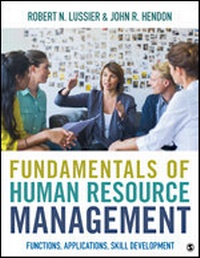
Fundamentals of Human Resource Management
Functions, Applications, Skill Development
1st Edition
Published on 29. February 2016
Book
Paperback/Softback
440 pages
978-1-4833-5850-5 (ISBN)
Description
Fundamentals of Human Resource Management takes a unique three-pronged approach that gives you a clear understanding of important HRM concepts and functions, shows you how to apply those concepts, and helps you build a strong skill set you can use in your personal and professional lives.
The authors use a variety of engaging applications and skill development exercises to improve your comprehension and retention. Featuring 90% of the 210 required SHRM 2013 Curriculum Guidebook topics, this text emphasizes current trends and the challenges facing HR managers today, provides you with key insights on important issues, and prepares you for successful careers in human resource management.
Key Features:
More than 180 required topics in the SHRM 2013 Curriculum Guidebook are covered in the text, equipping you with the knowledge you need for successful management careers
Application activities in every chapter help develop your critical thinking skills, while skill development activities in every chapter build and improve a variety of management skills
A chapter on Organizational Ethics, Sustainability, and Social Responsibility discusses how HR managers can help create ethical, socially responsible organizations
Trends and Issues in HRM at the end of every chapter introduce you to increasingly important and cutting-edge topics such as social media, gamification, globalization, data management, and more.
Get the SAGE edge!
SAGE edge offers a robust online environment featuring an impressive array of free tools and resources for review, study, and further exploration, keeping both instructors and students on the cutting edge of teaching and learning. Learn more at edge.sagepub.com/fundamentalsofhrm
The authors use a variety of engaging applications and skill development exercises to improve your comprehension and retention. Featuring 90% of the 210 required SHRM 2013 Curriculum Guidebook topics, this text emphasizes current trends and the challenges facing HR managers today, provides you with key insights on important issues, and prepares you for successful careers in human resource management.
Key Features:
More than 180 required topics in the SHRM 2013 Curriculum Guidebook are covered in the text, equipping you with the knowledge you need for successful management careers
Application activities in every chapter help develop your critical thinking skills, while skill development activities in every chapter build and improve a variety of management skills
A chapter on Organizational Ethics, Sustainability, and Social Responsibility discusses how HR managers can help create ethical, socially responsible organizations
Trends and Issues in HRM at the end of every chapter introduce you to increasingly important and cutting-edge topics such as social media, gamification, globalization, data management, and more.
Get the SAGE edge!
SAGE edge offers a robust online environment featuring an impressive array of free tools and resources for review, study, and further exploration, keeping both instructors and students on the cutting edge of teaching and learning. Learn more at edge.sagepub.com/fundamentalsofhrm
Reviews / Votes
"The three-pronged approaches are very important. I feel I am lacking of proper materials to encourage students in applying the concepts through critical thinking and application. The textbook under review did good job on this aspect." -- Wai Kwan (Elaine) Lau "Not only does it provide examples from older techniques and policies, it provides the changing perspective that modern HR managers must face." -- Tony Daniel "I feel that you have covered every major topic in an introduction to HR course." -- Samuel L. Rohr "The course that I teach was designed and developed in a manner that enhances critical thinking skills and the use of case studies to provide hands on and in class experiences that provide opportunities to learn from peers. This text works very well with the way my course was designed. I am a firm believer in setting up a student for success. All of these tools available at the instructors' disposal will allow for an effective and efficient opportunity to enhance the learning experience for the student. I personally incorporate as many tools or modes of instructional delivery as possible to accommodate the different learning styles that students have." -- Marie A. Valentin "It is a very comprehensive overview of HRM and the HR function. I especially like the references to and integration with other management disciplines and areas such as finance and strategic management." -- Brian Martinson "It is a great way to introduce students to Human Resource Management fundamentals. The topics are specific and students can easily understand them." -- Tony Bledsoe "The information is very easy to understand and absorb. It is also interesting to read. I have used the Lussier / Hendon textbook for my doctorates course. I enjoyed it a great deal and it was very beneficial." -- Joni Koegel "Appropriate level of writing. Style is clear, concise, and logical flow." -- Richard Bahner "The topics are appropriate. I particularly like chapter 9 dealing with rights and employee management. Although these concepts are covered in most of the textbooks, this is the one I have seen that did most justice to it by pooling them together under one chapter for in depth coverage." -- Hudson Nwakanma "I am very impressed with the content of all chapters and consider all chapters to be highly valuable and relevant for HRM courses. The three-pronged approach is my preferred approach to take in a course. The discussion of concepts provides the foundation they need to be able to work with applied exercises, and the development activities can help students overcome pitfalls identified during application exercises." -- Kelly Hall "It's better than most textbooks as far as not being too technically focused on HR as a function.' -- Kelly MollicaMore details
Language
English
Place of publication
Thousand Oaks
United States
Target group
College/higher education
Dimensions
Height: 279 mm
Width: 216 mm
Weight
793 gr
ISBN-13
978-1-4833-5850-5 (9781483358505)
Copyright in bibliographic data and cover images is held by Nielsen Book Services Limited or by the publishers or by their respective licensors: all rights reserved.
Schweitzer Classification
Other editions
New editions
Robert N. Lussier | John R. Hendon
Fundamentals of Human Resource Management
Functions, Applications, and Skill Development
Book
08/2019
2nd Edition
SAGE Publications Inc
€116.72
Article exhausted; check for reprint
Persons
Robert N. Lussier is a professor of management at Springfield College and taught management for more than 35 years. He is a prolific writer, with more than 500 publications to his credit. His articles have been published in the Academy of Entrepreneurship Journal, Business Horizons, Entrepreneurship Theory and Practice, Family Business Review, Journal of Business Strategies, Journal of Management Education, Journal of Small Business Management, Journal of Small Business Strategy, SAM Advanced Management Journal, and several others. He also has a human resources management textbook (with John Hendon) published by SAGE and other textbooks.
More than two million people globally have used his textbooks, earning him an unsurpassed national and international reputation as an author and keynote speaker. Dr. Lussier is the founder of Publish Don't Perish (www.publishdonotperish.com) and through contact, his Publish Don't Perish: The Top Secrets to Get Published book, and workshops has helped hundreds of institutions and individuals in 80-plus countries get published. His presentations inspire comments like: "Bob explains complex business topics in an easy-to-understand language while keeping his audience engaged and spellbound" (Dr. Raj V. Mahto, professor, University of New Mexico)
Dr. Lussier also consults to a wide array of commercial and nonprofit organizations. In fact, some of the material in the book was developed for such clients as Baystate Medical Center, Coca-Cola, Friendly's Ice Cream, National Institute of Financial Education, Mead, Monsanto, Smith & Wesson, the Social Security Administration, the Visiting Nurse Association, and YMCAs.
Dr. Lussier holds a bachelor of science in business administration from Salem State College, master's degrees in business and education from Suffolk University (AACSB accredited), and a doctorate in management from the University of New Haven (AACSB MBA accredited, prior to doctoral accreditation).
John R. Hendon is a seven-time entrepreneur and former director of operations for a $60 million company. He brought his experience and interests to the classroom full time in 1994 and has been a Management faculty member at the University of Arkansas at Little Rock for over 17 years. An active member of the Society for Human Resource Management, he teaches in the areas of Human Resources Management, Strategy, and Organizational Management, and researches in a number of areas in the Management field, specializing in Entrepreneurial research. John is also currently the President of "The VMP Group," an Arkansas-based business consulting firm. John's company consults with a variety of businesses on human resources, family business, strategic planning, organizational design, and leadership. He has provided professional assistance in the start-up and operation of dozens of Arkansas and California-based businesses and non-profits, government agencies, and utilities. John holds an MBA degree from San Diego State University and a BS in Education from the University of Central Arkansas.
More than two million people globally have used his textbooks, earning him an unsurpassed national and international reputation as an author and keynote speaker. Dr. Lussier is the founder of Publish Don't Perish (www.publishdonotperish.com) and through contact, his Publish Don't Perish: The Top Secrets to Get Published book, and workshops has helped hundreds of institutions and individuals in 80-plus countries get published. His presentations inspire comments like: "Bob explains complex business topics in an easy-to-understand language while keeping his audience engaged and spellbound" (Dr. Raj V. Mahto, professor, University of New Mexico)
Dr. Lussier also consults to a wide array of commercial and nonprofit organizations. In fact, some of the material in the book was developed for such clients as Baystate Medical Center, Coca-Cola, Friendly's Ice Cream, National Institute of Financial Education, Mead, Monsanto, Smith & Wesson, the Social Security Administration, the Visiting Nurse Association, and YMCAs.
Dr. Lussier holds a bachelor of science in business administration from Salem State College, master's degrees in business and education from Suffolk University (AACSB accredited), and a doctorate in management from the University of New Haven (AACSB MBA accredited, prior to doctoral accreditation).
John R. Hendon is a seven-time entrepreneur and former director of operations for a $60 million company. He brought his experience and interests to the classroom full time in 1994 and has been a Management faculty member at the University of Arkansas at Little Rock for over 17 years. An active member of the Society for Human Resource Management, he teaches in the areas of Human Resources Management, Strategy, and Organizational Management, and researches in a number of areas in the Management field, specializing in Entrepreneurial research. John is also currently the President of "The VMP Group," an Arkansas-based business consulting firm. John's company consults with a variety of businesses on human resources, family business, strategic planning, organizational design, and leadership. He has provided professional assistance in the start-up and operation of dozens of Arkansas and California-based businesses and non-profits, government agencies, and utilities. John holds an MBA degree from San Diego State University and a BS in Education from the University of Central Arkansas.
Content
PART I. 21st Century Human Resource Management Strategic Planning and Legal Issues
Chapter 1. The New Human Resource Management Process
Why Study Human Resource Management (HRM)?
21st Century HRM
Disciplines Within HRM
HRM Responsibilities
HRM Skills
HRM Careers
Practitioner's Model for HRM
Trends and Issues in HRM
Chapter 2. Strategy Driven Human Resource Management
Strategy and Strategic Planning in the 21st Century: The Organization and the Environment
The External Environment
Strategy
Structure
Organizational Culture
An Introduction to Data Analytics for HRM
Human Resource Information Systems (HRIS)
Measurement Tools for Strategic HRM
Trends and Issues in HRM
Chapter 3. The Legal Environment and Diversity Management
The Legal Environment for HRM: Protecting Your Organization
A User's Guide to Managing People: The OUCH Test
Major Employment Laws
Equal Employment Opportunity Commission (EEOC)
EEO, Affirmative Action, and Diversity: What's the Difference?
Sexual Harassment: A Special Type of Discrimination
Religious Discrimination
Trends and Issues in HRM
PART II. Staffing
Chapter 4. Matching Employees with Jobs
Employee and Job Matching
Workflow Analysis
Job Analysis
Job Design/Redesign
The Job Characteristics Model (JCM)
Designing Motivational Jobs
HR Forecasting
Reconciling Internal Labor Supply and Demands
Trends and Issues in HRM
Chapter 5. Recruiting Job Candidates
The Recruiting Process
Organizational Recruiting Considerations
Internal or External Recruiting?
Challenges and Constraints in Recruiting
Evaluation of Recruiting Programss
Trends and Issues in HRM
Chapter 6. Selecting New Employees
The Selection Process
Looking for "Fit"
Uniform Guidelines on Employee Selection Procedures
Applications and Preliminary Screening
Testing and Legal Issues
Selection Interviews
Background Checks
Selecting the Candidate and Offering the Jobs
Trends and Issues in HRM
PART III. Developing and Managing
Chapter 7. Training, Learning, Talent Management, and Development
The Need for Training and Development
The Training Process and Needs Assessment
Learning and Shaping Behavior
Design and Delivery of Training
Assessing Training
Talent Management and Development
Trends and Issues in HRM
Chapter 8. Performance Management and Appraisal
Performance Management Systems
Why Do We Conduct Performance Appraisals?
What Do We Assess?
How Do We Use Appraisal Methods and Forms?
Who Should Assess Performance?
Performance Appraisal Problems
Debriefing the Appraisal
Trends and Issues in HRM
Chapter 9. Employee Rights and Labor Relations
Managing and Leading Your Workforce
Job Satisfaction
Commonly Accepted Employee Rights
Management Rights
Coaching, Counseling, and Discipline
Legal Issues in Labor Relations
Unions and Labor Rights
Trends and Issues in HRM
PART IV. Compensating
Chapter 10. Compensation Management
Compensation Management
Organizational Philosophy
Legal and Fairness Issues in Compensation
Job Evaluation
Developing a Pay System
Trends and Issues in HRM
Chapter 11. Employee Incentives and Benefits
The Value of Incentives and Benefits
Individual Incentives
Group Incentives
Executive Compensation
Statutory Benefits
Statutory Requirements When Providing Certain Voluntary Benefits
Voluntary Benefits
Flexible Benefit (Cafeteria) Plans
Trends and Issues in HRM
PART V. PROTECTING AND EXPANDING ORGANIZATIONAL OUTREACH
Chapter 12. Workplace Safety, Health, and Security
Workplace Safety and OSHA
The Occupational Safety and Health Administration (OSHA)
Employee Health
Stress
Workplace Security
Workplace Violence
Trends and Issues in HRM
Chapter 13. Organizational Ethics, Sustainability, and Social Responsibility
Ethical Organizations
Codes of Ethics
Corporate Social Responsibility (CSR)
Sustainability
Trends and Issues in HRM
Chapter 14. Global Issues for Human Resource Managers
Globalization of Business and HRM
Legal, Ethical, and Cultural Issues
Global Staffing
Developing and Managing Global Human Resources
Compensating Your Global Workforce
Trends and Issues in HRM
Chapter 1. The New Human Resource Management Process
Why Study Human Resource Management (HRM)?
21st Century HRM
Disciplines Within HRM
HRM Responsibilities
HRM Skills
HRM Careers
Practitioner's Model for HRM
Trends and Issues in HRM
Chapter 2. Strategy Driven Human Resource Management
Strategy and Strategic Planning in the 21st Century: The Organization and the Environment
The External Environment
Strategy
Structure
Organizational Culture
An Introduction to Data Analytics for HRM
Human Resource Information Systems (HRIS)
Measurement Tools for Strategic HRM
Trends and Issues in HRM
Chapter 3. The Legal Environment and Diversity Management
The Legal Environment for HRM: Protecting Your Organization
A User's Guide to Managing People: The OUCH Test
Major Employment Laws
Equal Employment Opportunity Commission (EEOC)
EEO, Affirmative Action, and Diversity: What's the Difference?
Sexual Harassment: A Special Type of Discrimination
Religious Discrimination
Trends and Issues in HRM
PART II. Staffing
Chapter 4. Matching Employees with Jobs
Employee and Job Matching
Workflow Analysis
Job Analysis
Job Design/Redesign
The Job Characteristics Model (JCM)
Designing Motivational Jobs
HR Forecasting
Reconciling Internal Labor Supply and Demands
Trends and Issues in HRM
Chapter 5. Recruiting Job Candidates
The Recruiting Process
Organizational Recruiting Considerations
Internal or External Recruiting?
Challenges and Constraints in Recruiting
Evaluation of Recruiting Programss
Trends and Issues in HRM
Chapter 6. Selecting New Employees
The Selection Process
Looking for "Fit"
Uniform Guidelines on Employee Selection Procedures
Applications and Preliminary Screening
Testing and Legal Issues
Selection Interviews
Background Checks
Selecting the Candidate and Offering the Jobs
Trends and Issues in HRM
PART III. Developing and Managing
Chapter 7. Training, Learning, Talent Management, and Development
The Need for Training and Development
The Training Process and Needs Assessment
Learning and Shaping Behavior
Design and Delivery of Training
Assessing Training
Talent Management and Development
Trends and Issues in HRM
Chapter 8. Performance Management and Appraisal
Performance Management Systems
Why Do We Conduct Performance Appraisals?
What Do We Assess?
How Do We Use Appraisal Methods and Forms?
Who Should Assess Performance?
Performance Appraisal Problems
Debriefing the Appraisal
Trends and Issues in HRM
Chapter 9. Employee Rights and Labor Relations
Managing and Leading Your Workforce
Job Satisfaction
Commonly Accepted Employee Rights
Management Rights
Coaching, Counseling, and Discipline
Legal Issues in Labor Relations
Unions and Labor Rights
Trends and Issues in HRM
PART IV. Compensating
Chapter 10. Compensation Management
Compensation Management
Organizational Philosophy
Legal and Fairness Issues in Compensation
Job Evaluation
Developing a Pay System
Trends and Issues in HRM
Chapter 11. Employee Incentives and Benefits
The Value of Incentives and Benefits
Individual Incentives
Group Incentives
Executive Compensation
Statutory Benefits
Statutory Requirements When Providing Certain Voluntary Benefits
Voluntary Benefits
Flexible Benefit (Cafeteria) Plans
Trends and Issues in HRM
PART V. PROTECTING AND EXPANDING ORGANIZATIONAL OUTREACH
Chapter 12. Workplace Safety, Health, and Security
Workplace Safety and OSHA
The Occupational Safety and Health Administration (OSHA)
Employee Health
Stress
Workplace Security
Workplace Violence
Trends and Issues in HRM
Chapter 13. Organizational Ethics, Sustainability, and Social Responsibility
Ethical Organizations
Codes of Ethics
Corporate Social Responsibility (CSR)
Sustainability
Trends and Issues in HRM
Chapter 14. Global Issues for Human Resource Managers
Globalization of Business and HRM
Legal, Ethical, and Cultural Issues
Global Staffing
Developing and Managing Global Human Resources
Compensating Your Global Workforce
Trends and Issues in HRM