

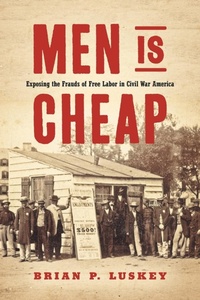
Men Is Cheap
Exposing the Frauds of Free Labor in Civil War America
Published on 1. February 2025
Book
Paperback/Softback
296 pages
978-1-4696-8838-1 (ISBN)
Description
When a Civil War substitute broker told business associates that "Men is cheep here to Day," he exposed an unsettling contradiction at the heart of the Union's war effort. Despite Northerners' devotion to the principles of free labor, the war produced rampant speculation and coercive labor arrangements that many Americans labeled fraudulent. Debates about this contradiction focused on employment agencies called "intelligence offices," institutions of dubious character that nevertheless served the military and domestic necessities of the Union army and Northern households. Northerners condemned labor agents for pocketing fees above and beyond contracts for wages between employers and employees. Yet the transactions these middlemen brokered with vulnerable Irish immigrants, Union soldiers and veterans, former slaves, and Confederate deserters defined the limits of independence in the wage labor economy and clarified who could prosper in it.
Men Is Cheap shows that in the process of winning the war, Northerners were forced to grapple with the frauds of free labor. Labor brokers, by helping to staff the Union military and Yankee households, did indispensable work that helped the Northern state and Northern employers emerge victorious. They also gave rise to an economic and political system that enriched the managerial class at the expense of laborers--a reality that resonates to this day.
Men Is Cheap shows that in the process of winning the war, Northerners were forced to grapple with the frauds of free labor. Labor brokers, by helping to staff the Union military and Yankee households, did indispensable work that helped the Northern state and Northern employers emerge victorious. They also gave rise to an economic and political system that enriched the managerial class at the expense of laborers--a reality that resonates to this day.
Reviews / Votes
Luskey offers a genuinely original take on the Civil War era, a combination of cultural, economic, social, and labor history. . . . The cast of characters is wide, including speculators, soldiers, enslaved and emancipated black people, and headstrong Irish domestic servants. Brokers, Luskey concludes, helped the Union achieve victory in war, but as agents of capitalism, they profited at the expense of those who did the actual work and fighting, a story that seems familiar enough in our own time." - North Carolina Historical Review"The research is very thorough, the analysis of particular items and incidents is perceptive, and the whole book repays close attention and gives us a new vision about how capitalism and its frauds shaped the Civil War."-The American Historical Review
"A deeply researched and strongly argued study about the frauds underlying the ethos of free labor . . . and should be read by those interested in labor, political economy, and the Civil War era."-Pennsylvania History: A Journal of Mid-Atlantic Studies
"A necessary caveat to the celebration of the Civil War as the victory for freedom."-Labor The depth and quality of Luskey's archival research, as well as his sharp rendering of the complexities of the Northern free-labor vision, make this book a valuable addition to the labor and cultural history of the Civil War."-The Journal of American History
More details
Series
Language
English
Place of publication
Chapel Hill
United States
Target group
Professional and scholarly
Product notice
Paperback (trade)
Illustrations
20 halftones
Dimensions
Height: 234 mm
Width: 156 mm
Thickness: 18 mm
Weight
507 gr
ISBN-13
978-1-4696-8838-1 (9781469688381)
Copyright in bibliographic data and cover images is held by Nielsen Book Services Limited or by the publishers or by their respective licensors: all rights reserved.
Schweitzer Classification
Person
Brian P. Luskey is associate professor of history at West Virginia University and author of On the Make: Clerks and the Quest for Capital in Nineteenth-Century America.