

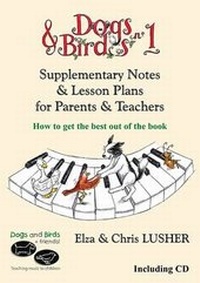
Dogs and Birds Bk. 1: Supplementary Notes and Lesson Plans for Parents and Teachers
How to Get the Best Out of the Book
Published on 1. March 2007
Book
Paperback/Softback
45 pages
978-0-9568497-4-8 (ISBN)
Description
This book is a guide to teaching children the material in Dogs and Birds on the Keyboard Book 1. The Dogs and Birds approach, allows very young children to learn the piano, even before they know the alphabet. The music is suitable for children between the ages of 3 and 7. The method uses animal symbols to represent the musical notes, for example Cat is C and Dog is D. The animal names are monosyllabic and children are encouraged to sing the names as they play the tunes on the piano or keyboard. These supplementary notes to Book 1 describe all the additional musical games and exercises which form part of the Dogs and Birds method. This book is useful for both parent and teachers, and by using it parents can teach their children the material in book 1. It gives a set of lesson plans which take students through book 1, supplementing the material at all stages with additional musical games. The extra elements of the method include rhythm exercises, sung finger exercises, sight-singing, sight-reading, singing and listening games using a set of wooden animals and a large set of staves, improvisation, composition and telling stories about the illustrations.
These supplementary notes also contain helpful tips for teaching very young children (4 years old and under). It explains all the musical notation necessary for working through book 1, thereby enabling parents without any prior musical knowledge to teach their children the material in book 1. Working through this material can provide a good parent child bonding opportunity, and this provides the child a firm musical foundation for the study of any instrument, including the piano. A CD of all the musical pieces and rhythm exercises in Book 1 is included with these supplementary notes.
These supplementary notes also contain helpful tips for teaching very young children (4 years old and under). It explains all the musical notation necessary for working through book 1, thereby enabling parents without any prior musical knowledge to teach their children the material in book 1. Working through this material can provide a good parent child bonding opportunity, and this provides the child a firm musical foundation for the study of any instrument, including the piano. A CD of all the musical pieces and rhythm exercises in Book 1 is included with these supplementary notes.
Reviews / Votes
"I find Elza Lusher's invention extraordinary - unique in the world. I am proud that I can support such a creation." (Prof. Cecilia Vajda - Student of Kodaly and Director of the Kodaly Institute of Britain). "It is a real treat to discover a new and imaginative approach to teaching the piano which really works and is completely accessible and user-friendly." (Faye Caley, Music Teacher magazine). "This fascinating set of materials from Elza and Chris Lusher is based on the principles of Kodaly teaching, enabling very young children to start their musical education before they can read notated music or understand the alphabet." (Maggie Williams, International Piano magazine). "A great pedagogical idea... definitely an important contribution in an area not over-endowed with good things." (John York, Piano magazine).More details
Language
English
Place of publication
Egham
United Kingdom
Target group
Primary & secondary/elementary & high school
Dimensions
Height: 210 mm
Width: 148 mm
ISBN-13
978-0-9568497-4-8 (9780956849748)
Copyright in bibliographic data and cover images is held by Nielsen Book Services Limited or by the publishers or by their respective licensors: all rights reserved.
Schweitzer Classification
Persons
Elza Lusher was born in Hungary and obtained a degree in Piano Teaching from the Liszt Academy. She taught piano for five years in Hungary before moving to England in 1991. Elza has always incorporated Kodaly principles into her piano teaching, in particular the use of singing and listening to develop musicality. As piano tutor on the Kodaly Institute of Britain's Teachers' Course run by Prof. Cecilia Vajda she helped many piano teachers to use this approach. She developed the Dogs and Birds method, together with her husband Chris, a senior lecturer in physics at Royal Holloway University of London. The Dogs and Birds approach enables very young children (ages 3 to 7) to learn to play the piano, and includes a strong emphasis on singing.
Content
The Basic Elements of the Dogs and Birds Approach; The Components used in the Seventeen Steps; The Seventeen Steps; Some Helpful Tips to Make Things EASIER, IN Particular for the Very Young Child; Important Notes for Parents; Additional Explanatory Notes for Teachers; CD Tracks and Credits.