

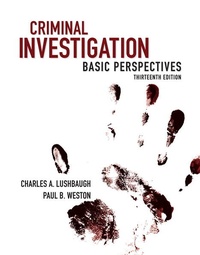
Criminal Investigation: Basic Perspectives
Description
A Guide to Effective Criminal Investigations
Drawing upon the author's 50 plus years of experience, Criminal Investigation gives students a comprehensive introduction to the investigative process. From preliminaries to case preparation for prosecutorial review, this text focuses on the fundamentals of inquiry and each element of investigation.
Concise and well-organized, Criminal Investigation exposes students to the most recent investigative techniques and features real-life case studies to help them develop their ability to analyze, evaluate, and reason. Through the emphasis of ethical awareness students gain an understanding of the need for honesty and fidelity in effective criminal investigations.
The Thirteenth Edition includes numerous pedagogical aids to assist the learning process as well as new chapter segments on cell phones, social networking, and video cameras as investigative leads, cold case investigations, home invasion and drug house robberies, organized retail theft and cargo theft, financial investigative responses to organized crime and updates on terrorist activities.
More details
Other editions
Previous edition
Persons
Charles Lushbaugh
after having earned his bachelor's degree in Criminal Justice and a master's degree in Public Administration was hired as a Postal Inspector. After a few years he left this position and was hired by the U.S. Marshal's Service in Sacramento, California. Eventually he became a deputy with the Sacramento Sheriff's Department. He served in the corrections and patrol divisions prior to being promoted and placed in charge of the departments training academy. He attended the FBI National Academy and retired at the rank of Lieutenant after 26 years of service. He taught at the California State University at Sacramento in the division of Criminal Justice. During his tenure as a lecturer he taught a variety of courses including Basic and Advance Criminal Investigation, Interviewing and the Detection of Deception and Drug Abuse and Criminal Behavior.
Paul Weston
, the original author of this text, was born in New York City. He joined the police force there at a young age and rapidly rose through the ranks and retired at the rank of Chief Deputy. He moved west to become a professor at the California State University at Sacramento. He served in this capacity until he took leave to become the Chief of the California State Police. When he returned to teaching he became to Chair of the division of Criminal Justice. He authored a number of books on Criminal Justice topics such as
Arson Investigation, Police Personnel Management, Police Organization and Management
, and
Criminal Investigation.
Content
PART 1: THE INITIAL INVESTIGATION
1. Evolution of Policing and Investigation
2. Rules of Evidence and Arrest
3. The Crime Scene
4. Physical Evidence
5. Laboratory and Technical Services
6. Basic Investigative Leads and Informants
7. Interviewing and Interrogation
PART 2: INVESTIGATING MAJOR CRIMES
8. Crimes of Violence
9. Sexual Assaults
10. Missing and Exploited Persons
11. Robbery
12. Arson, Bombing, and Hate Crimes
13. Property Crimes
14. CyberCrime
15. Dangerous Drugs
16. Special Investigations
17. Terrorism
18. The Investigator as a Witness and Ethical Awareness
Appendices
A. Case Briefs
B. Federal Controlled Substances Law
C. Identity Theft: What to Do If It Happens to You
D. Answers to Chapter Review Questions
Glossary