

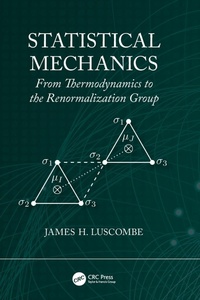
Statistical Mechanics
From Thermodynamics to the Renormalization Group
1st Edition
Published on 29. December 2020
Book
Hardback
386 pages
978-0-367-68927-8 (ISBN)
Description
This textbook provides a comprehensive, yet accessible, introduction to statistical mechanics. Crafted and class-tested over many years of teaching, it carefully guides advanced undergraduate and graduate students who are encountering statistical mechanics for the first time through this - sometimes - intimidating subject. The book provides a strong foundation in thermodynamics and the ensemble formalism of statistical mechanics. An introductory chapter on probability theory is included. Applications include degenerate Fermi systems, Bose-Einstein condensation, cavity radiation, phase transitions, and critical phenomena. The book concludes with a treatment of scaling theories and the renormalization group.
In addition, it provides clear descriptions of how to understand the foundational mathematics and physics involved and includes exciting case studies of modern applications of the subject in physics and wider interdisciplinary areas.
Key Features:
Presents the subject in a clear and entertaining style which enables the author to take a sophisticated approach whilst remaining accessible
Contains contents that have been carefully reviewed with a substantial panel to ensure that coverage is appropriate for a wide range of courses, worldwide
Accompanied by volumes on thermodynamics and non-equilibrium statistical mechanics, which can be used in conjunction with this book, on courses which cover both thermodynamics and statistical mechanics
In addition, it provides clear descriptions of how to understand the foundational mathematics and physics involved and includes exciting case studies of modern applications of the subject in physics and wider interdisciplinary areas.
Key Features:
Presents the subject in a clear and entertaining style which enables the author to take a sophisticated approach whilst remaining accessible
Contains contents that have been carefully reviewed with a substantial panel to ensure that coverage is appropriate for a wide range of courses, worldwide
Accompanied by volumes on thermodynamics and non-equilibrium statistical mechanics, which can be used in conjunction with this book, on courses which cover both thermodynamics and statistical mechanics
More details
Language
English
Place of publication
London
United Kingdom
Publishing group
Taylor & Francis Ltd
Target group
College/higher education
Illustrations
104 s/w Zeichnungen, 19 s/w Tabellen
19 Tables, black and white; 104 Line drawings, black and white
Dimensions
Height: 260 mm
Width: 183 mm
Thickness: 26 mm
Weight
945 gr
ISBN-13
978-0-367-68927-8 (9780367689278)
Copyright in bibliographic data and cover images is held by Nielsen Book Services Limited or by the publishers or by their respective licensors: all rights reserved.
Schweitzer Classification
Other editions
Additional editions
E-Book
01/2021
1st Edition
CRC Press
€97.99
Available for download
E-Book
01/2021
1st Edition
CRC Press
€97.99
Available for download
Book
12/2020
1st Edition
CRC Press
€104.10
Shipment within 10-20 days
Person
James H. Luscombe received the PhD in Physics from the University of Chicago in 1983. After post-doctoral positions at the University of Toronto and Iowa State University, he joined the Research Laboratory of Texas Instruments, where he worked on the development of nanoelectronic devices. In 1994, he joined the Naval Postgraduate School in Monterey, CA, where he is Professor of Physics. He was Chair of the Department of Physics from 2003 - 2009. He teaches a wide variety of topics, including generalrelativity, statistical mechanics, mathematical methods, and quantum computation. He has published more than 60 research articles, and has given more than 100 conference presentations; he holds 2 patents.
Content
Part One. Structure of Statistics. 1. Thermodynamics. 2. From Mechanics to Statistical Mechanics. 3. Probability Theory. 4. Ensemble Theory. Part Two. Applications of Equilibrium Statistical Mechanics. 5. Ideal Systems. 6. Interacting Systems. 7. Phase Transitions and Critical Phenomena. 8. Scaling Theories and the Renormalization Group