

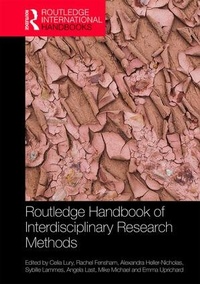
Routledge Handbook of Interdisciplinary Research Methods
1st Edition
Published on 2. July 2018
Book
Hardback
366 pages
978-1-138-88687-2 (ISBN)
Description
The landscape of contemporary research is characterized by growing interdisciplinarity, and disciplinary boundaries are blurring faster than ever. Yet while interdisciplinary methods, and methodological innovation in general, are often presented as the 'holy grail' of research, there are few examples or discussions of their development and 'behaviour' in the field.
This Routledge Handbook of Interdisciplinary Research presents a bold intervention by showcasing a diversity of stimulating approaches. Over 50 experienced researchers illustrate the challenges, but also the rewards of doing and representing interdisciplinary research through their own methodological developments. Featured projects cover a variety of scales and topics, from small art-science collaborations to the 'big data' of mass observations.
Each section is dedicated to an aspect of data handling, from collection, classification, validation to communication to research audiences. Most importantly, Interdisciplinary Methods presents a distinctive approach through its focus on knowledge as process, defamiliarising and reworking familiar practices such as experimenting, archiving, observing, prototyping or translating.
This Routledge Handbook of Interdisciplinary Research presents a bold intervention by showcasing a diversity of stimulating approaches. Over 50 experienced researchers illustrate the challenges, but also the rewards of doing and representing interdisciplinary research through their own methodological developments. Featured projects cover a variety of scales and topics, from small art-science collaborations to the 'big data' of mass observations.
Each section is dedicated to an aspect of data handling, from collection, classification, validation to communication to research audiences. Most importantly, Interdisciplinary Methods presents a distinctive approach through its focus on knowledge as process, defamiliarising and reworking familiar practices such as experimenting, archiving, observing, prototyping or translating.
More details
Series
Language
English
Place of publication
London
United Kingdom
Publishing group
Taylor & Francis Ltd
Target group
College/higher education
Professional and scholarly
Academic and Postgraduate
Illustrations
49 s/w Abbildungen, 36 s/w Photographien bzw. Rasterbilder, 13 s/w Zeichnungen
13 Line drawings, black and white; 36 Halftones, black and white; 49 Illustrations, black and white
Dimensions
Height: 246 mm
Width: 174 mm
Weight
846 gr
ISBN-13
978-1-138-88687-2 (9781138886872)
Copyright in bibliographic data and cover images is held by Nielsen Book Services Limited or by the publishers or by their respective licensors: all rights reserved.
Schweitzer Classification
Other editions
Additional editions
Celia Lury | Rachel Fensham | Alexandra Heller-Nicholas
Routledge Handbook of Interdisciplinary Research Methods
Book
09/2020
1st Edition
Routledge
€74.80
Shipment within 15-20 days
Celia Lury | Rachel Fensham | Alexandra Heller-Nicholas
Routledge Handbook of Interdisciplinary Research Methods
E-Book
07/2018
1st Edition
Routledge
€66.99
Available for download
Celia Lury | Rachel Fensham | Alexandra Heller-Nicholas
Routledge Handbook of Interdisciplinary Research Methods
E-Book
07/2018
1st Edition
Routledge
€67.49
Available for download
Persons
Celia Lury is Professor and Director of the Centre for Interdisciplinary Methodologies at the University of Warwick.
Rachel Fensham is Professor of Dance and Theatre Studies and Assistant Dean of the Digital Studio, Faculty of Arts, University of Melbourne.
Alexandra Heller-Nicholas is a writer on contemporary cinema and a Research Associate at the Victorian College of the Arts, University of Melbourne.
Sybille Lammes is Professor of New Media and Digital Culture at the University of Leiden.
Angela Last is Lecturer in Environmental Humanities at the University of Leicester.
Mike Michael is Professor of Sociology in the Department of Sociology, Philosophy and Anthropology at the University of Exeter.
Emma Uprichard is Reader at the Centre for Interdisciplinary Methodologies at the University of Warwick.
Rachel Fensham is Professor of Dance and Theatre Studies and Assistant Dean of the Digital Studio, Faculty of Arts, University of Melbourne.
Alexandra Heller-Nicholas is a writer on contemporary cinema and a Research Associate at the Victorian College of the Arts, University of Melbourne.
Sybille Lammes is Professor of New Media and Digital Culture at the University of Leiden.
Angela Last is Lecturer in Environmental Humanities at the University of Leicester.
Mike Michael is Professor of Sociology in the Department of Sociology, Philosophy and Anthropology at the University of Exeter.
Emma Uprichard is Reader at the Centre for Interdisciplinary Methodologies at the University of Warwick.
Content
General introduction, Section 1: Making and Assembling 1. Making and Assembling: Towards a Conjectural Paradigm for Interdisciplinary Research, 2. Arranging, 3. Drawing, 4. Experimenting, 5. Figuring, 6. Imaging, 7. Rescaling, 8. Sand-drawing, 9. Suspending, Section 2: Capturing and Composing, 1. Capturing and Composing: Doing the Epistemic and the Ontic Together, 2. Abducting, 3. Archiving, 4. iBorder/ing, 5. Casing, 6. Diffracting, 7. Figurationing, 8. Notating, 9. Prototyping, 10. Retrieving, 11. Timing, 12. Visualising Data: A View from Design Space Section 3: Engaging and Distributing 1. Engaging and Distributing, 2. Affective analysis, 3. Data-Sprinting: A Public Approach to Digital Research, 4. Digging, 5. Issuecrawling: Building Lists of URLs and Mapping Website Networks, 6. Moving methods, 7. Playing with Ethics, 8. Sensing atmospheres, Section 4: Of Interdisciplinarity, 1. Of Interdisciplinarity, 2. Diagramming, 3. Conversation Between Angela Last and Nina Lykke, 4. Haunting Seedy Connections, 5. Dirty Methods as Ethical Methods? In the Field with 'The Cultural Politics of Dirt in Africa, 1880-Present' Section 5: Valuing and Validating, 1. Valuing and Validating: On the 'Success' of Interdisciplinary Research, 2. Compromising, 3. Deriving, 4. Disrupting, 5. Dissenting, 6. Exemplifying, 7. Explaining, 8. Generalizing, 9. Interdisciplines, and Indigenous Research and Methodologies, 10. Troubling, 11. Problem-Making, 12. Projecting, 13. Qualifying, 14. Scaling, 15. Speculating, 16. Wedging