

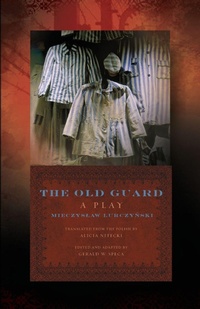
The Old Guard
Published on 1. February 2010
Book
Paperback/Softback
116 pages
978-1-4384-3082-9 (ISBN)
Description
A brutal and unflinchingly honest portrayal of the effects of concentration camp life on the human psyche.
Brutally and unflinchingly honest in its depiction of the effects of concentration camp life on the human psyche, Mieczyslaw Lurczynski's The Old Guard is one of the earliest works of Holocaust literature and one of the few works written by a non-Jew who was also a survivor of the camps. Begun during his imprisonment on fragments and scraps of paper and completed immediately after the war, in 1945, the play is based on Lurczynski's experiences in Buchenwald and its subcamp in Eschenhausen, SS-kommando Hecht. The action takes place in the Block Elder's room at Hecht, where the prisoners who hold privileged positions in the camp-old-timers from Auschwitz, Majdanek, and other camps-play cards, drink moonshine, and steal from one another. The play's hero, based on the pre-war Polish actor Fryderyk Jarosy, who was also interned at Hecht, attempts to uphold the values of Western civilization in this depraved environment, an impossible task that ultimately leads to his death at the hands of the Camp Elder. As Lurczysnki writes in his preface, the play contains no great atrocities: "The focus, rather, is on internal experiences and on depicting pained, sick, desparate, and resigned psyches, on depicting the methods by which people were turned into beasts, and beasts into freaks of nature." Available for the first time in English, The Old Guard is an important and compelling work of Holocaust literature that stands on a par with the work of Tadeusz Borowski and Primo Levi.
Brutally and unflinchingly honest in its depiction of the effects of concentration camp life on the human psyche, Mieczyslaw Lurczynski's The Old Guard is one of the earliest works of Holocaust literature and one of the few works written by a non-Jew who was also a survivor of the camps. Begun during his imprisonment on fragments and scraps of paper and completed immediately after the war, in 1945, the play is based on Lurczynski's experiences in Buchenwald and its subcamp in Eschenhausen, SS-kommando Hecht. The action takes place in the Block Elder's room at Hecht, where the prisoners who hold privileged positions in the camp-old-timers from Auschwitz, Majdanek, and other camps-play cards, drink moonshine, and steal from one another. The play's hero, based on the pre-war Polish actor Fryderyk Jarosy, who was also interned at Hecht, attempts to uphold the values of Western civilization in this depraved environment, an impossible task that ultimately leads to his death at the hands of the Camp Elder. As Lurczysnki writes in his preface, the play contains no great atrocities: "The focus, rather, is on internal experiences and on depicting pained, sick, desparate, and resigned psyches, on depicting the methods by which people were turned into beasts, and beasts into freaks of nature." Available for the first time in English, The Old Guard is an important and compelling work of Holocaust literature that stands on a par with the work of Tadeusz Borowski and Primo Levi.
More details
Series
Language
English
Place of publication
Albany, NY
United States
Publishing group
State University of New York Press
Target group
US School Grade: College Graduate Student and over
Product notice
Paperback (trade)
Dimensions
Height: 213 mm
Width: 140 mm
Thickness: 10 mm
Weight
159 gr
ISBN-13
978-1-4384-3082-9 (9781438430829)
Copyright in bibliographic data and cover images is held by Nielsen Book Services Limited or by the publishers or by their respective licensors: all rights reserved.
Schweitzer Classification
Other editions
Additional editions
Mieczyslaw Lurczynski | Gerald W. Speca
The Old Guard
E-Book
02/2010
1st Edition
State University of New York Press
from
€35.99
Available for download
Persons
Content
JEWISH PRISONER
KOSTEK: Th e storekeeper (supply steward).
JAN: A Kapo (foreman) of one of the work units (Kommandos); an intellectual of extensive, exceptional camp experience.
VORARBEITER KOMINEK: Another foreman.
LAGERSCHUTZ
VAN DER BOSCH
GORECKI
LAGERSCHUTZ 2: JEWISH PRISONER
UKRAINIAN PRISONER
PIPEL: A teenager; works for the kapos; whipping boy of the camp.
OTHER LAGERSCHUTZE
SANIN: A Russian tailor.
MARKOWSKI: A Polish tailor.
TWO OTHER TAILORS
DOCTOR: LEICHENTRAGERS
KAZIK
KOSTEK: Th e storekeeper (supply steward).
JAN: A Kapo (foreman) of one of the work units (Kommandos); an intellectual of extensive, exceptional camp experience.
VORARBEITER KOMINEK: Another foreman.
LAGERSCHUTZ
VAN DER BOSCH
GORECKI
LAGERSCHUTZ 2: JEWISH PRISONER
UKRAINIAN PRISONER
PIPEL: A teenager; works for the kapos; whipping boy of the camp.
OTHER LAGERSCHUTZE
SANIN: A Russian tailor.
MARKOWSKI: A Polish tailor.
TWO OTHER TAILORS
DOCTOR: LEICHENTRAGERS
KAZIK