

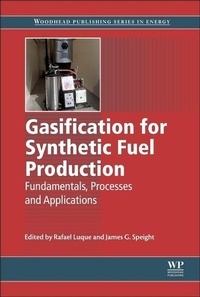
Gasification for Synthetic Fuel Production
Fundamentals, Processes and Applications
Published on 15. October 2014
Book
Hardback
348 pages
978-0-85709-802-3 (ISBN)
Description
Gasification involves the conversion of carbon sources without combustion to syngas, which can be used as a fuel itself or further processed to synthetic fuels. The technology provides a potentially more efficient means of energy generation than direct combustion. This book provides an overview of gasification science and engineering and the production of synthetic fuels by gasification from a variety of feedstocks. Part one introduces gasification, reviewing the scientific basis of the process and gasification engineering. Part two then addresses gasification and synthentic fuel production processes. Finally, chapters in part three outline the different applications of gasification, with chapters on the conversion of different types of feedstock.
More details
Series
Language
English
Place of publication
Cambridge
United Kingdom
Publishing group
Elsevier Science & Technology
Target group
College/higher education
Product notice
sewn/stitched
Cloth over boards
Dimensions
Height: 232 mm
Width: 156 mm
Thickness: 24 mm
Weight
703 gr
ISBN-13
978-0-85709-802-3 (9780857098023)
Copyright in bibliographic data and cover images is held by Nielsen Book Services Limited or by the publishers or by their respective licensors: all rights reserved.
Schweitzer Classification
Other editions
Additional editions
R. Luque | J. Speight
Gasification for Synthetic Fuel Production
Fundamentals, Processes and Applications
Book
10/2018
Woodhead Publishing Ltd
€173.32
The article will not be published
R. Luque | J. Speight
Gasification for Synthetic Fuel Production
Fundamentals, Processes and Applications
E-Book
08/2014
Woodhead Publishing
€175.00
Available for download
Persons
Dr Rafael Luque is a Ramon y Cajal Fellow at the University of Cordoba, Spain. He is noted for his research and publications in the fields of biofuels production and green chemistry. James Speight, Consultant, USA.
Content
List of contributors
Woodhead publishing series in energy
Part One: Fundamentals
1. Gasification and synthetic liquid fuel production: an overview
Abstract
1.1 Introduction
1.2 Gasification processes
1.3 Gasification feedstocks
1.4 Gasification for power generation
1.5 Gasification for synthetic fuel production
1.6 Future trends
2. Types of gasifier for synthetic liquid fuel production: design and technology
Abstract
2.1 Introduction
2.2 Gasifier types
2.3 Products of gasification
2.4 Reactor design: chemical aspects
2.5 Reactor design: physical aspects
2.6 Gasification mechanism
3. Preparation of feedstocks for gasification for synthetic liquid fuel production
Abstract
Acknowledgements
3.1 Introduction
3.2 Feedstock types, properties, and characterization
3.3 Feedstock suitability and utilization challenges
3.4 Preparation techniques for onward processing
3.5 Advantages and limitations of feedstocks for gasification
4. Sustainability assessment of gasification processes for synthetic liquid fuel production: economic, environmental, and policy issues
Abstract
4.1 Introduction
4.2 Environmental and energy issues
4.3 Economic assessment of synthetic liquid and gaseous biofuels
4.4 The role of sustainability assessment in supporting international biofuel policies
4.5 Conclusions
4.6 Future trends
Part Two: Gasification processes for synthetic liquid fuel production
5. Gasification reaction kinetics for synthetic liquid fuel production
Abstract
5.1 Introduction
5.2 General chemistry of gasification
5.3 Process chemistry
5.4 Conclusions
6. Gasification processes for syngas and hydrogen production
Abstract
6.1 Introduction
6.2 Synthesis gas production
6.3 Hydrogen production
6.4 Gasification products: composition and quality
6.5 Advantages and limitations
7. Synthetic liquid fuel production from gasification
Abstract
7.1 Introduction
7.2 Fischer-Tropsch synthesis
7.3 Sabatier-Senderens process
7.4 Thermal, catalytic, and hydrocracking processes
7.5 Product quality
7.6 Conclusions
8. Assessing fuels for gasification: analytical and quality control techniques for coal
Abstract
8.1 Introduction
8.2 Sampling
8.3 Proximate analysis
8.4 Calorific value
8.5 Ultimate analysis
8.6 Physical properties
8.7 Mechanical properties
8.8 Thermal properties
8.9 Real-time analysis for quality control
8.10 Advantages and limitations
Part Three: Applications
9. Coal gasification processes for synthetic liquid fuel production
Abstract
9.1 Introduction
9.2 Coal types and properties
9.3 Gas products
9.4 Products and product quality
9.5 Production of chemicals
9.6 Advantages and limitations
10. Heavy hydrocarbon gasification for synthetic fuel production
Abstract
10.1 Introduction
10.2 Heavy feedstocks
10.3 Synthesis gas production
10.4 Output products
10.5 Conclusion and future trends
11. Biomass gasification for synthetic liquid fuel production
Abstract
Acknowledgements
11.1 Introduction
11.2 Properties of biomass resources
11.3 Biomass gasification
11.4 Biomass gasification properties
11.5 The biomass gasifier
11.6 The formation and cracking of tar
11.7 Char gasification
11.8 Novel technology for biomass gasification
11.9 Mathematical simulation of biomass gasification
11.10 Conclusion and future trends
12. Waste gasification for synthetic liquid fuel production
Abstract
12.1 Introduction
12.2 Waste types
12.3 Feedstock properties and plant safety
12.4 Fuel production
12.5 Process products
12.6 Advantages and limitations
13. Gasification for synthetic liquid fuel production: past, present, and future
Abstract
13.1 Introduction
13.2 Applications and products
13.3 Environmental benefits of gasification-based systems
13.4 A process for now and the future
13.5 Conclusions
Index
Woodhead publishing series in energy
Part One: Fundamentals
1. Gasification and synthetic liquid fuel production: an overview
Abstract
1.1 Introduction
1.2 Gasification processes
1.3 Gasification feedstocks
1.4 Gasification for power generation
1.5 Gasification for synthetic fuel production
1.6 Future trends
2. Types of gasifier for synthetic liquid fuel production: design and technology
Abstract
2.1 Introduction
2.2 Gasifier types
2.3 Products of gasification
2.4 Reactor design: chemical aspects
2.5 Reactor design: physical aspects
2.6 Gasification mechanism
3. Preparation of feedstocks for gasification for synthetic liquid fuel production
Abstract
Acknowledgements
3.1 Introduction
3.2 Feedstock types, properties, and characterization
3.3 Feedstock suitability and utilization challenges
3.4 Preparation techniques for onward processing
3.5 Advantages and limitations of feedstocks for gasification
4. Sustainability assessment of gasification processes for synthetic liquid fuel production: economic, environmental, and policy issues
Abstract
4.1 Introduction
4.2 Environmental and energy issues
4.3 Economic assessment of synthetic liquid and gaseous biofuels
4.4 The role of sustainability assessment in supporting international biofuel policies
4.5 Conclusions
4.6 Future trends
Part Two: Gasification processes for synthetic liquid fuel production
5. Gasification reaction kinetics for synthetic liquid fuel production
Abstract
5.1 Introduction
5.2 General chemistry of gasification
5.3 Process chemistry
5.4 Conclusions
6. Gasification processes for syngas and hydrogen production
Abstract
6.1 Introduction
6.2 Synthesis gas production
6.3 Hydrogen production
6.4 Gasification products: composition and quality
6.5 Advantages and limitations
7. Synthetic liquid fuel production from gasification
Abstract
7.1 Introduction
7.2 Fischer-Tropsch synthesis
7.3 Sabatier-Senderens process
7.4 Thermal, catalytic, and hydrocracking processes
7.5 Product quality
7.6 Conclusions
8. Assessing fuels for gasification: analytical and quality control techniques for coal
Abstract
8.1 Introduction
8.2 Sampling
8.3 Proximate analysis
8.4 Calorific value
8.5 Ultimate analysis
8.6 Physical properties
8.7 Mechanical properties
8.8 Thermal properties
8.9 Real-time analysis for quality control
8.10 Advantages and limitations
Part Three: Applications
9. Coal gasification processes for synthetic liquid fuel production
Abstract
9.1 Introduction
9.2 Coal types and properties
9.3 Gas products
9.4 Products and product quality
9.5 Production of chemicals
9.6 Advantages and limitations
10. Heavy hydrocarbon gasification for synthetic fuel production
Abstract
10.1 Introduction
10.2 Heavy feedstocks
10.3 Synthesis gas production
10.4 Output products
10.5 Conclusion and future trends
11. Biomass gasification for synthetic liquid fuel production
Abstract
Acknowledgements
11.1 Introduction
11.2 Properties of biomass resources
11.3 Biomass gasification
11.4 Biomass gasification properties
11.5 The biomass gasifier
11.6 The formation and cracking of tar
11.7 Char gasification
11.8 Novel technology for biomass gasification
11.9 Mathematical simulation of biomass gasification
11.10 Conclusion and future trends
12. Waste gasification for synthetic liquid fuel production
Abstract
12.1 Introduction
12.2 Waste types
12.3 Feedstock properties and plant safety
12.4 Fuel production
12.5 Process products
12.6 Advantages and limitations
13. Gasification for synthetic liquid fuel production: past, present, and future
Abstract
13.1 Introduction
13.2 Applications and products
13.3 Environmental benefits of gasification-based systems
13.4 A process for now and the future
13.5 Conclusions
Index