

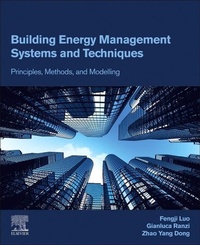
Building Energy Management Systems and Techniques
Principles, Methods, and Modelling
Published on 22. February 2024
Book
Paperback/Softback
332 pages
978-0-323-96107-3 (ISBN)
Description
Building Energy Management Systems and Techniques: Principles, Methods, and Modelling presents basic concepts, methodologies, modeling techniques, and fundamental design schemes of building energy management systems. Covering the latest developments and methodologies from academia and industry, the book brings together energy management, demand response, evolutionary computation, and fundamental programming.
The authors explore the basic concepts related to building energy management systems and put them into the context of smart grids, demand response and demand-side management, internet of things, and distributed renewable energy. Advanced topics provide the reader with an understanding of various energy management scenarios and procedures for modern buildings in an automatic and highly renewable-penetrated building environment. This includes a range of energy management techniques for building-side energy resources such as battery energy storage systems, plug-in appliances, and HVAC systems. The fundamental principles of evolutionary computation are covered and applied to building energy management problems. The authors also introduce the paradigm of occupant-to-grid integration and its implementation through personalized recommendation technology to guide the occupants' choices on energy-related products and their energy usage behaviors, as well as to enhance the energy efficiency of buildings. The book includes several application examples throughout, illustrating for the reader the key aspects involved in the implementation of building energy management schemes.
Building Energy Management Systems and Techniques is an invaluable resource for undergraduate and postgraduate students enrolled in courses related to energy-efficient building systems and smart grids and researchers working in the fields of smart grids, smart buildings/homes, and energy demand response. The book will be of use to professional electrical, civil, computing, and communications engineers, architects, and building energy consultants.
The authors explore the basic concepts related to building energy management systems and put them into the context of smart grids, demand response and demand-side management, internet of things, and distributed renewable energy. Advanced topics provide the reader with an understanding of various energy management scenarios and procedures for modern buildings in an automatic and highly renewable-penetrated building environment. This includes a range of energy management techniques for building-side energy resources such as battery energy storage systems, plug-in appliances, and HVAC systems. The fundamental principles of evolutionary computation are covered and applied to building energy management problems. The authors also introduce the paradigm of occupant-to-grid integration and its implementation through personalized recommendation technology to guide the occupants' choices on energy-related products and their energy usage behaviors, as well as to enhance the energy efficiency of buildings. The book includes several application examples throughout, illustrating for the reader the key aspects involved in the implementation of building energy management schemes.
Building Energy Management Systems and Techniques is an invaluable resource for undergraduate and postgraduate students enrolled in courses related to energy-efficient building systems and smart grids and researchers working in the fields of smart grids, smart buildings/homes, and energy demand response. The book will be of use to professional electrical, civil, computing, and communications engineers, architects, and building energy consultants.
More details
Language
English
Place of publication
Philadelphia
United States
Target group
Professional and scholarly
Postgraduate and advanced undergraduates enrolled in courses related to energy-efficient building systems and smart grids, and researchers working in the fields of smart grid, smart building/home, and energy demand response. Electrical engineers, civil engineers, building energy consultants, computing and communication engineers.
Product notice
Paperback (trade)
Unsewn / adhesive bound
Dimensions
Height: 233 mm
Width: 188 mm
Thickness: 18 mm
Weight
710 gr
ISBN-13
978-0-323-96107-3 (9780323961073)
Copyright in bibliographic data and cover images is held by Nielsen Book Services Limited or by the publishers or by their respective licensors: all rights reserved.
Schweitzer Classification
Other editions
Additional editions
Fengji Luo | Gianluca Ranzi | Zhao Yang Dong
Building Energy Management Systems and Techniques
Principles, Methods, and Modelling
E-Book
02/2024
Elsevier
€122.00
Available for download
Persons
Fengji Luo is an Academic Fellow and a Lecturer in the School of Civil Engineering at The University of Sydney. His research interests include power demand response and demand side management, building/home energy management, smart grid, and computational intelligence and its applications in smart grids and smart buildings. Gianluca Ranzi is a Professor in the School of Civil Engineering and Director of the Centre for Advanced Structural Engineering at The University of Sydney. His research interests fall in the fields of structural engineering, architectural science, building energy management and power demand side management, and heritage conservation. Zhao Yang Dong is a Professor in the School of Electrical and Electronics Engineering at
Nanyang Technological University, Singapore. His previous roles include Director of UNSW
Digital Grid Futures Institute, Ausgrid Chair Professor and Director of Ausgrid Centre for Intelligent Electricity Networks led R&D support for the Smart Grid, Smart City national demonstration project in Australia. He is a Fellow of IEEE for his contributions in computational methods in power system planning and stability. His research interests include smart grid, power demand response and demand side management, energy market and economics, and power system stability and control.
Nanyang Technological University, Singapore. His previous roles include Director of UNSW
Digital Grid Futures Institute, Ausgrid Chair Professor and Director of Ausgrid Centre for Intelligent Electricity Networks led R&D support for the Smart Grid, Smart City national demonstration project in Australia. He is a Fellow of IEEE for his contributions in computational methods in power system planning and stability. His research interests include smart grid, power demand response and demand side management, energy market and economics, and power system stability and control.
Author
Academic Fellow and Researcher, School of Civil Engineering, The University of Sydney, Australia
Professor and Director, Centre for Advanced Structural Engineering, School of Civil Engineering, The University of Sydney, NSW, Australia
Professor, School of Electrical and Electronics Engineering, Nanyang Technological University, Singapore
Content
1. Introduction to Building Energy Management Systems
2. Emerging Energy Resources in Modern Buildings
3. Information Infrastructures for Modern Buildings
4. Power Demand Response and Demand Side Management
5. Building Energy Management Systems (BEMSs)
6. Optimization and Evolutionary Computation
7. Energy Management of Non-Thermostatically Controlled Appliances
8. Energy Management of Thermostatically Controlled Appliances
9. Energy Sharing Among Buildings10. Building-to-Grid Integration
11. Microgrids
12. No C Occupant-to-Grid Integration
2. Emerging Energy Resources in Modern Buildings
3. Information Infrastructures for Modern Buildings
4. Power Demand Response and Demand Side Management
5. Building Energy Management Systems (BEMSs)
6. Optimization and Evolutionary Computation
7. Energy Management of Non-Thermostatically Controlled Appliances
8. Energy Management of Thermostatically Controlled Appliances
9. Energy Sharing Among Buildings10. Building-to-Grid Integration
11. Microgrids
12. No C Occupant-to-Grid Integration