

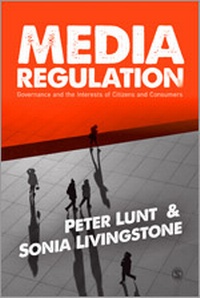
Media Regulation
Governance and the Interests of Citizens and Consumers
1st Edition
Published on 9. December 2011
Book
Hardback
232 pages
978-0-85702-569-2 (ISBN)
Description
"An exemplary study of how media regulation works (and, by implication, how it could work better) set within a wider discussion of democratic theory and political values. It will be of interest not only to students and scholars but to people around the world grappling with the same problem: the need to regulate markets, and the difficulty of doing this well."
- James Curran, Goldsmiths, University of London
In Media Regulation, two leading scholars of the media examine the challenges of regulation in the global mediated sphere. This book explores the way that regulation affects the relations between government, the media and communications market, civil society, citizens and consumers. Drawing on theories of governance and the public sphere, the book critically analyzes issues at the heart of today's media, from the saturation of advertising to burdens on individuals to control their own media literacy.
Peter Lunt and Sonia Livingstone incisively lay bare shifts in governance and the new role of the public sphere which implicate self-regulation, the public interest, the role of civil society and the changing risks and opportunities for citizens and consumers. It is essential reading to understand the forces that are reshaping the media landscape.
- James Curran, Goldsmiths, University of London
In Media Regulation, two leading scholars of the media examine the challenges of regulation in the global mediated sphere. This book explores the way that regulation affects the relations between government, the media and communications market, civil society, citizens and consumers. Drawing on theories of governance and the public sphere, the book critically analyzes issues at the heart of today's media, from the saturation of advertising to burdens on individuals to control their own media literacy.
Peter Lunt and Sonia Livingstone incisively lay bare shifts in governance and the new role of the public sphere which implicate self-regulation, the public interest, the role of civil society and the changing risks and opportunities for citizens and consumers. It is essential reading to understand the forces that are reshaping the media landscape.
Reviews / Votes
An exemplary study of how media regulation works (and, by implication, how it could work better) set within a wider discussion of democratic theory and political values. It will be of interest not only to students and scholars but to people around the world grappling with the same problem: the need to regulate markets, and the difficulty of doing this well. -- James Curran Separately and jointly, Lunt and Livingstone have authored many fine writings, but this is arguably the best of the bunch! What makes this research special - even timeless for regulatory 'theory' - is its positioning amidst a set of well-defined philosophical and political tensions, especially between the interests of consumers and those of citizens. -- Jay G. Blumler In the 1970s, media regulation began to be analyzed as a political development; in the 1980s, as a facet of and contributor to globalization; in the 1990s, as a discourse; and in the first decade of the 20th century, as exemplars and evidence of changes in the nature of the state itself. In this book, Lunt and Livingstone rely upon their deep knowledge of audiences to treat British media regulator Ofcom as an agent within the public sphere, adding to the interdisciplinary toolkit of those involved in policy analysis and providing a model that could usefully be applied to other types and loci of regulatory processes. -- Sandra Braman Media Regulation's strength lies, first of all, in its multifaceted and extremely convincing analysis of Ofcom as a regulatory institution in the UK context. The variety of case studies adds to the richness and balance of the arguments provided. Secondly, the book provides a more general analysis of modern-day media governance per se. It shows a sensitivity to how changing paradigms in media regulation have an effect on how media institutions and regulatory authorities interact to constitute modern-day media as both a consumer good and as a democratic tool in the public sphere. -- Mette Marie Roslyng - Dept. of Communication and Psychology, University of Aalborg, DenmarkMore details
Language
English
Place of publication
London
United Kingdom
Target group
College/higher education
Professional and scholarly
Dimensions
Height: 234 mm
Width: 156 mm
Weight
481 gr
ISBN-13
978-0-85702-569-2 (9780857025692)
Copyright in bibliographic data and cover images is held by Nielsen Book Services Limited or by the publishers or by their respective licensors: all rights reserved.
Schweitzer Classification
Other editions
Additional editions
Peter Lunt | Sonia Livingstone
Media Regulation
Governance and the Interests of Citizens and Consumers
Book
12/2011
1st Edition
SAGE Publications Ltd
€87.60
Shipment within 15-20 days
Persons
Peter Lunt is Professor of Media and Communication at the University of Leicester. His
research interests include audience research, popular television, the public
understanding of media regulation and media and social theory. He is currently
working on a project on media, history and memory and on the changing
understanding of public service broadcasting. He is the author of five books
including Talk on Television (with
Sonia Livingstone, Routledge, 1994) and Stanley
Milgram (Palgrave, 2010) and many academic papers and chapters.
Sonia Livingstone DPhil (Oxon), OBE, FBA, FBPS, FAcSS, FRSA, is a professor in the Department of Media and Communications at the London School of Economics and Political Science. Taking a comparative, critical and contextualised approach, her research examines how changing conditions of mediation reshape everyday practices and possibilities for action. She has published 20 books on media audiences, children and young people's risks and opportunities, media literacy and rights in the digital environment, including "Parenting for a Digital Future: How hopes and fears about technology shape children's lives" (OUP 2020). Since founding the EC-funded 33 country "EU Kids Online" research network, and Global Kids Online (with UNICEF Office of Research-Innocenti), she has advised DCMS, UKCIS, Ofcom, European Commission, European Parliament, UN Committee on the Rights of the Child, OECD, ITU and UNICEF. She chaired LSE's Truth, Trust and Technology Commission and is currently leading the Digital Futures Commission with the 5Rights Foundation. See www.sonialivingstone.net
research interests include audience research, popular television, the public
understanding of media regulation and media and social theory. He is currently
working on a project on media, history and memory and on the changing
understanding of public service broadcasting. He is the author of five books
including Talk on Television (with
Sonia Livingstone, Routledge, 1994) and Stanley
Milgram (Palgrave, 2010) and many academic papers and chapters.
Sonia Livingstone DPhil (Oxon), OBE, FBA, FBPS, FAcSS, FRSA, is a professor in the Department of Media and Communications at the London School of Economics and Political Science. Taking a comparative, critical and contextualised approach, her research examines how changing conditions of mediation reshape everyday practices and possibilities for action. She has published 20 books on media audiences, children and young people's risks and opportunities, media literacy and rights in the digital environment, including "Parenting for a Digital Future: How hopes and fears about technology shape children's lives" (OUP 2020). Since founding the EC-funded 33 country "EU Kids Online" research network, and Global Kids Online (with UNICEF Office of Research-Innocenti), she has advised DCMS, UKCIS, Ofcom, European Commission, European Parliament, UN Committee on the Rights of the Child, OECD, ITU and UNICEF. She chaired LSE's Truth, Trust and Technology Commission and is currently leading the Digital Futures Commission with the 5Rights Foundation. See www.sonialivingstone.net
Content
Media and Communications Regulation and the Public Interest
Introduction
Regulation and the Role of the State
Regulation, Civil Society and the Public Sphere
Market Innovation versus Social Democratic Values
Introducing the Case Studies
Regulation and the Public Interest
From Government to Governance
The Theory of Regulation
Strategies of Regulation
New Labour, Social Democracy and Regulation
The European Context
The UK Context
Regulation and the Public Interest
Ofcom's Core Purposes: A Discursive Struggle
Media Regulation and the Implied Audience
The Communications Act 2003: In Whose Interest?
Ofcom's Remit: Interpreting Its Primary Duties
Actions to Further Citizens' and Consumers' Interests
Citizen Interests in a Wider Perspective
Ofcom as a Regulatory Agency
Ofcom's Remit and Rationale
From Guiding Principles to Working Practices
Core Business: Telecommunications, Spectrum Management and Media Plurality
Ofcom as an Institution in the Public Sphere
The Content Board and (Communications) Consumer Panel
Defining Citizen and Consumer Interests in Practice
Public Views of Regulation
Conclusion
Ofcom's Review of Public Service Television
Introduction
Public Service Broadcasting in the 1980s and 1990s
Ofcom's Remit in Reviewing Public Service Television
Ofcom's First Review of Public Service Television
A Public Service for All
Ofcom's Second Public Service Television Review
Ofcom's Consultation on the Second Review
Conclusion
Media Literacy
A New Lease of Life for an Old Policy
A Puzzling Task for the New Regulator
Definitional Diversity in Europe
Media Literacy as a Neo-Liberal Policy
The Politics of Media Literacy
From Media Literacy to Digital Participation
From Principles to Practice
From Individual Skills to Social Capabilities
Conclusion
Advertising Regulation and Childhood Obesity
Introduction
Regulating Advertising to Children
The Challenges of Evidence-Based Policy
Regulatory Action and Reaction
Regulatory Effectiveness?
Reflections on Evidence-Based Policy
Conclusion
Community Radio
Introduction
The Community Radio Order 2004
Regulating Community Radio
Evaluating Ofcom's Regulation of Community Radio
Conclusion
Conclusions
A Change of Direction
The Power to Make Policy
On the Value of an Independent Regulator
Conclusions
Afterword
Introduction
Regulation and the Role of the State
Regulation, Civil Society and the Public Sphere
Market Innovation versus Social Democratic Values
Introducing the Case Studies
Regulation and the Public Interest
From Government to Governance
The Theory of Regulation
Strategies of Regulation
New Labour, Social Democracy and Regulation
The European Context
The UK Context
Regulation and the Public Interest
Ofcom's Core Purposes: A Discursive Struggle
Media Regulation and the Implied Audience
The Communications Act 2003: In Whose Interest?
Ofcom's Remit: Interpreting Its Primary Duties
Actions to Further Citizens' and Consumers' Interests
Citizen Interests in a Wider Perspective
Ofcom as a Regulatory Agency
Ofcom's Remit and Rationale
From Guiding Principles to Working Practices
Core Business: Telecommunications, Spectrum Management and Media Plurality
Ofcom as an Institution in the Public Sphere
The Content Board and (Communications) Consumer Panel
Defining Citizen and Consumer Interests in Practice
Public Views of Regulation
Conclusion
Ofcom's Review of Public Service Television
Introduction
Public Service Broadcasting in the 1980s and 1990s
Ofcom's Remit in Reviewing Public Service Television
Ofcom's First Review of Public Service Television
A Public Service for All
Ofcom's Second Public Service Television Review
Ofcom's Consultation on the Second Review
Conclusion
Media Literacy
A New Lease of Life for an Old Policy
A Puzzling Task for the New Regulator
Definitional Diversity in Europe
Media Literacy as a Neo-Liberal Policy
The Politics of Media Literacy
From Media Literacy to Digital Participation
From Principles to Practice
From Individual Skills to Social Capabilities
Conclusion
Advertising Regulation and Childhood Obesity
Introduction
Regulating Advertising to Children
The Challenges of Evidence-Based Policy
Regulatory Action and Reaction
Regulatory Effectiveness?
Reflections on Evidence-Based Policy
Conclusion
Community Radio
Introduction
The Community Radio Order 2004
Regulating Community Radio
Evaluating Ofcom's Regulation of Community Radio
Conclusion
Conclusions
A Change of Direction
The Power to Make Policy
On the Value of an Independent Regulator
Conclusions
Afterword