

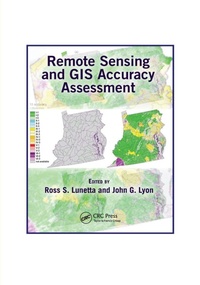
Remote Sensing and GIS Accuracy Assessment
1st Edition
Published on 17. October 2019
Book
Paperback/Softback
328 pages
978-0-367-39407-3 (ISBN)
Description
The development of robust accuracy assessment methods for the validation of spatial data represents a difficult challenge for the geospatial science community. Obstacles to robust assessments include continuous data characteristics and positional errors, demanding ongoing development by GIS and remote sensing experts.
Based upon a special symposium sponsored by the U.S. Environmental Protection Agency (EPA), Remote Sensing and GIS Accuracy Assessment evaluates the important scientific elements related to the performance of accuracy assessments for remotely sensed data, GIS data analysis, and integration products. Scientists from federal, state, and local governments, academia, and nongovernmental organizations present twenty technical chapters that examine sampling issues, reference data collection, edge and boundary effects, error matrix and fuzzy assessments, error budget analysis, and change detection accuracy assessment.
The book includes the keynote presentation by Russell G. Congalton that provides a historical accuracy assessment overview, articulatescurrent technical shortcomings, and identified numerous issues that were debated throughout the symposium. All chapters underwent a peer review and were determined to be valuable to the remote sensing and GIS community. The editors arranged the chapters as a series of complementary scientific topics to provide you with a detailed treatise on spatial data accuracy assessment issues.
Based upon a special symposium sponsored by the U.S. Environmental Protection Agency (EPA), Remote Sensing and GIS Accuracy Assessment evaluates the important scientific elements related to the performance of accuracy assessments for remotely sensed data, GIS data analysis, and integration products. Scientists from federal, state, and local governments, academia, and nongovernmental organizations present twenty technical chapters that examine sampling issues, reference data collection, edge and boundary effects, error matrix and fuzzy assessments, error budget analysis, and change detection accuracy assessment.
The book includes the keynote presentation by Russell G. Congalton that provides a historical accuracy assessment overview, articulatescurrent technical shortcomings, and identified numerous issues that were debated throughout the symposium. All chapters underwent a peer review and were determined to be valuable to the remote sensing and GIS community. The editors arranged the chapters as a series of complementary scientific topics to provide you with a detailed treatise on spatial data accuracy assessment issues.
More details
Language
English
Place of publication
London
United Kingdom
Publishing group
Taylor & Francis Ltd
Target group
College/higher education
Professional and scholarly
Academic and Professional Practice & Development
Dimensions
Height: 254 mm
Width: 178 mm
Thickness: 18 mm
Weight
619 gr
ISBN-13
978-0-367-39407-3 (9780367394073)
Copyright in bibliographic data and cover images is held by Nielsen Book Services Limited or by the publishers or by their respective licensors: all rights reserved.
Schweitzer Classification
Other editions
Additional editions
Ross S. Lunetta | John G. Lyon
Remote Sensing and GIS Accuracy Assessment
E-Book
07/2004
CRC Press
€92.49
Available for download
Ross S. Lunetta | John G. Lyon
Remote Sensing and GIS Accuracy Assessment
Book
07/2004
1st Edition
CRC Press
€349.64
Article not available at the moment
Persons
Ross S. Lunetta, John G. Lyon
Content
Putting the map back in map accuracy assessment. Sampling design for accuracy assessment of large-area, land-cover maps: Challenges and future directions. Validation of global land-cover products by the committee on Earth observing satellites. In situ estimates of forest LAI for MODIS data validation. Light attenuation profiling as an indicator of structural changes in coastal marshes. Participatory reference data collection methods for accuracy assessment of land-cover change maps. Thematic accuracy assessment of regional scale land-cover data. An independent reliability assessment for the Australian agricultural land-cover change project 1990/91-1995. Assessing the accuracy of satellite-derived land-cover classification using historical aerial photography, digital orthophoto quadrangles, and airborne video data. Using classification consistency in interscene overlap areas to model spatial variations in land-cover accuracy over large geographic regions. Geostatistical mapping of thematic classification uncertainty. An error matrix approach to fuzzy accuracy assessment: The NIMA geocover project. Mapping spatial accuracy and estimating landscape indicators from thematic land-cover maps using fuzzy set theory. Fuzzy set and spatial analysis techniques for evaluating thematic accuracy of a land-cover map. The effects of classification accuracy on landscape indices. Assessing uncertainty in spatial landscape metrics derived from remote sensing data. Components of agreement between categorical maps at multiple resolutions. Accuracy assessments of airborne hyperspectral data for mapping opportunistic plant species in freshwater coastal wetlands. A technique for assessing the accuracy of subpixel impervious surface estimates derived from landsat TM imagery. Area and positional accuracy of DMSP nighttime lights data.