

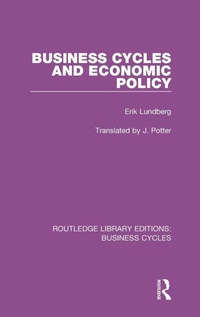
Business Cycles and Economic Policy (RLE: Business Cycles)
Business Cycles)
1st Edition
Published on 23. March 2015
Book
Hardback
366 pages
978-1-138-85330-0 (ISBN)
Description
The book's main purposes are to determine what statistical and other information is needed to formulate both the objects and the means of government economic policy and then to ask what theoretical tools should be used in order to clarify the issues of economic policy. Inflationary gap analysis, national budgeting techniques and the theory of economic fluctuations are examined against the experience of a country in which they have been intelligently applied. The book gives a lively account of Swedish economic thinking and of the economic policy debates in Sweden since 1920, discusses the scope and limitations of national forecasting and budgeting and assesses the relative merits of general and detailed measures of economic policy.
More details
Series
Language
English
Place of publication
London
United Kingdom
Publishing group
Taylor & Francis Ltd
Target group
College/higher education
Professional and scholarly
General, Postgraduate, Professional, and Undergraduate
Dimensions
Height: 240 mm
Width: 161 mm
Thickness: 24 mm
Weight
719 gr
ISBN-13
978-1-138-85330-0 (9781138853300)
Copyright in bibliographic data and cover images is held by Nielsen Book Services Limited or by the publishers or by their respective licensors: all rights reserved.
Schweitzer Classification
Other editions
Additional editions
Book
10/2016
1st Edition
Routledge
€74.46
Shipment within 10-20 days
Persons
Multivolume collection by leading authors in the field. Erik Lundberg, J. Potter.
Content
1. The Swedish Economy Between the Two World Wars 2. The Cyclical Sensitivity of the Swedish Economy: The Experiences of the Inter-War Period 3. Problems of Economic Instability in Sweden Since 1945 4. The Ends and Means of Economic Policy 5. The Economic Policy Debate of the Inter-War Period 6. The Ends and Menas of Swedish Monetary Policy Since 1945 7. Old and New Aspects of Monetary Policy 8. Inflationary Gap Analysis and the Preparation of National Budgets 9. The Possibilities of Fiscal Policy 10. Wages Under Full Employment 11. The Post-War Policy of Regulation 12. Economic Policy and the Functioning of the Price System