

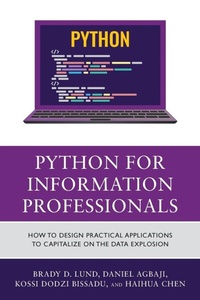
Python for Information Professionals
How to Design Practical Applications to Capitalize on the Data Explosion
Published on 1. November 2023
Book
Paperback/Softback
172 pages
978-1-5381-7825-6 (ISBN)
Description
Python for Information Professionals: How to Design Practical Applications to Capitalize on the Data Explosion is an introduction to the Python programming language for library and information professionals with little or no prior experience. As opposed to the many Python books available today that focus on the language only from a general sense, this book is designed specifically for information professionals who are seeking to advance their career prospects or challenge themselves in new ways by acquiring skills within the rapidly expanding field of data science.
Readers of Python for Information Professionals will learn to:
Develop Python applications for the retrieval, cleaning, and analysis of large datasets. Design applications to support traditional library functions and create new opportunities to maximize library value. Consider data security and privacy relevant to data analysis when using the Python language.
Readers of Python for Information Professionals will learn to:
Develop Python applications for the retrieval, cleaning, and analysis of large datasets. Design applications to support traditional library functions and create new opportunities to maximize library value. Consider data security and privacy relevant to data analysis when using the Python language.
Reviews / Votes
Python for Information Professionals unpacks a topic that both fascinates and terrifies information professionals: computational programming. While the pacing and tone are introductory, the book assumes some familiarity with programming concepts and will likely find a more eager audience among the already-data-savvy versus those trying to re-skill within the profession. [The] authors give Python outsiders a digestible way to familiarize themselves with a programming language and start the learning journey. The book leaves behind the mawkish puns that pervade the genre of programming manuals, and those who finish this work will be rewarded with a desire to keep digging into how Python-and coding in general-can elevate library work and services. Recommended. Graduate students, faculty, and professionals. * Choice Reviews *More details
Language
English
Place of publication
United States
Publishing group
Bloomsbury Publishing Plc
Target group
Professional and scholarly
Illustrations
9 b/w photos; 2 tables
Dimensions
Height: 229 mm
Width: 152 mm
Thickness: 10 mm
Weight
259 gr
ISBN-13
978-1-5381-7825-6 (9781538178256)
Copyright in bibliographic data and cover images is held by Nielsen Book Services Limited or by the publishers or by their respective licensors: all rights reserved.
Schweitzer Classification
Other editions
Additional editions
Brady Lund | Daniel Agbaji | Kossi Dodzi Bissadu
Python for Information Professionals
How to Design Practical Applications to Capitalize on the Data Explosion
E-Book
11/2023
1st Edition
Rowman & Littlefield Publishers
€32.99
Available for download
Brady Lund | Daniel Agbaji | Kossi Dodzi Bissadu
Python for Information Professionals
How to Design Practical Applications to Capitalize on the Data Explosion
E-Book
11/2023
1st Edition
Rowman & Littlefield Publishers
€32.99
Available for download
Persons
Brady Lund, Ph.D., is an assistant professor of information science at the University of North Texas. He has published four books related to technology in libraries and educational institutions - including Casting Light on the Dark Web and Creating Accessible Online Instruction Using Universal Design Principles, both for Rowman and Littlefield Publishing - and nearly 100 articles, editorials, and opinion papers. His work often combines data analytics principles with library and information science research topics.
Daniel Agbaji is a Ph.D. student in information science at the University of North Texas, with a major in Data Science-Artificial Intelligence and Machine Learning. As an experienced researcher and software developer, he has written scholarly publications and book chapters with notable publishers. Daniel has published articles in the information science and library field. As a software developer, Daniel has written thousands of lines of code for fortune 500 companies which are not publicly available due to company policies.
Kossi Dodzi Bissadu is a Ph.D. student in the computer science at the University of North Texas. He currently works as a software engineer at Zenner USA where he leads various products, software, applications, and systems development projects. He is also a US Air Force veteran, very talented and dedicated professional who has more than ten-year professional record achievements, and demonstrated success leading, managing, and working in Technology and Sciences. Kossi has several industry certifications including certified blockchain developer, AWS certified cloud practitioner, and CompTIA Security+.
Haihua Chen, Ph.D., is an assistant professor of information science at the University of North Texas. He has more than ten years of experience in Python and five years of experience in teaching technical courses for information science and data science students using Python. Dr. Chen has published nearly 40 articles on natural language processing, machine learning, data quality, information retrieval, digital libraries, and applied data science. He is the editor of The Electronic Library and the leading guest editor of Frontiers in Big Data and Information Discovery & Delivery special issues. He is also serving as the reviewer/ PC member for more than 20 peer-review journals/ conferences in information science and computer science.
Daniel Agbaji is a Ph.D. student in information science at the University of North Texas, with a major in Data Science-Artificial Intelligence and Machine Learning. As an experienced researcher and software developer, he has written scholarly publications and book chapters with notable publishers. Daniel has published articles in the information science and library field. As a software developer, Daniel has written thousands of lines of code for fortune 500 companies which are not publicly available due to company policies.
Kossi Dodzi Bissadu is a Ph.D. student in the computer science at the University of North Texas. He currently works as a software engineer at Zenner USA where he leads various products, software, applications, and systems development projects. He is also a US Air Force veteran, very talented and dedicated professional who has more than ten-year professional record achievements, and demonstrated success leading, managing, and working in Technology and Sciences. Kossi has several industry certifications including certified blockchain developer, AWS certified cloud practitioner, and CompTIA Security+.
Haihua Chen, Ph.D., is an assistant professor of information science at the University of North Texas. He has more than ten years of experience in Python and five years of experience in teaching technical courses for information science and data science students using Python. Dr. Chen has published nearly 40 articles on natural language processing, machine learning, data quality, information retrieval, digital libraries, and applied data science. He is the editor of The Electronic Library and the leading guest editor of Frontiers in Big Data and Information Discovery & Delivery special issues. He is also serving as the reviewer/ PC member for more than 20 peer-review journals/ conferences in information science and computer science.
Content
Preface
Part I: Python: The Basics
Chapter 1 - The Python WorkspaceChapter 2 - Object Oriented ProgrammingChapter 3 - Data Types, Structures, Sets and AlgorithmsChapter 4 - Functions: Code that Puts Our Data to WorkChapter 5 - Importing, Creating, and Maintaining Data FilesChapter 6 - Testing and TroubleshootingPart II: Further Applications of Python in Information Organizations
Chapter 7 - Library Management and Usage DataChapter 8 - Library Research Data ManagementChapter 9 - Text AnalysisChapter 10 - Library and Information Science ResearchChapter 11 - Artificial Intelligence ApplicationsPart III: Practical and Ethical Considerations for Using Python
Chapter 12 - Data Explosion, Big Data, and Data LiteracyChapter 13 - Data EthicsChapter 14 - Knowledge and Data EconomyChapter 15 - Further Resources for Advancing Your Python Mastery Glossary
Index
About the Author
Part I: Python: The Basics
Chapter 1 - The Python WorkspaceChapter 2 - Object Oriented ProgrammingChapter 3 - Data Types, Structures, Sets and AlgorithmsChapter 4 - Functions: Code that Puts Our Data to WorkChapter 5 - Importing, Creating, and Maintaining Data FilesChapter 6 - Testing and TroubleshootingPart II: Further Applications of Python in Information Organizations
Chapter 7 - Library Management and Usage DataChapter 8 - Library Research Data ManagementChapter 9 - Text AnalysisChapter 10 - Library and Information Science ResearchChapter 11 - Artificial Intelligence ApplicationsPart III: Practical and Ethical Considerations for Using Python
Chapter 12 - Data Explosion, Big Data, and Data LiteracyChapter 13 - Data EthicsChapter 14 - Knowledge and Data EconomyChapter 15 - Further Resources for Advancing Your Python Mastery Glossary
Index
About the Author