

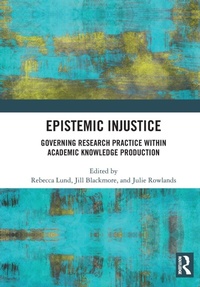
Epistemic Injustice
Governing Research Practice Within Academic Knowledge Production
1st Edition
Published on 21. May 2026
Book
Paperback/Softback
126 pages
978-1-032-88083-9 (ISBN)
Description
This book illustrates how feminist knowledge and postcolonial knowledge are marginalized in universities due to policies, organizational structures, and knowledge hierarchies that privilege metrics as measures of success and narrow views of science and research.
The changing relationship between the state and knowledge production is a critical issue for universities and governments when disinformation is creating a crisis in expertise and trust in democratic institutions. Yet academic autonomy is being undermined by processes of corporatization of the university: managerialism, marketisation, technologization and privatization. Epistemic injustice occurs when particular knowledges are privileged due to policy priorities, metrics and organizational practices as these are underpinned by unequal power relations that inform who does what research and with whom. In turn, injustice occurs when knowledge is evaluated primarily on the basis of its usefulness. The chapters in this book illustrate the epistemic implications of changing institutional and organizational conditions produced by narrow conceptions of 'knowledge' and 'good science' and relations between them. It explores these arrangements at the level of colonial and geopolitical relations, and their effects in terms of institutional processes, practices, and agency. The text shows how a lack of epistemic diversity reinforces structural and cultural racial and gender injustices arising from colonialism, patriarchy, and dominant views of science.
This volume will appeal to policy makers and researchers in higher education reform and scholars interested in changing academic practices from feminist and postcolonial perspectives. It was originally published as a special issue of Critical Studies in Education.
The changing relationship between the state and knowledge production is a critical issue for universities and governments when disinformation is creating a crisis in expertise and trust in democratic institutions. Yet academic autonomy is being undermined by processes of corporatization of the university: managerialism, marketisation, technologization and privatization. Epistemic injustice occurs when particular knowledges are privileged due to policy priorities, metrics and organizational practices as these are underpinned by unequal power relations that inform who does what research and with whom. In turn, injustice occurs when knowledge is evaluated primarily on the basis of its usefulness. The chapters in this book illustrate the epistemic implications of changing institutional and organizational conditions produced by narrow conceptions of 'knowledge' and 'good science' and relations between them. It explores these arrangements at the level of colonial and geopolitical relations, and their effects in terms of institutional processes, practices, and agency. The text shows how a lack of epistemic diversity reinforces structural and cultural racial and gender injustices arising from colonialism, patriarchy, and dominant views of science.
This volume will appeal to policy makers and researchers in higher education reform and scholars interested in changing academic practices from feminist and postcolonial perspectives. It was originally published as a special issue of Critical Studies in Education.
More details
Language
English
Place of publication
London
United Kingdom
Publishing group
Taylor & Francis Ltd
Target group
College/higher education
Postgraduate, Undergraduate Advanced, and Undergraduate Core
Dimensions
Height: 246 mm
Width: 174 mm
Weight
250 gr
ISBN-13
978-1-032-88083-9 (9781032880839)
Copyright in bibliographic data and cover images is held by Nielsen Book Services Limited or by the publishers or by their respective licensors: all rights reserved.
Schweitzer Classification
Other editions
Additional editions
Rebecca Lund | Jill Blackmore | Julie Rowlands
Epistemic Injustice
Governing Research Practice Within Academic Knowledge Production
Book
11/2024
1st Edition
Routledge
€196.70
Shipment within 10-20 days
Rebecca Lund | Jill Blackmore | Julie Rowlands
Epistemic Injustice
Governing Research Practice Within Academic Knowledge Production
E-Book
11/2024
1st Edition
Routledge
€73.99
Available for download
Rebecca Lund | Jill Blackmore | Julie Rowlands
Epistemic Injustice
Governing Research Practice Within Academic Knowledge Production
E-Book
11/2024
1st Edition
Routledge
€73.99
Available for download
Persons
Rebecca Lund, PhD, is Associate Professor of Gender Studies, Centre for Gender Research, University of Oslo. Her research draws on and develops feminist epistemology, critical social theory and methodology to explore how social relations of academic work are shaped by higher education policy, governance and organizational change. She has published in journals such as Gender, Work and Organization, Gender and Education, Discourse: Studies in the Cultural Politics of Education and Organization: The Critical Journal of Organization, Theory and Society.
Jill Blackmore, AM PhD FASSA, is Deakin Distinguished Professor in Education at the Faculty of Arts and Education, Deakin University, Geelong, Australia. She undertakes research from a feminist perspective of education policy and governance; international and intercultural education; leadership and organisational change; and teachers' and academics' work, health and well-being. Relevant publications include Disrupting Leadership in the Entrepreneurial University: Disengagement and Diversity (2023).
Julie Rowlands, PhD was Associate Professor in the School of Education at the Faculty of Arts and Education, and former head of governance, both at Deakin University, Gellong Australia. Her research focused on university governance through the critical perspectives of feminist theory, policy sociology, and Bourdieu in particular. She published widely on the changing nature of university governance in Australia, the UK and USA and its effects on academic practices. Julie was associate editor of Critical Studies in Education from 2015 to 2021.
Jill Blackmore, AM PhD FASSA, is Deakin Distinguished Professor in Education at the Faculty of Arts and Education, Deakin University, Geelong, Australia. She undertakes research from a feminist perspective of education policy and governance; international and intercultural education; leadership and organisational change; and teachers' and academics' work, health and well-being. Relevant publications include Disrupting Leadership in the Entrepreneurial University: Disengagement and Diversity (2023).
Julie Rowlands, PhD was Associate Professor in the School of Education at the Faculty of Arts and Education, and former head of governance, both at Deakin University, Gellong Australia. Her research focused on university governance through the critical perspectives of feminist theory, policy sociology, and Bourdieu in particular. She published widely on the changing nature of university governance in Australia, the UK and USA and its effects on academic practices. Julie was associate editor of Critical Studies in Education from 2015 to 2021.
Content
Epistemic governance of diverse research practices and knowledge production: an introduction 1. Academic citizenship, collegiality and good university governance: a dedication to Associate Professor Julie Rowlands (1964-2021) 2. Epistemic governance and the colonial epistemic structure: towards epistemic humility and transformed South-North relations 3. The role of bibliometric research assessment in a global order of epistemic injustice: a case study of humanities research in Denmark 4. The implicit epistemology of metric governance. New conceptions of motivational tensions in the corporate university 5. Building anti-racist education through spaces of border thinking 6. Governing knowledge in the entrepreneurial university: a feminist account of structural, cultural and political epistemic injustice 7. Power, knowledge, and universities: Turkey's dismissed 'academics for peace'