

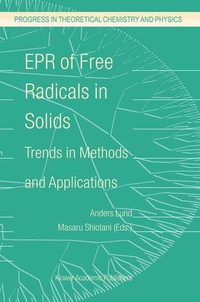
EPR of Free Radicals in Solids
Trends in Methods and Applications
Published on 31. July 2003
Book
Hardback
XVII, 645 pages
978-1-4020-1249-5 (ISBN)
Description
EPR of Free Radicals in Solids: Trends in Methods and Applications presents methods and applications of modern EPR for the study of free radical processes in solids, which so far are only available in the journal literature. The first part of the book, covering trends in methods, contains experimentally oriented chapters on continuous wave and pulsed EPR techniques and special methods involving muon magnetic resonance and optical detection and theory for dynamic studies. New simulation schemes, including the influence of dynamics, are presented as well as advances in the calculation of hyperfine and electronic g-tensors. The second part of the book presents applications involving studies of radiation and photo-induced inorganic and organic radicals in inert matrices, including novel results of quantum effects in small radicals. High-spin molecules and complexes are also considered as well as radical processes in photosynthesis. Recent advances in EPR dosimetry are summarized.
More details
Series
Edition
2003
Language
English
Place of publication
NY
United States
Target group
College/higher education
Professional and scholarly
Research
Product notice
Laminated cover
Illustrations
27
27 s/w Abbildungen
1, black & white illustrations
Dimensions
Height: 23.5 cm
Width: 15.5 cm
Thickness: 38 mm
Weight
2430 gr
ISBN-13
978-1-4020-1249-5 (9781402012495)
DOI
10.1007/978-1-4757-5166-6
Schweitzer Classification
Other editions
New editions
Book
12/2012
2nd Edition
Springer
€267.49
Shipment within 15-20 days
Book
11/2012
2nd Edition
Springer
€320.99
Shipment within 15-20 days
Additional editions

E-Book
06/2013
Springer
€85.59
Available for download

Book
12/2010
Springer
€85.59
Article exhausted; check different version
Content
Contributing Authors. Preface. Acknowledgments. Part 1: Trends in Methods. 1. Continuous wave EPR of radicals in solids; A. Lund, Wei Liu. 2. Pulsed EPR of paramagnectic centers in solid phases; M. Brustolon, A. Barbon. 3. Dynamical effects in CW and pulsed EPR; N.P. Benetis. 4. Quantum effects in deuterium labelled radicals at low temperature; M. Shiotani, K. Komaguchi. 5. XSophe - Sophe - XeprView: A computer simulation software suite for the analysis of continuous wave EPR spectra; G.R. Hanson, K.E. Gates, C.J. Noble, A. Mitchell, S. Benson, M. Griffin, K. Burrage. 6. The calculation of the hyperfine coupling tensors of biological radicals; Fuqiang Ban, J.W. Gauld, S.D. Wetmore, R.J. Boyd. 7. Ab initio and density functional calculations of electronic g-tensors for organic radicals; M. Kaupp. 8. Radiolabelled radicals derived from volatile organic compounds (VOCs) sorbed on reactive surfaces: implications for atmospheric chemistry and pollution control; C.J. Rhodes. Part II: Trends in Applications. 9. EPR studies of atomic impurities in rare gas matrices; H. Kunttu, J. Eloranta. 10. Organic radical cations and neutral radicals produced by radiation in low-temperature matrices; V. Feidman. 11. Molecule-based exchange high-spin clusters; T. Takui, H. Matsuoka, K. Furukawa, S. Nakazawa, K. Sato, D. Shiomi. 12. High spin molecules directed towards molecular magnets; M. Baumgarten. 13. Electron transfer and structure of plant photosystem II; A. Kawamori. 14. Recent development of EPR dosimetry; N.D. Yordanov, V. Gancheva. 15. Optically detected magnetic resonance of defects in semiconductors; Weimin M. Chen. Index.