

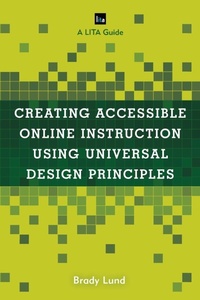
Creating Accessible Online Instruction Using Universal Design Principles
A LITA Guide
Published on 28. September 2020
Book
Paperback/Softback
132 pages
978-1-5381-3919-6 (ISBN)
Description
What is accessibility? Who needs it? Often, accessibility is defined narrowly, with emphasis on physical limitations. Accessibility needs, however, come in many forms, from vision and hearing impairment, to developmental disorders like Autism, to psychiatric conditions like anxiety, depression, ADHD, and PTSD.
Unfortunately, accessibility does not come with a simple set of checkboxes. It is a philosophy and practice that embraces social, physical, and informational elements. Universal design does not come in the form of a quick and easy guide. It is a philosophy. To implement it completely requires more than just screen readers and video captions.
Creating Accessible Online Instruction Using Universal Design Principles introduces the need for accessibility in online education and library services and the framework of universal design for learning. It takes a scoping, rather than a purely technical, approach. It will help you not only o create accessible content, but with how to communicate with students in an accessible manner.
This LITA Guide covers:
accessibility law, Universal Design for Learning and Web Content Accessibility guidelines, and communication and educational research and theory.
The content is interspersed with practical examples and case studies.
Unfortunately, accessibility does not come with a simple set of checkboxes. It is a philosophy and practice that embraces social, physical, and informational elements. Universal design does not come in the form of a quick and easy guide. It is a philosophy. To implement it completely requires more than just screen readers and video captions.
Creating Accessible Online Instruction Using Universal Design Principles introduces the need for accessibility in online education and library services and the framework of universal design for learning. It takes a scoping, rather than a purely technical, approach. It will help you not only o create accessible content, but with how to communicate with students in an accessible manner.
This LITA Guide covers:
accessibility law, Universal Design for Learning and Web Content Accessibility guidelines, and communication and educational research and theory.
The content is interspersed with practical examples and case studies.
Reviews / Votes
There has been a long-standing need for increased accessibility in library instruction. Many librarians, like Brady Lund, have been making this point for years. However, it has never been more apparent to the wider librarian community than during the COVID-19 pandemic. While Lund could not have known while writing Creating Accessible Online Instruction Using Universal Design Principles in 2019 that a major pandemic was just around the corner, it turned out to be a well-timed publication. Even as many institutions have shifted back to predominantly in-person instruction, many libraries are performing an increasing amount of instruction online. That many librarians faced a big learning curve around accessibility when moving instructional services online illustrates why this book is essential for libraries with a public instruction component.This book is recommended for academic libraries, public libraries, and library schools. Universal Design for Learning is one of the most well-regarded instructional frameworks in education and having a book of best practices for librarians teaching online would be a tremendously useful resource for these libraries. * Technical Services Quarterly * Creating Accessible Online Instruction Using Universal Design Principles: A LITA Guide is a useful, easy-to-read encapsulation of the complex sphere of accessibility. Lund provides abundant context in his review of pertinent legislation and standards, and a substantive discussion of accessibility products. -- David Comeaux, Systems and Discovery Librarian, Louisiana State UniversityMore details
Series
Language
English
Place of publication
United States
Publishing group
Bloomsbury Publishing Plc
Target group
Professional and scholarly
Illustrations
8 b/w photos; 5 tables
Dimensions
Height: 229 mm
Width: 152 mm
Thickness: 7 mm
Weight
203 gr
ISBN-13
978-1-5381-3919-6 (9781538139196)
Copyright in bibliographic data and cover images is held by Nielsen Book Services Limited or by the publishers or by their respective licensors: all rights reserved.
Schweitzer Classification
Other editions
Additional editions
E-Book
09/2020
1st Edition
Rowman & Littlefield Publishers
€39.49
Available for download
E-Book
09/2020
1st Edition
Bloomsbury eBooks US
€39.49
Available for download
Person
Brady Lund is a doctoral candidate at Emporia State University's School of Library and Information Management, where he also earned a master's degree in library science. He is author of over two dozen articles published in well-known library and information science journals as well as two books. His work generally encompasses information technology, information behavior, and statistical methods applied to library and information topics.
Content
Table of Contents
Preface
Chapter 1. Accessibility: It's the Law
Chapter 2. Introducing Universal Design for Learning and Web Content Accessibility
Chapter 3. Developing Online Content with UDL
Chapter 4. Effective Communication In-Person and Online
Chapter 5. Balancing Accessibility and Engagement
Chapter 6. How Accessibility Evolves with New Innovation
Chapter 7. Case Studies
Index
About the Author
Preface
Chapter 1. Accessibility: It's the Law
Chapter 2. Introducing Universal Design for Learning and Web Content Accessibility
Chapter 3. Developing Online Content with UDL
Chapter 4. Effective Communication In-Person and Online
Chapter 5. Balancing Accessibility and Engagement
Chapter 6. How Accessibility Evolves with New Innovation
Chapter 7. Case Studies
Index
About the Author