

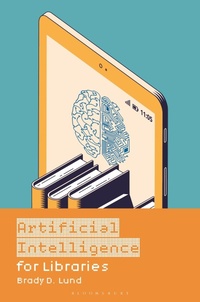
Artificial Intelligence for Libraries
Published on 8. January 2026
Book
Hardback
176 pages
979-8-216-19502-3 (ISBN)
Description
This detailed overview on artificial intelligence in libraries is a history, a guide for librarians, and a resource for students and researchers.
Artificial intelligence is an extremely important but little-understood topic, including in libraries. This timely book explores what AI is, how it works, how it's relevant to all types of libraries, and how it can be used. Readers will better understand the use of AI in library systems and applying AI to teaching and learning environments, and they will grow in the ability to discern potential ethical issues posed by this emerging technology. The final chapter provides a practical guide to using various types of AI in libraries.
Artificial intelligence is an extremely important but little-understood topic, including in libraries. This timely book explores what AI is, how it works, how it's relevant to all types of libraries, and how it can be used. Readers will better understand the use of AI in library systems and applying AI to teaching and learning environments, and they will grow in the ability to discern potential ethical issues posed by this emerging technology. The final chapter provides a practical guide to using various types of AI in libraries.
Reviews / Votes
Artificial Intelligence for Libraries is an excellent book for library professionals who wish to learn more about artificial intelligence. Conversational in tone and easy to understand, the book provides good technological knowledge and practical applications for libraries. It's a great first step to immerse yourself in AI in libraries. * Sandy Hervieux, Head Librarian, Nahum Gelber Law Library, McGill University, Canada, and Amanda Wheatley, Liaison Librarian, McGill University, Canada * Brady D. Lund's Artificial Intelligence for Libraries is a relevant and perceptive examination of how AI is changing the library and information services industry. Lund skillfully blends theory and practice by drawing on both technological and ethical underpinnings, providing librarians, educators, and information professionals with a thorough manual for comprehending and utilizing AI in actual library settings. This book is both accessible and forward-thinking, covering everything from fundamental ideas and moral dilemmas to real-world applications in education, learning, academic publication, and library systems. [It is] an essential resource for shaping the next generation of intelligent, inclusive, and adaptable library services in an era of rapid technological advancement. * Adeyinka Tella, Professor and Head, Department of Library and Information Science, University of Ilorin, Ilorin, Nigeria * [This] volume is a solid contribution and should prove very helpful to those working in libraries and others. * Library Journal *More details
Language
English
Place of publication
United States
Publishing group
Bloomsbury Publishing Plc
Target group
College/higher education
Professional and scholarly
Dimensions
Height: 240 mm
Width: 161 mm
Thickness: 14 mm
Weight
435 gr
ISBN-13
979-8-216-19502-3 (9798216195023)
Copyright in bibliographic data and cover images is held by Nielsen Book Services Limited or by the publishers or by their respective licensors: all rights reserved.
Schweitzer Classification
Person
Brady D. Lund, PhD, is an Assistant Professor of Information Science at the University of North Texas, USA.
Content
Introduction
1. What Is AI?
2. How AI Works
3. AI Ethics
4. A History of AI and Libraries
5. Library Systems and AI
6. AI Literacy
7. AI for Teaching and Learning
8. AI for Scholarly Publishing and Research
9. Building AI Solutions for Libraries
10. Our Next Generation of AI Libraries
Appendix
1. What Is AI?
2. How AI Works
3. AI Ethics
4. A History of AI and Libraries
5. Library Systems and AI
6. AI Literacy
7. AI for Teaching and Learning
8. AI for Scholarly Publishing and Research
9. Building AI Solutions for Libraries
10. Our Next Generation of AI Libraries
Appendix