

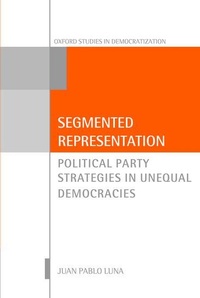
Segmented Representation
Political Party Strategies in Unequal Democracies
Published on 17. April 2014
Book
Hardback
402 pages
978-0-19-964264-9 (ISBN)
Description
Millions of enfranchised people live in abject poverty in democracies around the world. Yet in representative democracies, the success or failure of political parties rests on their ability to effectively engage voters. In today's highly unequal and individualized societies, the diversity of voters along socioeconomic, religious, and other lines presents an obstacle for parties vying for electoral success. How, then, can widespread, crushing poverty still exist in stable democracies, if every citizen has a vote? Two wildly different parties, Chile's right-wing UDI and Uruguay's left-wing Frente Amplio, have achieved stunning victories in this supposedly inhospitable political landscape. They have done so by simultaneously segmenting and strategically harmonizing their linkages to distinct cross-sections of voters in each society. While that electoral strategy makes for a winning hand for parties in fragmented modern societies, it perpetuates the gross inequalities that characterize the social, political, and economic landscapes of the developing democratic world. This book develops a new analytical and conceptual framework to unveil and explain segmented representation, revealing new implications for democratic societies.
Oxford Studies in Democratization is a series for scholars and students of comparative politics and related disciplines. Volumes concentrate on the comparative study of the democratization process that accompanied the decline and termination of the cold war. The geographical focus of the series is primarily Latin America, the Caribbean, Southern and Eastern Europe, and relevant experiences in Africa and Asia. The series editor is Laurence Whitehead, Official Fellow, Nuffield College, University of Oxford.
Oxford Studies in Democratization is a series for scholars and students of comparative politics and related disciplines. Volumes concentrate on the comparative study of the democratization process that accompanied the decline and termination of the cold war. The geographical focus of the series is primarily Latin America, the Caribbean, Southern and Eastern Europe, and relevant experiences in Africa and Asia. The series editor is Laurence Whitehead, Official Fellow, Nuffield College, University of Oxford.
Reviews / Votes
This is a path-breaking study of democratic representation in highly unequal societies. Juan Pablo Luna convincingly demonstrates that segmented societies create both incentives and opportunities for political parties'-on both the left and the right-to use different types of electoral appeals to attract distinct groups of voters. Drawing from survey data and field research in Chile and Uruguay, Luna shows how parties craft electoral strategies that combine programmatic, clientelistic, and personalistic linkages to voters, allowing them to generate support among heterogeneous but socially segmented constituencies. The result is a masterful analysis of how inequality structures democratic representation-and, ultimately, how democracy can reproduce social inequality. * Kenneth M.Roberts, Cornell University * High levels of income inequality pose a challenge to politicians. They need to keep the rich happy to keep investment and donations flowing and the poor happy to secure their votes. How do politicians and parties reconcile the demands of these different constituencies in the most unequal part of the world? In this pathbreaking study, Luna suggests that they simultaneously deliver policies to the rich and pork to the poor. He supports his argument with rich empirical work drawn from the experiences of two new Latin American democracies, Chile and Uruguay, as well as other cases from the region and India. This book will be a must-read for students of representation, electoral behavior and political parties in established as well as new democracies, and will also prove invaluable to practitioners of approaches to empirical research that draw on mixed-methods. * M.Victoria Murillo, Columbia University research that draw on mixed-methods.M.Victoria Murillo, Columbia University * Segmented Representation is one of one of the most important books on Latin American parties to be published in decades. Drawing on painstaking research in Chile and Uruguay, Luna shows that the kinds of programmatic appeal made by parties in advanced industrialized (and often taken for granted in theories of party behavior) are less viable in highly unequal societies, and that successful parties must make segmented appeals to diverse--even seemingly opposed--constituencies. The concept of segmented linkages will diffuse widely among scholars. Lunas work helps us understand why parties operate differently in a context of extreme inequality, while at the same time showing how segmented linkages work to reinforce existing inequalities. The book will make a major contribution to the study of political parties, not only in Latin America but throughout the developing world. * Steven Levitsky, Harvard University *More details
Series
Language
English
Place of publication
Oxford
United Kingdom
Target group
College/higher education
Product notice
sewn/stitched
Cloth over boards
With dust jacket
Dimensions
Height: 236 mm
Width: 163 mm
Thickness: 28 mm
Weight
748 gr
ISBN-13
978-0-19-964264-9 (9780199642649)
Copyright in bibliographic data and cover images is held by Nielsen Book Services Limited or by the publishers or by their respective licensors: all rights reserved.
Schweitzer Classification
Other editions
Additional editions
E-Book
04/2014
1st Edition
OUP eBook
€77.49
Available for download
Person
Juan Pablo Luna Farina is interested in the analysis of political parties and democratic representation, the political effects of inequality, and the nature of state institutions. In 2010 he co-authored the book Latin American Party Systems (Cambridge University Press). His dissertation research was awarded the 2008 Juan Linz Best Dissertation Award by the Comparative Democratization Section of APSA. His work has appeared in Comparative Political Studies, Politica y Gobierno, Revista de Ciencia Politica, Latin American Politics and Society, International Political Science Review, Third World Quarterly, Journal of Latin American Studies, the Journal of Democracy, Perfiles Latinoamericanos, and Democratization. He has held visiting positions at Princeton University (2008), Brown University (2011), and Harvard University (2013). He is Associate Professor, Instituto de Ciencia Politica, PUC-Chile.
Content
Introduction ; 1. Segmented Electoral Appeals: A Descriptive Framework ; 2. Patterns of Party-Voter Linkages in Chile and Uruguay: A Stylized Description of the Pre-1973 and Post-Transitional Periods ; 3. Socioeconomic Segmentation of Party-Voter Linkages in Post-transitional Chile and Uruguay ; 4. Territorial Segmentation of Party-Voter Linkages in Post-transitional Chile and Uruguay ; 5. Strategic Harmonization of Segmented Linkages: The UDI and Frente Amplio in Comparative Perspective ; 6. Causal Induction: Explaining Linkage Structures in Chile and Uruguay ; 7. Plausibility Tests: Out-of-Sample Cases ; 8. Conclusion ; Bibliography