

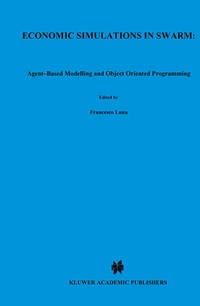
Economic Simulations in Swarm: Agent-Based Modelling and Object Oriented Programming
Agent-Based Modelling and Object Oriented Programming
Published on 31. January 2000
Book
Hardback
XXXVI, 291 pages
978-0-7923-8665-0 (ISBN)
Description
Computer simulations of economic systems are slowly gaining ground within the economic profession. However, such a process is hindered by a lack of communication among researchers who do not share a common language. For its object-oriented structure and its versatility, Swarm has the necessary characteristics to become a credible universal language of agent-based simulations.
Economic Simulations in Swarm collects a series of original articles in such domains as macro and micro economics, industrial organization, monetary theory, and finance, all linked by a common denominator: the use of the Swarm simulation platform.
Swarm, a standard set of program libraries, allows users to construct simulations where a collection of heterogeneous independent agents or elements interact through discrete events. This volume offers the first extensive tutorial to the use of these software libraries developed at the Santa Fe Institute as part of the ongoing research into complexity.
The editors conceived the idea of this book while visiting the Santa Fe Institute as members of the `Working Group on Adaptive and Computable Economics'. Francesco Luna is a specialist in Computable Economics, and Benedikt Stefansson is an active contributor to the Swarm community.
Economic Simulations in Swarm collects a series of original articles in such domains as macro and micro economics, industrial organization, monetary theory, and finance, all linked by a common denominator: the use of the Swarm simulation platform.
Swarm, a standard set of program libraries, allows users to construct simulations where a collection of heterogeneous independent agents or elements interact through discrete events. This volume offers the first extensive tutorial to the use of these software libraries developed at the Santa Fe Institute as part of the ongoing research into complexity.
The editors conceived the idea of this book while visiting the Santa Fe Institute as members of the `Working Group on Adaptive and Computable Economics'. Francesco Luna is a specialist in Computable Economics, and Benedikt Stefansson is an active contributor to the Swarm community.
Reviews / Votes
` Economic Simulations in Swarm is not specifically targeted at urban studies audiences, but is well crafted enough to be a very useful resource for those involved in building urban models, and for anybody interested in urban simulation and multiagent systems in general. 'Environment and Planning B: Planning and Design 2001, Vol.28
More details
Series
Edition
2000 ed.
Language
English
Place of publication
New York
United States
Target group
Professional and scholarly
Research
Illustrations
XXXVI, 291 p.
Dimensions
Height: 241 mm
Width: 160 mm
Thickness: 23 mm
Weight
658 gr
ISBN-13
978-0-7923-8665-0 (9780792386650)
DOI
10.1007/978-1-4615-4641-2
Schweitzer Classification
Other editions
Additional editions
Francesco Luna | Benedikt Stefansson
Economic Simulations in Swarm: Agent-Based Modelling and Object Oriented Programming
E-Book
12/2012
Springer
€149.79
Available for download
Francesco Luna | Benedikt Stefansson
Economic Simulations in Swarm: Agent-Based Modelling and Object Oriented Programming
Book
10/2012
Springer
€160.49
Shipment within 7-9 days
Persons
Francesco Luna
is a specialist in Computable Economics
Benedikt Stefansson
is an active contributor to the Swarm community
Content
I The Grammar.- 1 Simulating Economic Agents in Swarm.- 2 Installation: An Appendix.- II. and Some Prose.- 3 Economic Experiments with Swarm: a Neural Network Approach to the Self-Development of Consistency in Agents' Behavior.- 4 Endogenous Growth in a Swarm Economy.- 5 Imitative Behaviour in Tax Evasion.- 6 An Experimental Approach to the Study of Banking Intermediation: the BankNet Simulator.- 7 Numerical Modeling, Noise Traders, and the Swarm Simulation System.- 8 Nonlinear Stochastic Dynamics for Supply Counterfeiting in Monopolistic Markets.- 9 Using Swarm for Simulating the Order Fulfillment Process in Divergent Assembly Supply Chains.- 10 Online Supply Chain Modeling and Simulation.- 11 The Coevolution of Human Capital and Firm Structure.