

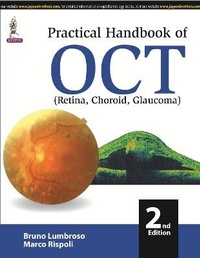
Practical Handbook of OCT
2nd Edition
Published on 30. November 2014
Book
Hardback
260 pages
978-93-5152-531-8 (ISBN)
Description
Optical coherence tomography (OCT) is a non-invasive imaging test that uses light waves to take cross-section pictures of the retina, the light-sensitive tissue lining the back of the eye (eyeSmart).
This new edition has been fully updated to provide clinicians and trainees with the most recent advances in OCT imaging. Beginning with an introduction to the technique for obtaining clear images, and discussion on normal anatomy, the following sections offer step by step guidance on the interpretation of OCT images and data acquired by OCT, 'en face' OCT and OCT angiography.
Each chapter has been revised and new examination and diagnostic protocols are covered in depth. The second edition includes two new chapters on OCT Dyeless Angiography and OCT Analysis and Interpretation of Common Disorders.
Highly illustrated with more than 400 clinical images and tables, this practical reference has been written by renowned experts Bruno Lumbroso and Marco Rispoli from Centro Oftalmologico Mediterraneo in Rome.
Key points
Fully revised new edition providing latest advances in interpretation of OCT imaging
Includes two new chapters and more than 400 clinical images and tables
Authored by renowned ophthalmologists Bruno Lumbroso and Marco Rispoli
Previous edition published in 2012
This new edition has been fully updated to provide clinicians and trainees with the most recent advances in OCT imaging. Beginning with an introduction to the technique for obtaining clear images, and discussion on normal anatomy, the following sections offer step by step guidance on the interpretation of OCT images and data acquired by OCT, 'en face' OCT and OCT angiography.
Each chapter has been revised and new examination and diagnostic protocols are covered in depth. The second edition includes two new chapters on OCT Dyeless Angiography and OCT Analysis and Interpretation of Common Disorders.
Highly illustrated with more than 400 clinical images and tables, this practical reference has been written by renowned experts Bruno Lumbroso and Marco Rispoli from Centro Oftalmologico Mediterraneo in Rome.
Key points
Fully revised new edition providing latest advances in interpretation of OCT imaging
Includes two new chapters and more than 400 clinical images and tables
Authored by renowned ophthalmologists Bruno Lumbroso and Marco Rispoli
Previous edition published in 2012
More details
Edition
2nd Revised edition
Language
English
Place of publication
New Delhi
India
Target group
College/higher education
Edition type
Revised edition
Illustrations
106 Tabellen, 194 Fotos bzw. Rasterbilder, 104 Abbildungen
106 Tables, unspecified; 194 Halftones, unspecified; 104 Illustrations
Dimensions
Height: 279 mm
Width: 216 mm
Weight
320 gr
ISBN-13
978-93-5152-531-8 (9789351525318)
Copyright in bibliographic data and cover images is held by Nielsen Book Services Limited or by the publishers or by their respective licensors: all rights reserved.
Schweitzer Classification
Persons
Bruno Lumbroso
Marco Rispoli
Both at Centro Oftalmologico Mediterraneo, Rome, Italy
Marco Rispoli
Both at Centro Oftalmologico Mediterraneo, Rome, Italy
Content
Practical Suggestions to Obtain Clear and Clinically Useful OCT Images
Basic Normal Anatomy and OCT
Logical Method of OCT Interpretation: Analysis, Synthesis and Deduction
Tridimensional and "En Face" Scan Analysis
OCT Dyeless Angiography
Synthesis and Deduction
Elementary OCT Lesions
Ocular Syndromes and Disorders
Complex Case Analysis and Interpretation
Glaucoma
Neurological Disorders and OCT
OCT Analysis and Interpretation of the Most Common Disorders
Basic Normal Anatomy and OCT
Logical Method of OCT Interpretation: Analysis, Synthesis and Deduction
Tridimensional and "En Face" Scan Analysis
OCT Dyeless Angiography
Synthesis and Deduction
Elementary OCT Lesions
Ocular Syndromes and Disorders
Complex Case Analysis and Interpretation
Glaucoma
Neurological Disorders and OCT
OCT Analysis and Interpretation of the Most Common Disorders