

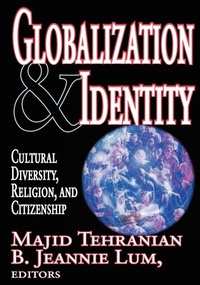
Globalization and Identity
Cultural Diversity, Religion, and Citizenship
1st Edition
Published on 15. February 2006
Book
Paperback/Softback
120 pages
978-1-4128-0561-2 (ISBN)
Description
In the first decade of the twenty-first century, globalization and identity have emerged as the most critical challenges to world peace. This volume of Peace & Policy addresses the overarching question, "What are the effects of globalization in the areas of culture, ethnic diversity, religion, and citizenship, and how does terrorism help groups attain a sense of global identity?"
Part I, "Citizenship in a Globalizing World," reexamines globalization in light of the traditions from which human civilizations have evolved. Linda Groff focuses on Samuel R. Huntington's thesis that the Cold War would be followed by a clash of civilizations. Joseph A. Camilleri traces the history of the concept of citizenship and its transformation through the ages to modern times. Kamran Mofid argues that the marketplace is not just an economic sphere but one where economic and business interests must embrace the spiritual assets of the community. Majid Tehranian raises the problem of identity and advocates the assumption of global identity, responsibility, and citizenship. Part II, "Convergence in Global Cultures," explores the complex issues of diversity in religions. Christopher Leeds, Vladimir Korobov, and Bharapt Gupt show how the reconceptualization of the world both geographically and regionally can recreate new sensibilities needed to overcome differences. Part III, "Divergence in Global Conflicts," discusses the multiple dimensions of the globalizing effects of economic expansion and political strife experienced by different cultures at local and regional levels. Audrey Kitigawa and Ade Ogunrinade use Nigeria as an example of political manipulation of religious and ethnic groups to divert attention from the real problems of social and economic marginalization. Fred Riggs looks at how the Web has become a medium in the globalization of religious movements.
The authors maintain that continuing efforts for dialogue across cultural and religious boundaries in today's interreligious and interfaith organizations can become a force for healing.
Part I, "Citizenship in a Globalizing World," reexamines globalization in light of the traditions from which human civilizations have evolved. Linda Groff focuses on Samuel R. Huntington's thesis that the Cold War would be followed by a clash of civilizations. Joseph A. Camilleri traces the history of the concept of citizenship and its transformation through the ages to modern times. Kamran Mofid argues that the marketplace is not just an economic sphere but one where economic and business interests must embrace the spiritual assets of the community. Majid Tehranian raises the problem of identity and advocates the assumption of global identity, responsibility, and citizenship. Part II, "Convergence in Global Cultures," explores the complex issues of diversity in religions. Christopher Leeds, Vladimir Korobov, and Bharapt Gupt show how the reconceptualization of the world both geographically and regionally can recreate new sensibilities needed to overcome differences. Part III, "Divergence in Global Conflicts," discusses the multiple dimensions of the globalizing effects of economic expansion and political strife experienced by different cultures at local and regional levels. Audrey Kitigawa and Ade Ogunrinade use Nigeria as an example of political manipulation of religious and ethnic groups to divert attention from the real problems of social and economic marginalization. Fred Riggs looks at how the Web has become a medium in the globalization of religious movements.
The authors maintain that continuing efforts for dialogue across cultural and religious boundaries in today's interreligious and interfaith organizations can become a force for healing.
More details
Series
Language
English
Place of publication
New York
United States
Publishing group
Taylor & Francis Inc
Target group
College/higher education
Dimensions
Height: 254 mm
Width: 178 mm
Thickness: 7 mm
Weight
250 gr
ISBN-13
978-1-4128-0561-2 (9781412805612)
Copyright in bibliographic data and cover images is held by Nielsen Book Services Limited or by the publishers or by their respective licensors: all rights reserved.
Schweitzer Classification
Other editions
Additional editions
Book
10/2017
1st Edition
Routledge
€206.10
Shipment within 10-20 days
E-Book
07/2017
Routledge
€67.49
Available for download
E-Book
07/2017
Routledge
€67.49
Available for download
Person
Majid Tehranian is director of the Toda Institute for Global Peace and Policy Research. B. Jeannie Lum is an associate professor at the University of Hawaii at Manoa in the Department of Educational Foundations, College of Education.
Content
Peacenotes, by Majid Tehranian, Introduction, by B. Jeannie Lum, I. Civilization in the Global Age, II. Convergence in Global Cultures, III. Divergence in Global Conflicts, News & Views, Peace Poetry, In Memoriam, Booknotes