

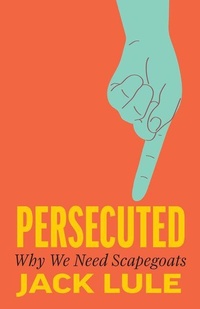
Persecuted
Why We Need Scapegoats
Will be published approx. on 15. December 2026
Book
Hardback
248 pages
978-1-4214-5585-3 (ISBN)
Description
The making of the modern scapegoat.
Who gets blamed when societies feel under threat and why? In Persecuted, journalism scholar Jack Lule examines the deep roots of scapegoating as essential to human society. Scapegoating helps explain how and why people unite, shaping the ways groups define belonging, exclusion, and collective identity.
Drawing on the work of Kenneth Burke and Rene Girard, Lule argues that scapegoating is not a social malfunction but a core mechanism through which communities are formed. Nations rely on scapegoating to draw boundaries between "us" and "them." What makes the modern era especially volatile, he contends, is the role of media-from early messengers and newspapers to contemporary social platforms-in manufacturing crises, amplifying accusations, identifying targets, and accelerating cycles of blame. Moving fluidly across history, theory, and contemporary politics, the book shows how media systems have increased the reach, speed, and intensity of scapegoating, often transforming local resentments into global networks of hate and hostility. Lule presents a sober analysis of how scapegoating persists precisely because it feels natural, justified, and invisible to those participating in it.
Persecuted is a concise, unsettling exploration of a process that underlies nationalism, moral panics, and political polarization. Its hope-tentative but urgent-is that recognizing the recurring power of scapegoating may help readers identify it in real time and resist its most destructive consequences.
Who gets blamed when societies feel under threat and why? In Persecuted, journalism scholar Jack Lule examines the deep roots of scapegoating as essential to human society. Scapegoating helps explain how and why people unite, shaping the ways groups define belonging, exclusion, and collective identity.
Drawing on the work of Kenneth Burke and Rene Girard, Lule argues that scapegoating is not a social malfunction but a core mechanism through which communities are formed. Nations rely on scapegoating to draw boundaries between "us" and "them." What makes the modern era especially volatile, he contends, is the role of media-from early messengers and newspapers to contemporary social platforms-in manufacturing crises, amplifying accusations, identifying targets, and accelerating cycles of blame. Moving fluidly across history, theory, and contemporary politics, the book shows how media systems have increased the reach, speed, and intensity of scapegoating, often transforming local resentments into global networks of hate and hostility. Lule presents a sober analysis of how scapegoating persists precisely because it feels natural, justified, and invisible to those participating in it.
Persecuted is a concise, unsettling exploration of a process that underlies nationalism, moral panics, and political polarization. Its hope-tentative but urgent-is that recognizing the recurring power of scapegoating may help readers identify it in real time and resist its most destructive consequences.
More details
Language
English
Place of publication
Baltimore, MD
United States
Dimensions
Height: 216 mm
Width: 140 mm
Thickness: 23 mm
ISBN-13
978-1-4214-5585-3 (9781421455853)
DOI
10.56021/9781421455853
Copyright in bibliographic data and cover images is held by Nielsen Book Services Limited or by the publishers or by their respective licensors: all rights reserved.
Schweitzer Classification
Person
Jack Lule is professor emeritus of journalism at Lehigh University. He is the author of Globalization and Media: Global Village of Babel; Understanding Media and Culture: An Introduction to Mass Communication; and Daily News, Eternal Stories: The Mythological Role of Journalism.
Content
Table of Contents
1. On Scapegoating: An Introduction
2. Study of the Scapegoat: "The Lucky Goat"
3. Kenneth Burke: The Scapegoat Arises from Language
4. Rene Girard: The Scapegoat Arises from Mimesis
5. Burke and Girard: "The Club of Scapegoating"
6. The Nation: Origins of Nationalism
7. The Nation: Nationalism and the Other
8. The Nation: Nationalism and Racism
9. The Media and the Nation: Creating Whose Imagined Community?
10. The Media and the Nation: Creating Whose Imagined Community?
11. The Media: Merchants of Hate
12. The Media: Networks of Hate
13. The Media and the Scapegoat: "Using Up" the Scapegoat
14. "Using Up" the Scapegoat: Imagine That
1. On Scapegoating: An Introduction
2. Study of the Scapegoat: "The Lucky Goat"
3. Kenneth Burke: The Scapegoat Arises from Language
4. Rene Girard: The Scapegoat Arises from Mimesis
5. Burke and Girard: "The Club of Scapegoating"
6. The Nation: Origins of Nationalism
7. The Nation: Nationalism and the Other
8. The Nation: Nationalism and Racism
9. The Media and the Nation: Creating Whose Imagined Community?
10. The Media and the Nation: Creating Whose Imagined Community?
11. The Media: Merchants of Hate
12. The Media: Networks of Hate
13. The Media and the Scapegoat: "Using Up" the Scapegoat
14. "Using Up" the Scapegoat: Imagine That