

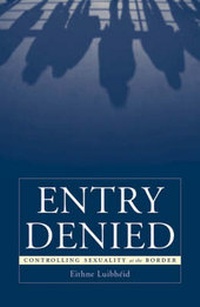
Entry Denied
Controlling Sexuality at the Border
Published on 17. June 2015
Book
Paperback/Softback
288 pages
978-0-8166-3804-8 (ISBN)
Description
A revelatory examination of 150 years of sexuality-based discrimination against immigrants to the United States.
Lesbians, prostitutes, women likely to have sex across racial lines, "brought to the United States for immoral purposes," or "arriving in a state of pregnancy"-national threats, one and all. Since the late nineteenth century, immigrant women's sexuality has been viewed as a threat to national security, to be contained through strict border-monitoring practices. By scrutinizing this policy, its origins, and its application, Eithne LuibhEid shows how the U.S. border became a site not just for controlling female sexuality but also for contesting, constructing, and renegotiating sexual identity.
Initially targeting Chinese women, immigration control based on sexuality rapidly expanded to encompass every woman who sought entry to the United States. The particular cases LuibhEid examines-efforts to differentiate Chinese prostitutes from wives, the 1920s exclusion of Japanese wives to reduce the Japanese-American birthrate, the deportation of a Mexican woman on charges of lesbianism, the role of rape in mediating women's border crossings today-challenge conventional accounts that attribute exclusion solely to prejudice or lack of information. This innovative work clearly links sexuality-based immigration exclusion to a dominant nationalism premised on sexual, gender, racial, and class hierarchies.
Lesbians, prostitutes, women likely to have sex across racial lines, "brought to the United States for immoral purposes," or "arriving in a state of pregnancy"-national threats, one and all. Since the late nineteenth century, immigrant women's sexuality has been viewed as a threat to national security, to be contained through strict border-monitoring practices. By scrutinizing this policy, its origins, and its application, Eithne LuibhEid shows how the U.S. border became a site not just for controlling female sexuality but also for contesting, constructing, and renegotiating sexual identity.
Initially targeting Chinese women, immigration control based on sexuality rapidly expanded to encompass every woman who sought entry to the United States. The particular cases LuibhEid examines-efforts to differentiate Chinese prostitutes from wives, the 1920s exclusion of Japanese wives to reduce the Japanese-American birthrate, the deportation of a Mexican woman on charges of lesbianism, the role of rape in mediating women's border crossings today-challenge conventional accounts that attribute exclusion solely to prejudice or lack of information. This innovative work clearly links sexuality-based immigration exclusion to a dominant nationalism premised on sexual, gender, racial, and class hierarchies.
More details
Language
English
Place of publication
Minnesota
United States
Target group
College/higher education
Dimensions
Height: 229 mm
Width: 149 mm
Thickness: 15 mm
ISBN-13
978-0-8166-3804-8 (9780816638048)
Copyright in bibliographic data and cover images is held by Nielsen Book Services Limited or by the publishers or by their respective licensors: all rights reserved.
Schweitzer Classification
Person
Eithne LuibhEid is assistant professor of ethnic studies at Bowling Green State University.
Content
Entry denied : a history of U.S. immigration control -- A blueprint for exclusion : the Page law, prostitution, and discrimination against Chinese women -- Birthing a nation : race, ethnicity, and childbearing -- Looking like a lesbian : sexual monitoring at the U.S.-Mexico border -- Rape, asylum, and the U.S. border patrol.