

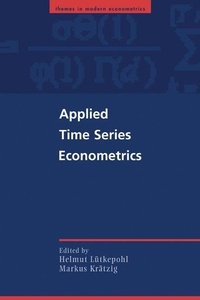
Applied Time Series Econometrics
Published on 4. August 2004
Book
Paperback/Softback
352 pages
978-0-521-54787-1 (ISBN)
Description
Time series econometrics is a rapidly evolving field. Particularly, the cointegration revolution has had a substantial impact on applied analysis. Hence, no textbook has managed to cover the full range of methods in current use and explain how to proceed in applied domains. This gap in the literature motivates the present volume. The methods are sketched out, reminding the reader of the ideas underlying them and giving sufficient background for empirical work. The treatment can also be used as a textbook for a course on applied time series econometrics. Topics include: unit root and cointegration analysis, structural vector autoregressions, conditional heteroskedasticity and nonlinear and nonparametric time series models. Crucial to empirical work is the software that is available for analysis. New methodology is typically only gradually incorporated into existing software packages. Therefore a flexible Java interface has been created, allowing readers to replicate the applications and conduct their own analyses.
More details
Series
Language
English
Place of publication
Cambridge
United Kingdom
Target group
Professional and scholarly
Product notice
Paperback (trade)
Illustrations
38 Tables, unspecified; 69 Line drawings, unspecified
Dimensions
Height: 229 mm
Width: 152 mm
Thickness: 21 mm
Weight
572 gr
ISBN-13
978-0-521-54787-1 (9780521547871)
Copyright in bibliographic data and cover images is held by Nielsen Book Services Limited or by the publishers or by their respective licensors: all rights reserved.
Schweitzer Classification
Other editions
Additional editions
Helmut Luetkepohl | Markus Kraetzig
Applied Time Series Econometrics
E-Book
07/2006
1st Edition
Cambridge University Press
€38.49
Available for download
Helmut Luetkepohl | Markus Kraetzig
Applied Time Series Econometrics
Book
08/2004
Cambridge University Press
€150.70
Shipment within 15-20 days
Persons
Helmut Luetkepohl is Professor of Economics at the European University Institute in Florence, Italy. He is on leave from Humboldt University Berlin where he has been Professor of Econometrics in the Faculty of Economics and Business Administration since 1992. He had previously been Professor of Statistics at the University of Kiel (1987-1992) and the University of Hamburg (1985-1987) and was Visiting Assistant Professor at the University of California, San Diego (1984-85). Professor Luetkepohl is Associate Editor of Econometric Theory, the Journal of Applied Econometrics, Macroeconomic Dynamics, Empirical Economics and Econometric Reviewa. He has published extensively in learned journals and books and is author, co-author and editor of a number of books in econometrics and time series analysis. Professor Luetkepohl is the author of Introduction to Multiple Time Series Analysis (1991) and a Handbook of Matrices (1996). His current teaching and research interests include methodological issues related to the study of nonstationary, integrated time series and the analysis of the transmission mechanism of monetary policy in the Euro area. Markus Kraetzig is a doctoral student in the Department of Economics at Humboldt University, Berlin.
Content
Preface; Notation and abbreviations; List of contributors; Part I. Initial Tasks and Overview Helmut Luetkepohl: 1. Introduction; 2. Setting up an econometric project; 3. Getting data; 4. Data handling; 5. Outline of chapters; Part II. Univariate Time Series Analysis Helmut Luetkepohl: 6. Characteristics of time series; 7. Stationary and integrated stochastic processes; 8. Some popular time series models; 9. Parameter estimation; 10. Model specification; 11. Model checking; 12. Unit root tests; 13. Forecasting univariate time series; 14. Examples; 15. Where to go from here; Part III. Vector Autoregressive and Vector Error Correction Models Helmut Luetkepohl: 16. Introduction; 17. VARs and VECMs; 18. Estimation; 19. Model specification; 20. Model checking; 21. Forecasting VAR processes and VECMs; 22. Granger-causality analysis; 23. An example; 24. Extensions; Part IV. Structural Vector Autoregressive Modelling and Impulse Responses Joerg Breitung, Ralf Brueggemann and Helmut Luetkepohl: 25. Introduction; 26. The models; 27. Impulse response analysis; 28. Estimation of structural parameters; 29. Statistical inference for impulse responses; 30. Forecast error variance decomposition; 31. Examples; 32. Conclusions; Part V. Conditional Heteroskedasticity Helmut Herwartz: 33. Stylized facts of empirical price processes; 34. Univariate GARCH models; 35. Multivariate GARCH models; Part VI. Smooth Transition Regression Modelling Timo Teraesvirta: 36. Introduction; 37. The model; 38. The modelling cycle; 39. Two empirical examples; 40. Final remarks; Part VII. Nonparametric Time Series Modelling Rolf Tschernig: 41. Introduction; 42. Local linear estimation; 43. Bandwidth and lag selection; 44. Diagnostics; 45. Modelling the conditional volatility; 46. Local linear seasonal modelling; 47. Example I: average weekly working hours in the United States; 48. Example II: XETRA dax index; Part VIII. The Software JMulTi Markus Kraetzig: 49. Introduction to JMulTi; 50. Numbers, dates and variables in JMulTi; 51. Handling data sets; 52. Selecting, transforming and creating time series; 53. Managing variables in JMulTi; 54. Notes for econometric software developers; 55. Conclusion; References; Index.