

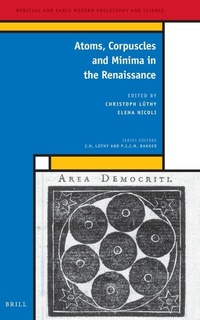
Atoms, Corpuscles and Minima in the Renaissance
Published on 3. November 2022
Book
Hardback
332 pages
978-90-04-52891-8 (ISBN)
Description
The Renaissance witnessed an upsurge in explanations of natural events in terms of invisibly small particles - atoms, corpuscles, minima, monads and particles. The reasons for this development are as varied as are the entities that were proposed. This volume covers the period from the earliest commentaries on Lucretius' De rerum natura to the sources of Newton's alchemical texts. Contributors examine key developments in Renaissance physiology, meteorology, metaphysics, theology, chymistry and historiography, all of which came to assign a greater explanatory weight to minute entities. These contributions show that there was no simple 'revival of atomism', but that the Renaissance confronts us with a diverse and conceptually messy process.
Contributors are: Stephen Clucas, Christoph Luethy, Craig Martin, Elisabeth Moreau, William R. Newman, Elena Nicoli, Sandra Plastina, Kuni Sakamoto, Jole Shackelford, and Leen Spruit.
Contributors are: Stephen Clucas, Christoph Luethy, Craig Martin, Elisabeth Moreau, William R. Newman, Elena Nicoli, Sandra Plastina, Kuni Sakamoto, Jole Shackelford, and Leen Spruit.
More details
Series
Language
English
Place of publication
Leiden
Netherlands
Target group
Professional and scholarly
Product notice
sewn/stitched
Cloth over boards
Illustrations
1 s/w Abbildung, 4 farbige Abbildungen
4 Illustrations, color; 1 Illustrations, black and white
Dimensions
Height: 234 mm
Width: 155 mm
Thickness: 19 mm
Weight
635 gr
ISBN-13
978-90-04-52891-8 (9789004528918)
Copyright in bibliographic data and cover images is held by Nielsen Book Services Limited or by the publishers or by their respective licensors: all rights reserved.
Schweitzer Classification
Persons
Christoph Luethy, Ph.D. (1995) is Professor of the History of Philosophy and Science at Radboud University, Nijmegen (The Netherlands). His publications concern mainly the history of matter theories and the development and logic of 'epistemic images'.
Elena Nicoli, Ph.D. (2017) is an Associate Researcher at the Center for the History of Philosophy and Science at Radboud University, Nijmegen (The Netherlands). Her research and publications mainly concern the reception of Lucretius and Epicureanism in the Renaissance.
Elena Nicoli, Ph.D. (2017) is an Associate Researcher at the Center for the History of Philosophy and Science at Radboud University, Nijmegen (The Netherlands). Her research and publications mainly concern the reception of Lucretius and Epicureanism in the Renaissance.
Content
Contents
List of Illustrations
Notes on Contributors
1 Atoms, Corpuscles, and Minima in the Renaissance: An Overview
?Christoph Luethy and Elena Nicoli
2 Atomism in Sixteenth-Century Italian Commentaries on Lucretius
?Elena Nicoli
3 Galenic Medicine and the Atomist Revival: Elements, Particles, and Minima in Late Renaissance Physiology
?Elisabeth Moreau
4 Pores, Parts, and Powers in Sixteenth-Century Commentaries on Meteorologica IV
?Craig Martin
5 Atoms, Corpuscles, and Minima in the Renaissance: The Case of Nicolaus Biesius (1516-1573)
?Christoph Luethy
6 Mechanical Arts and Biological Development on the Sixteenth-Century World Stage: The Paracelsian Mechanical Philosophy of Petrus Severinus
?Jole Shackelford
7 Democritus in Francesco Patrizi and Giordano Bruno
?Leen Spruit
8 Nicholas Hill, an English Atomist
?Sandra Plastina
9 Finite God and Infinite Space: Conrad Vorstius and David Gorlaeus
?Kuni Sakamoto
10 Atomism, Mechanism, and Chymistry in the Natural Philosophy of Walter Warner
?Stephen Clucas
11 Isaac Newton's Atomist Sources: The Case of Bernhard Varenius
?William R. Newman
Bibliography
Index
List of Illustrations
Notes on Contributors
1 Atoms, Corpuscles, and Minima in the Renaissance: An Overview
?Christoph Luethy and Elena Nicoli
2 Atomism in Sixteenth-Century Italian Commentaries on Lucretius
?Elena Nicoli
3 Galenic Medicine and the Atomist Revival: Elements, Particles, and Minima in Late Renaissance Physiology
?Elisabeth Moreau
4 Pores, Parts, and Powers in Sixteenth-Century Commentaries on Meteorologica IV
?Craig Martin
5 Atoms, Corpuscles, and Minima in the Renaissance: The Case of Nicolaus Biesius (1516-1573)
?Christoph Luethy
6 Mechanical Arts and Biological Development on the Sixteenth-Century World Stage: The Paracelsian Mechanical Philosophy of Petrus Severinus
?Jole Shackelford
7 Democritus in Francesco Patrizi and Giordano Bruno
?Leen Spruit
8 Nicholas Hill, an English Atomist
?Sandra Plastina
9 Finite God and Infinite Space: Conrad Vorstius and David Gorlaeus
?Kuni Sakamoto
10 Atomism, Mechanism, and Chymistry in the Natural Philosophy of Walter Warner
?Stephen Clucas
11 Isaac Newton's Atomist Sources: The Case of Bernhard Varenius
?William R. Newman
Bibliography
Index