

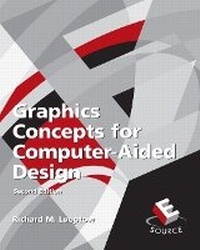
Graphics Concepts for Computer-Aided Design
2nd Edition
Published on 17. April 2007
Book
Paperback/Softback
128 pages
978-0-13-222987-6 (ISBN)
Description
For Freshman or Introductory courses in Engineering and Computer Science.
Engineering has always required graphics to communicate ideas. However, the transition from hand drawings to computer-aided design has resulted in many important concepts being left out of the standard engineering curriculum. This book is a compact resource that connects traditional engineering graphics with computer-aided design.
Engineering has always required graphics to communicate ideas. However, the transition from hand drawings to computer-aided design has resulted in many important concepts being left out of the standard engineering curriculum. This book is a compact resource that connects traditional engineering graphics with computer-aided design.
More details
Edition
2nd edition
Language
English
Place of publication
United States
Publishing group
Pearson Education (US)
Target group
College/higher education
Dimensions
Height: 10 mm
Width: 10 mm
Thickness: 10 mm
Weight
336 gr
ISBN-13
978-0-13-222987-6 (9780132229876)
Copyright in bibliographic data and cover images is held by Nielsen Book Services Limited or by the publishers or by their respective licensors: all rights reserved.
Schweitzer Classification
Other editions
Previous edition
Content
1. Engineering Graphics.
The Importance of Engineering Graphics. Engineering Graphics. CAD. Design and CAD.
2. Projections Used in Engineering Graphics.
Projections. 3-D Projections. Multiview Projections. Working Drawings.
3. Freehand Sketching.
Why Freehand Sketches? Freehand Sketching Fundamentals. Basic Freehand Sketching. Advanced Freehand Sketching.
4. Computer-Aided Design and Drafting.
CAD Models. CAD and Solids Modeling. The Nature of Solids Modeling.
5. Standard Practice for Engineering Drawings.
Introduction to Drawing Standards. Sheet Layouts. Lines. Dimension Placement and Conventions. Section and Detail Views. Fasteners and Screw Threads. Assembly Drawings.
6. Tolerances.
Why Tolerances? Displaying Tolerances on Drawings. How to Determine Tolerances. Surface Finish. Geometric Dimensioning and Tolerancing.
The Importance of Engineering Graphics. Engineering Graphics. CAD. Design and CAD.
2. Projections Used in Engineering Graphics.
Projections. 3-D Projections. Multiview Projections. Working Drawings.
3. Freehand Sketching.
Why Freehand Sketches? Freehand Sketching Fundamentals. Basic Freehand Sketching. Advanced Freehand Sketching.
4. Computer-Aided Design and Drafting.
CAD Models. CAD and Solids Modeling. The Nature of Solids Modeling.
5. Standard Practice for Engineering Drawings.
Introduction to Drawing Standards. Sheet Layouts. Lines. Dimension Placement and Conventions. Section and Detail Views. Fasteners and Screw Threads. Assembly Drawings.
6. Tolerances.
Why Tolerances? Displaying Tolerances on Drawings. How to Determine Tolerances. Surface Finish. Geometric Dimensioning and Tolerancing.