

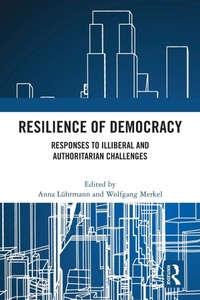
Resilience of Democracy
Responses to Illiberal and Authoritarian Challenges
1st Edition
Published on 8. October 2024
Book
Paperback/Softback
174 pages
978-1-032-42616-7 (ISBN)
Description
Illiberalism and authoritarianism have become major threats to democracy across the world. In response to this development, research on the causes and processes of democratic declines has blossomed. Much less scholarly attention has been devoted to the issue of democratic resilience. Why are some democracies more resilient than others to the current trend of autocratization? What role do institutions, actors and structural factors play in this regard? What options do democratic actors have to address illiberal and authoritarian challenges? This book addresses all these questions.
The present introduction sets the stage by developing a new concept of democratic resilience as the ability of a democratic system, its institutions, political actors, and citizens to prevent or react to external and internal challenges, stresses, and assaults. The book posits three potential reactions of democratic regimes: to withstand without changes, to adapt through internal changes, and to recover without losing the democratic character of its regime and its constitutive core institutions, organizations, and processes. The more democracies are resilient on all four levels of the political system (political community, institutions, actors, citizens) the less vulnerable they turn out to be in the present and future.
This edited volume will be of great value to students, academics, and researchers interested in politics, political regimes and theories, democracy and democratization, autocracy and autocratization, polarization, social democracy, and comparative government. The chapters in this book were originally published as a special issue of Democratization.
The present introduction sets the stage by developing a new concept of democratic resilience as the ability of a democratic system, its institutions, political actors, and citizens to prevent or react to external and internal challenges, stresses, and assaults. The book posits three potential reactions of democratic regimes: to withstand without changes, to adapt through internal changes, and to recover without losing the democratic character of its regime and its constitutive core institutions, organizations, and processes. The more democracies are resilient on all four levels of the political system (political community, institutions, actors, citizens) the less vulnerable they turn out to be in the present and future.
This edited volume will be of great value to students, academics, and researchers interested in politics, political regimes and theories, democracy and democratization, autocracy and autocratization, polarization, social democracy, and comparative government. The chapters in this book were originally published as a special issue of Democratization.
More details
Language
English
Place of publication
London
United Kingdom
Publishing group
Taylor & Francis Ltd
Target group
College/higher education
Professional and scholarly
Academic, Postgraduate, and Undergraduate
Dimensions
Height: 234 mm
Width: 156 mm
Thickness: 10 mm
Weight
295 gr
ISBN-13
978-1-032-42616-7 (9781032426167)
Copyright in bibliographic data and cover images is held by Nielsen Book Services Limited or by the publishers or by their respective licensors: all rights reserved.
Schweitzer Classification
Other editions
Additional editions
Anna Luehrmann | Wolfgang Merkel
Resilience of Democracy
Responses to Illiberal and Authoritarian Challenges
E-Book
02/2023
1st Edition
Routledge
€55.49
Available for download
Anna Luehrmann | Wolfgang Merkel
Resilience of Democracy
Responses to Illiberal and Authoritarian Challenges
E-Book
02/2023
1st Edition
Routledge
€55.49
Available for download
Anna Luehrmann | Wolfgang Merkel
Resilience of Democracy
Responses to Illiberal and Authoritarian Challenges
Book
02/2023
1st Edition
Routledge
€185.80
Shipment within 10-20 days
Persons
Anna Luehrmann has been Associate Professor of Political Science at the University of Gothenburg, Sweden, and since 2021 serves as a Member of the German Bundestag and Minister of State at the Federal Foreign Office.
Wolfgang Merkel is Professor Emeritus at Humboldt University, Berlin, Germany, and Director Emeritus at WZB Berlin Social Science Center. He serves as Senior Scholar at the Democracy Institute at Central University in Budapest. His research focuses on Transformation of political regimes, (defective) democracy and democratization, political parties, and social democracy in power. He co-edited The Oxford Handbook of Political, Social, and Economic Transformation (2019).
Wolfgang Merkel is Professor Emeritus at Humboldt University, Berlin, Germany, and Director Emeritus at WZB Berlin Social Science Center. He serves as Senior Scholar at the Democracy Institute at Central University in Budapest. His research focuses on Transformation of political regimes, (defective) democracy and democratization, political parties, and social democracy in power. He co-edited The Oxford Handbook of Political, Social, and Economic Transformation (2019).
Content
Introduction - Resilience of democracies: responses to illiberal and authoritarian challenges 1. How democracies prevail: democratic resilience as a two-stage process 2. What halts democratic erosion? The changing role of accountability 3. Pernicious polarization, autocratization and opposition strategies 4. Negative partisanship towards the populist radical right and democratic resilience in Western Europe 5. The supply and demand model of civic education: evidence from a field experiment in the Democratic Republic of Congo 6. Democratic Horizons: what value change reveals about the future of democracy 7. Disrupting the autocratization sequence: towards democratic resilience