

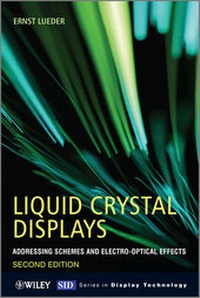
Liquid Crystal Displays
Addressing Schemes and Electro-Optical Effects
2nd Edition
Published on 5. March 2010
Book
Hardback
516 pages
978-0-470-74519-9 (ISBN)
Description
In this second edition of Liquid Crystal Displays, Ernst Lueder provides a timely update to his successful text. His unique combination of theory and practice presents all the information required for the development and manufacture of modern high performance and energy saving LCDs. The author also strives for an easy to understand description of complex facts.
The second edition focuses on a variety of liquid crystal cells and their electronic addressing, and outlines new developments including:
* High performance VA cells, especially for TV, due to two subpixels with excellent gamma-correction also at oblique viewing
* Short optical response times in the range of 1 ms also for inter-gray transitions due to novel addressing waveforms
* Fringe field switching for acceleration of rise and decay of luminance eliminating frame memories
* Reduction of motion blur by scanning backlights, high frequency frames, edge enhancement and motion blur modeling
* Very thin LCDs with power saving LED backlights exhibiting unmatched color purity and larger than NTSC color gamut
* Printed layers on hydrophobic and hydrophilic areas replacing photolithography
Practicing electrical engineers, physicists, chemists and display specialists will find this a valuable resource. Researchers will appreciate the practical guidance given for the design of improved LCDs, whilst students are provided with a useful overview of the field.
More details
Product info
gebunden
Series
Edition
2. Auflage
Language
English
Place of publication
New York
United States
Target group
College/higher education
Professional and scholarly
Product notice
sewn/stitched
Cloth over boards
Dimensions
Height: 249 mm
Width: 173 mm
Thickness: 33 mm
Weight
980 gr
ISBN-13
978-0-470-74519-9 (9780470745199)
Schweitzer Classification
Other editions
New editions
Ernst Lueder | Peter Knoll | Seung Hee Lee
Liquid Crystal Displays
Addressing Schemes and Electro-Optical Effects
Book
05/2022
Wiley-Blackwell
€159.50
Shipment within 15-20 days
Additional editions
E-Book
02/2010
2nd Edition
Wiley
€102.99
Available for download
Previous edition
Book
04/2001
1st Edition
Wiley
€115.00
Article exhausted; check for reprint
Person
Dr Ernst Lueder (retired), Emeritus Professor, Department of Electrical Communications, University of Stuttgart, Germany
Now retired, Ernst Lueder was Professor at the Department of Electrical Communications and Director of the Institute of Network and Systems Theory at Stuttgart University until 1999. He also headed a research laboratory for the fabrication of flat panel displays. Professor Lueder is a Fellow of SID, and is also an IEEE Fellow. He has been awarded the order of merit 1st Class of the Federal Republic of Germany. Since his retirement, he has written the first edition of Liquid Crystal Displays: Addressing Schemes and Electro-Optical Effects (Wiley, Mar 2001). He has also authored Bau Hybrider Mikroschaltungen (Springer-Verlag, 1977) and written over 200 papers on LCDs, network systems and theory and thin film sensors.
Now retired, Ernst Lueder was Professor at the Department of Electrical Communications and Director of the Institute of Network and Systems Theory at Stuttgart University until 1999. He also headed a research laboratory for the fabrication of flat panel displays. Professor Lueder is a Fellow of SID, and is also an IEEE Fellow. He has been awarded the order of merit 1st Class of the Federal Republic of Germany. Since his retirement, he has written the first edition of Liquid Crystal Displays: Addressing Schemes and Electro-Optical Effects (Wiley, Mar 2001). He has also authored Bau Hybrider Mikroschaltungen (Springer-Verlag, 1977) and written over 200 papers on LCDs, network systems and theory and thin film sensors.
Content
Foreword
Preface to the First Edition
Preface to the Second Edition
About the Author
1 Introduction
2 Liquid Crystal Materials and Liquid Crystal Cells
2.1 Properties of Liquid Crystals
3 Electro-optic Effects in Untwisted Nematic Liquid Crystals
3.1 The Planar and Harmonic Wave of Light
3.2 Propagation of Polarized Light in Birefringent Untwisted Nematic Liquid Crystal Cells
4 Electro-optic Effects in Twisted Nematic Liquid Crystals
4.1 The Propagation of Polarized Light in Twisted Nematic Liquid Crystal Cells
4.2 The Various Types of TN Cells
4.3 Electronically Controlled Birefringence for the Generation of Colour
5 Descriptions of Polarization
5.1 The Characterizations of Polarization
5.2 A Differential Equation for the Propagation of Polarized Light through Anisotropic Media
5.3 Special Cases for Propagation of Light
6 Propagation of Light with an Arbitrary Incident Angle through Anisotropic Media
6.1 Basic Equations for the Propagation of Light
6.2 Enhancement of the Performance of LC Cells
6.3 Electro-optic Effects with Wide Viewing Angle
6.4 Multidomain VA Cells, Especially for TV
6.5 Polarizers with Increased Luminous Output
6.6 Two Non-birefringent Foils
7 Modified Nematic Liquid Crystal Displays
7.1 Polymer Dispersed LCDs (PDLCDs)
7.2 Guest-Host Displays
8 Bistable Liquid Crystal Displays
8.1 Ferroelectric Liquid Crystal Displays (FLCDs)
8.2 Chiral Nematic Liquid Crystal Displays
8.3 Bistable Nematic Liquid Crystal Displays
9 Continuously Light Modulating Ferroelectric Displays
9.1 Deformed Helix Ferroelectric Devices
9.2 Antiferroelectric LCDs
10 Addressing Schemes for Liquid Crystal Displays
11 Direct Addressing
12 Passive Matrix Addressing of TN Displays
12.1 The Basic Addressing Scheme and the Law of Alt and Pleshko
12.2 Implementation of PM Addressing
12.3 Multiple Line Addressing
12.4 Two Frequency Driving of PMLCDs
13 Passive Matrix Addressing of Bistable Displays
13.1 Addressing of Ferroelectric LCDs
13.2 Addressing of Chiral Nematic Liquid Crystal Displays
14 Addressing of Liquid Crystal Displays with a-Si Thin Film Transistors (a-Si-TFTs)
14.1 Properties of a-Si Thin Film Transistors
14.2 Static Operation of TFTs in an LCD
14.3 The Dynamics of Switching by TFTs
14.4 Bias-Temperature Stress Test of TFTs
14.5 Drivers for AMLCDs
14.6 The Entire Addressing System
14.7 Layouts of Pixels with TFT Switches
14.8 Fabrication Processes of a-Si TFTs
14.9 Addressing of VA Displays
14.10 Motion Blur
14.11 The Optical Response of a VA Cell
14.12 Reduction of the Optical Response Time by a Special Addressing Waveform
15 Addressing of LCDs with Poly Si-TFTs
15.1 Fabrication Steps for Top-Gate and Bottom-Gate Poly-Si TFTs
15.2 Laser Crystallization by Scanning or Large Area Anneal
15.3 Lightly Doped Drains for Poly-Si TFTs
15.4 The Kink Effect and its Suppression
15.5 Circuits with Poly-Si TFTs
16 Liquid Crystal on Silicon Displays
16.1 Fabrication of LCOS with DRAM-Type Analog Addressing
16.2 SRAM-Type Digital Addressing of LCOS
16.3 Microdisplays Using LCOS Technology
17 Addressing of Liquid Crystal Displays with Metal-Insulator-Metal Pixel Switches
18 Addressing of LCDs with Two-Terminal Devices and Optical, Plasma, Laser and e-beam Techniques
19 Components of LCD Cells
19.1 Additive Colours Generated by Absorptive Photosensitive Pigmented Colour Filters
19.2 Additive and Subtractive Colours Generated by Reflective Dichroic Colour Filters
19.3 Colour Generation by Three Stacked Displays
19.4 LED Backlights
19.5 Cell Assembly
20 Projectors with Liquid Crystal Light Valves
20.1 Single Transmissive Light Valve Systems
20.2 Systems with Three Light Valves
20.3 Projectors with Two LC Light Valves
20.4 A Rear Projector with One or Three Light Valves
20.5 A Projector with Three Optically Addressed Light Valves
21 Liquid Crystal Displays with Plastic Substrates
21.1 Advantages of Plastic Substrates
21.2 Plastic Substrates and their Properties
21.3 Barrier Layers for Plastic Substrates
21.4 Thermo-Mechanical Problems with Plastics
21.5 Fabrication of TFTs and MIMs at low Process Temperatures
22 Printing of Layers for LC-Cells
22.1 Printing Technologies
22.2 Surface Properties for Printing
22.3 Printing of Components for Displays
22.4 Cell Building by Lamination
Appendix 1: Formats of Flat Panel Displays
Appendix 2: Optical Units of Displays
Appendix 3: Properties of Polarized Light
References
Index