

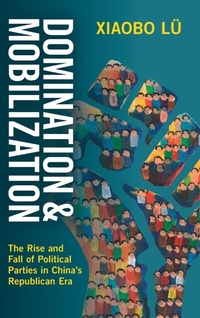
Domination and Mobilization
The Rise and Fall of Political Parties in China's Republican Era
Published on 14. August 2025
Book
Hardback
280 pages
978-1-009-58887-4 (ISBN)
Description
Examining the miraculous rise of the Chinese Communist Party (CCP) and the surprising downfall of the Kuomintang (KMT) in the early twentieth century, Xiaobo Lue reveals that domination and mobilization are key for authoritarian parties to seize state power, challenging the prevailing wisdom on power-sharing and emphasizing the importance of dominant party leaders for organizational strength and resource mobilization. Lue convincingly argues that the CCP's mass mobilization infrastructure, initially seen as a disadvantage before the Sino-Japanese War, became a powerful asset during the war and led to its victory. The KMT's elite mobilization infrastructure, conversely, was decimated by the war, and its lack of a strong leader prevented a successful shift in party-building strategy. Party building subsequently played a pivotal role in shaping the successes and failures of resource mobilization for both parties. The book sheds new light on the origins of the CCP and the inner workings of revolutionary parties, making in a landmark study in Chinese politics.
More details
Language
English
Place of publication
Cambridge
United Kingdom
Illustrations
Worked examples or Exercises
Dimensions
Height: 235 mm
Width: 157 mm
Thickness: 21 mm
Weight
609 gr
ISBN-13
978-1-009-58887-4 (9781009588874)
Copyright in bibliographic data and cover images is held by Nielsen Book Services Limited or by the publishers or by their respective licensors: all rights reserved.
Schweitzer Classification
Other editions
Additional editions
Xiaobo Lue
Domination and Mobilization
The Rise and Fall of Political Parties in China's Republican Era
Book
08/2025
Cambridge University Press
€38.60
Shipment within 15-20 days
Person
Xiaobo Lue is Associate Professor of Government at the University of Texas, Austin. His research centers on distributive politics of fiscal policies and party building in authoritarian regimes, with a focus on China. Lue is particularly interested in how fiscal extraction shapes state-society relations and its implications on the evolution and functioning of authoritarian parties.
Content
1. The Reversal of Fortune of Revolutionary Parties; 2. A Theory of Party Building by Revolutionary Parties; 3. Prewar Resource Mobilization by the CCP and the KMT (1921-1937); 4: Reversal of Fortune: Wartime Resource Mobilization by the CCP and KMT (1937-1945); 5. The CCP: Navigating Elite Power Conflicts and Struggling to Build a Mass Mobilization Infrastructure (1921-1934); 6. Mao's Power Consolidation and the Emergence of a Rural Mobilization Infrastructure (1935-1945); 7. The KMT: Revolutionary Party Aborted; 8 The Legacies of Party-Building among Revolutionary Parties in China and Beyond.