


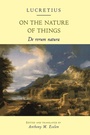
On the Nature of Things
De rerum natura
Published on 27. July 1995
Book
Hardback
312 pages
978-0-8018-5054-7 (ISBN)
Description
Titus Lucretius Carus was probably born in the early first century B.C., and died in the year 55. Little is known of his life, although two tantalizing bits of gossip were passed on by St. Jerome: that he was poisoned by a madness-inducing aphrodisiac given him by his wife, and that his great poem On the Nature of Things was posthumously edited by Cicero. For the latter assertion, writes Anthony Esolen in his introduction to the present volume, there is little evidence, and none whatsoever for the former.
What does survive is a masterful poetic work that stands as the greatest exposition of Epicurean philosophy. Writing in the waning days of the Roman Republic-as Rome's politics grew individualistic and treacherous, its high-life wanton, its piety introspective and morbid-Lucretius sets forth a rational and materialistic view of the world which offers a retreat into a quiet community of wisdom and friendship.
Even to modern readers, the sweep of Lucretius's observations is remarkable. A careful observer of nature, he writes with an innocent curiosity into how things are put together-from the oceans, lands, and stars to a mound of poppy seeds, from the "applause" of a rooster's wings to the human mind and soul. Yet Lucretius is no romantic. Nature is what it is-fascinating,purposeless, beautiful, deadly. Once we understand this, we free ourselves of superstitious fears, becoming as human and as godlike as we can be. The poem, then, is about the universe and how human beings ought to live in it. Epicurean physics and morality converge.
Until now, there has been no adequate English verse translation of Lucretius's work. Anthony Esolen fills that gap with a version that reproduces-with remarkable faithfulness-the meaning, pace, and tone of the original Latin.
Here is a book that will introduce a new generation of readers to a thinker whose powers of observation and depth of insight remain fresh to the present day.
"Esolen has the rare gift of being both a fine poet and a lover of languages. His diction is poetic and natural; he has a fine ear for sound, and the translation benefits greatly from being read aloud-as Latin poetry was meant to be. This translation is clear and forceful. It can, and will, be read."-Kenneth J. Reckford, University of North Carolina, Chapel Hill
What does survive is a masterful poetic work that stands as the greatest exposition of Epicurean philosophy. Writing in the waning days of the Roman Republic-as Rome's politics grew individualistic and treacherous, its high-life wanton, its piety introspective and morbid-Lucretius sets forth a rational and materialistic view of the world which offers a retreat into a quiet community of wisdom and friendship.
Even to modern readers, the sweep of Lucretius's observations is remarkable. A careful observer of nature, he writes with an innocent curiosity into how things are put together-from the oceans, lands, and stars to a mound of poppy seeds, from the "applause" of a rooster's wings to the human mind and soul. Yet Lucretius is no romantic. Nature is what it is-fascinating,purposeless, beautiful, deadly. Once we understand this, we free ourselves of superstitious fears, becoming as human and as godlike as we can be. The poem, then, is about the universe and how human beings ought to live in it. Epicurean physics and morality converge.
Until now, there has been no adequate English verse translation of Lucretius's work. Anthony Esolen fills that gap with a version that reproduces-with remarkable faithfulness-the meaning, pace, and tone of the original Latin.
Here is a book that will introduce a new generation of readers to a thinker whose powers of observation and depth of insight remain fresh to the present day.
"Esolen has the rare gift of being both a fine poet and a lover of languages. His diction is poetic and natural; he has a fine ear for sound, and the translation benefits greatly from being read aloud-as Latin poetry was meant to be. This translation is clear and forceful. It can, and will, be read."-Kenneth J. Reckford, University of North Carolina, Chapel Hill
Reviews / Votes
"Esolen has focused on the poet, translating the Latin hexameters into accented pentameter in order to capture the dynamics, rhythms, and syntax of the original. The results are both satisfying and readable. Esolen includes an elegant introduction on Lucretius, as well as useful notes. A valuable contribution to students of literature as well as philosophy."--'Library Journal' "Esolen has the rare gift of being both a fine poet and a lover of languages. His diction is poetic and natural; he has a fine ear for sound, and the translation benefits greatly from being read aloud--as Latin poetry was meant to be. This translation is clear and forceful. It can, and will, be read."--Kenneth J. Reckford, University of North Carolina, Chapel HillMore details
Language
English
Place of publication
Baltimore, MD
United States
Dimensions
Height: 229 mm
Width: 152 mm
Weight
624 gr
ISBN-13
978-0-8018-5054-7 (9780801850547)
DOI
10.56021/9780801850547
Copyright in bibliographic data is held by Nielsen Book Services Limited or its licensors: all rights reserved.
Schweitzer Classification
Other editions
Additional editions
Book
07/1995
Johns Hopkins University Press
€41.50
Article not available for order