

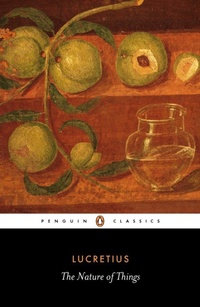
The Nature of Things
Published on 26. July 2007
Book
Paperback/Softback
304 pages
978-0-14-044796-5 (ISBN)
Description
Lucretius' poem On the Nature of Things combines a scientific and philosophical treatise with some of the greatest poetry ever written. With intense moral fervour he demonstrates to humanity that in death there is nothing to fear since the soul is mortal, and the world and everything in it is governed by the mechanical laws of nature and not by gods; and that by believing this men can live in peace of mind and happiness. He bases this on the atomic theory expounded by the Greek philosopher Epicurus, and continues with an examination of sensation, sex, cosmology, meteorology, and geology, all of these subjects made more attractive by the poetry with which he illustrates them.
Reviews / Votes
One of the most extraordinary classical translations of recent times -- Peter Stothard * Times Literary Supplement * A.E. Stallings's brilliant recent translation -- Eric Orrmsby * Wall Street Journal *More details
Language
English
Place of publication
London
United Kingdom
Publishing group
Penguin Books Ltd
Product notice
Paperback (UK-B)
Dimensions
Height: 195 mm
Width: 130 mm
Thickness: 2 mm
Weight
226 gr
ISBN-13
978-0-14-044796-5 (9780140447965)
Copyright in bibliographic data and cover images is held by Nielsen Book Services Limited or by the publishers or by their respective licensors: all rights reserved.
Schweitzer Classification
Other editions
Additional editions
Lucretius
The Nature of Things
E-Book
07/2007
1st Edition
Penguin Books Ltd
€9.49
Available for download
Persons
Titus Lucretius Carus (who died c.50 BC) was an Epicurean poet writing in the middle years of the first century BC. His six-book Latin hexameter poem De rerum natura survives virtually intact, although it is disputed whether he lived to put the finishing touches to it. As well as being a pioneering figure in the history of philosophical poetry, Lucretius has come to be our primary source of information on Epicurean physics, the official topic of his poem.
A. E. Stallings was born in 1968. She grew up in Decatur, GA, and was educated at the University of Georgia and Oxford University in classics. Her poetry has appeared in The Best American Poetry (1994 and 2000) and has received numerous awards, including a Pushcart Prize (Pushcart Prize Anthology XXII), the 1997 Eunice Tietjens Prize from Poetry and the third annual James Dickey Prize from Five Points.
Richard Jenkyns is Professor of the Classical Tradition, University of Oxford, a Fellow of Lady Margaret Hall and author of a number of books including Dignity and Decadence: Some Classical Aspects of Victorian Art and Architecture and The Victorians and Ancient Greece.
A. E. Stallings was born in 1968. She grew up in Decatur, GA, and was educated at the University of Georgia and Oxford University in classics. Her poetry has appeared in The Best American Poetry (1994 and 2000) and has received numerous awards, including a Pushcart Prize (Pushcart Prize Anthology XXII), the 1997 Eunice Tietjens Prize from Poetry and the third annual James Dickey Prize from Five Points.
Richard Jenkyns is Professor of the Classical Tradition, University of Oxford, a Fellow of Lady Margaret Hall and author of a number of books including Dignity and Decadence: Some Classical Aspects of Victorian Art and Architecture and The Victorians and Ancient Greece.