

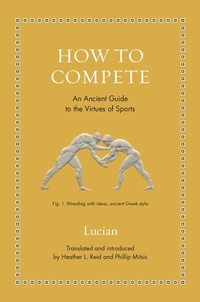
How to Compete
An Ancient Guide to the Virtues of Sports
Published on 24. February 2026
Book
Hardback
208 pages
978-0-691-28140-7 (ISBN)
Description
An energetic new translation of the ancient Greek satirist Lucian's humorous and enlightening dialogue on the pros-and cons-of athletics, fitness, and competition
Sports and philosophy went hand in hand for the ancient Greeks and Romans, and philosophical conversation was a recognized part of gym life throughout Greco-Roman antiquity. Athens's Lyceum was a gym-and reportedly a hangout of that philosophical gym rat Socrates-before it became the site of Aristotle's school. Fittingly, that gym is the setting of the Greek satirist Lucian's Anacharsis, a witty philosophical dialogue that wrestles with questions about the purpose and value of sports-questions that we are still grappling with in our own sports- and fitness-obsessed times. How to Compete presents a new translation of Lucian's timeless classic, inviting us into a ringside debate about the point of sports.
Pitting a sports skeptic, Anacharsis, against a superfan, Solon, this delightful and thought-provoking work tries to make sense of sports. Why do so many of us care so much about them? Are sports like boxing too violent? Should we take fitness so seriously? Do athletics have educational value? And, most important of all, why did the ancient Greeks exercise naked? While Anacharsis, observing a Greek sport that sounds something like mixed martial arts, asks what kind of citizens set aside serious affairs to watch young men beat each other to a pulp, Solon counters that sports have great civic benefits and that athletes are ultimately competing for the highest prize-human excellence.
Featuring an inviting introduction, a handy glossary, helpful notes, and the original Greek on facing pages, How to Compete is a winning exploration of why sports are more than just a game.
Sports and philosophy went hand in hand for the ancient Greeks and Romans, and philosophical conversation was a recognized part of gym life throughout Greco-Roman antiquity. Athens's Lyceum was a gym-and reportedly a hangout of that philosophical gym rat Socrates-before it became the site of Aristotle's school. Fittingly, that gym is the setting of the Greek satirist Lucian's Anacharsis, a witty philosophical dialogue that wrestles with questions about the purpose and value of sports-questions that we are still grappling with in our own sports- and fitness-obsessed times. How to Compete presents a new translation of Lucian's timeless classic, inviting us into a ringside debate about the point of sports.
Pitting a sports skeptic, Anacharsis, against a superfan, Solon, this delightful and thought-provoking work tries to make sense of sports. Why do so many of us care so much about them? Are sports like boxing too violent? Should we take fitness so seriously? Do athletics have educational value? And, most important of all, why did the ancient Greeks exercise naked? While Anacharsis, observing a Greek sport that sounds something like mixed martial arts, asks what kind of citizens set aside serious affairs to watch young men beat each other to a pulp, Solon counters that sports have great civic benefits and that athletes are ultimately competing for the highest prize-human excellence.
Featuring an inviting introduction, a handy glossary, helpful notes, and the original Greek on facing pages, How to Compete is a winning exploration of why sports are more than just a game.
More details
Series
Language
English
Place of publication
New Jersey
United States
Product notice
Trade binding
Dimensions
Height: 175 mm
Width: 116 mm
Thickness: 25 mm
Weight
232 gr
ISBN-13
978-0-691-28140-7 (9780691281407)
Copyright in bibliographic data and cover images is held by Nielsen Book Services Limited or by the publishers or by their respective licensors: all rights reserved.
Schweitzer Classification
Other editions
Additional editions
E-Book
02/2026
NYU Press
€18.49
Available for download
Persons
Lucian (c. 125-180 CE) was one of the most popular writers in the ancient Greek-speaking world. With brilliant wit and rhetorical charm, his dialogues examined contemporary religious, philosophical, and cultural beliefs. Heather L. Reid is professor emerita at Morningside University in Sioux City, Iowa. Her books include Introduction to the Philosophy of Sport and Athletics and Philosophy in the Ancient World. Phillip Mitsis is the A. S. Onassis Professor of Hellenic Culture and Civilization at New York University. His books include The Oxford Handbook of Epicurus and Epicureanism.